


















Lesson 35 of 43 · Pensions and Applications
Defined Benefit Pension Valuation
Value a final salary pension: the deferred life annuity, projected unit credit and traditional unit credit liabilities, the service cost and sensitivity to assumptions.
A defined benefit pension is a deferred life annuity whose size is not known today. It depends on how long the member works and how high the salary has risen by retirement. To value it, the actuary projects the pension at retirement, discounts it to today, weights it by the probability that the member survives to collect it, and then decides how much of the promise has been earned so far.
That last step is a modelling choice, and the standard choices have names. This lesson develops the projected unit credit method (liabilities based on projected final salary) and the traditional unit credit method (current salary), and shows how the cost of one more year of service falls out of them.
What you will learn
- Write the actuarial present value of a deferred pension.
- Compute the PUC and TUC accrued liabilities and the service cost.
- Explain why liabilities grow as the member approaches retirement.
- Test the sensitivity of the liability to discount rate and salary growth.
Key terms
Deferred annuity: an annuity whose payments start at a future date, here retirement.
Accrued benefit: the part of the final pension earned for service to date.
Projected unit credit (PUC): accrued benefit measured on projected final salary.
Traditional unit credit (TUC): accrued benefit measured on current salary.
Service cost: the liability added by one more year of service.
The pension as a deferred annuity
Consider a member aged x, retiring at age r, with a pension B per year payable annually in advance from age r for life. Its actuarial present value (APV) at age x is
APV = B · v^(r−x) · (r−x)p_x · ä_r
where v = 1/(1+i), (r−x)p_x is the probability of surviving from x to r, and ä_r is the annuity-due at retirement age. Three discount factors are hiding here: interest for the waiting time, survival of the waiting time, and the annuity itself.
The pension amount B comes from the plan rules. A typical final salary formula is
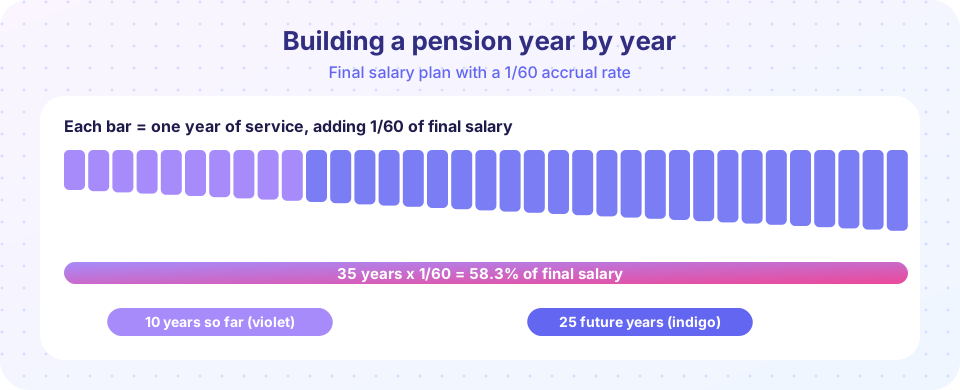
B = α · (years of service) · (final salary) α = 1/60 for a "sixtieths" plan
Setting up the example
Our example member:
| Item | Value |
|---|---|
Age now x |
40 |
| Joined at | 30 (10 years of service so far) |
Retirement age r |
65 |
| Salary now | 50,000, growing 3% a year |
| Accrual rate | 1/60 per year of service |
| Interest | 4% |
| Mortality | Illustrative Makeham law used throughout this chapter, deaths only (no leavers) |
The projected final salary is 50,000 × 1.03²⁵ ≈ 104,689. A full career of 35 years would earn 35/60 ≈ 58.3% of that, about 61,069 a year.
PUC and TUC liabilities
Projected unit credit. The benefit accrued for the 10 years already served is 10/60 of projected final salary: 10/60 × 104,689 ≈ 17,448 a year from age 65. Its APV is 17,448 × v²⁵ × ₂₅p₄₀ × ä₆₅.
Traditional unit credit. The accrued benefit is based on today's salary: 10/60 × 50,000 ≈ 8,333. The APV is lower because it assumes no future salary rises affect the accrued pension (in a final salary plan this understates the true cost, which is why many sponsors prefer PUC).
Service cost. Under PUC, one more year of service adds a further 1/60 of final salary, so the service cost is (1/60 × 104,689) × v²⁵ × ₂₅p₄₀ × ä₆₅. Under PUC with a constant salary growth rate the service cost for a given member is proportional to the same discounted factors, which is why the cost rises as retirement approaches: fewer years of discounting and a higher chance of survival.
Running the first TryIt below gives ä₆₅ ≈ 10.50, a PUC liability of about 53,448, a TUC liability of about 25,527 and a service cost of about 5,345. The PUC figure is more than twice the TUC figure because 25 years of salary growth at 3% doubles the salary. Lowering the discount rate from 4% to 3% lifts the PUC liability to about 73,014, an increase of more than a third.
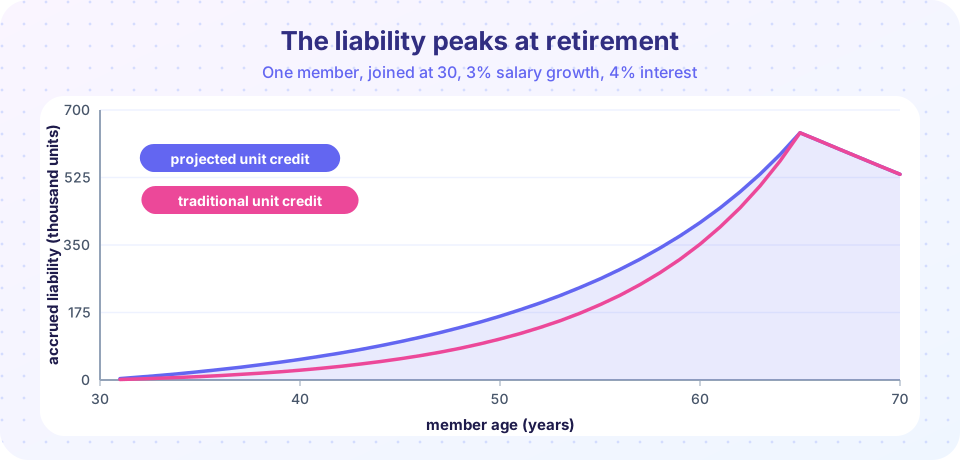
Why the liability accelerates
Three things push the liability up with age:
- More service raises the accrued pension linearly.
- Less discounting: with fewer years to wait,
v^(r−x)approaches 1. - Higher survival chance to retirement.
After retirement, the liability becomes B × ä_x, which falls as the member ages and fewer payments remain. The liability therefore peaks around retirement, which is why plans with many members near retirement are called "mature" and are sensitive to interest rates.
Try it
Press Run (or Ctrl + Enter) to see the result here.
Program input · what you'd type while the program runs
Type the answers before you press Run, one per line. Each time the program reads a line (with input()), it gets the next line from this box.
Press Run (or Ctrl + Enter) to see the result here.
Program input · what you'd type while the program runs
Type the answers before you press Run, one per line. Each time the program reads a line (with input()), it gets the next line from this box.
Common misconceptions
"The pension liability is the pension times 20." The multiplier is the annuity factor, which depends on age, mortality and interest; a rule of thumb can be far off.
"TUC is the cheaper, so it is the better method." It only looks cheaper because it ignores future salary growth that the formula will pay for. It understates the true cost of a final salary promise.
"A 1% fall in the discount rate raises the liability by 1%." For long-dated liabilities the effect is closer to 1% times the duration, often 10 to 20 times larger.
Check your understanding
Quick check · 5 questions
of 5 answered You scored / 5 · perfect!
-
1. A member aged 40 retires at 65 on a pension B payable annually in advance for life. The APV at 40 is
Discount for 25 years, weight by the chance of surviving 25 years, then multiply by the annuity at 65. -
2. A plan accrues 1/60 per year of service. After 24 years of service the accrued benefit is
24/60 = 0.40. -
3. Projected unit credit liabilities are usually larger than traditional unit credit because PUC
PUC accrues on projected final salary; TUC on today's salary. -
4. As a member approaches retirement (all else equal), the accrued liability tends to
More service, less discounting and higher survival probability all raise the value. -
5. The service cost is
It is the value of the benefit earned in the coming year.
Summary
- A DB pension is valued as
B · v^(r−x) · (r−x)p_x · ä_r. - PUC accrues on projected final salary; TUC on current salary; the service cost is one more year's accrual.
- Liabilities rise steeply near retirement; they depend strongly on the discount rate and salary growth.
Track your progress
Create a free account to tick off lessons and pick up where you left off on any device.
of Actuarial Mathematics lessons completed