


















Lesson 41 of 43 · Projects and Practice
Actuarial Mathematics Glossary
A searchable glossary of 35 actuarial terms from premiums and reserves to risk theory, credibility, ruin theory and pensions, with a flashcard trainer.
Actuarial mathematics has its own vocabulary, and much of the difficulty of reading an exam question or a valuation report is knowing the words. This glossary collects the key terms of the premiums, risk, credibility, ruin and pension chapters in alphabetical order, with a short definition and, where useful, the formula.
Use it as a reference while you work, or turn it into a game with the flashcard trainer at the end of the lesson.
What you will learn
- Recognise the 35 core terms of the second half of the course.
- Link each term to the chapter and formula where it belongs.
- Practise recall with a search tool and a flashcard trainer.
Key terms
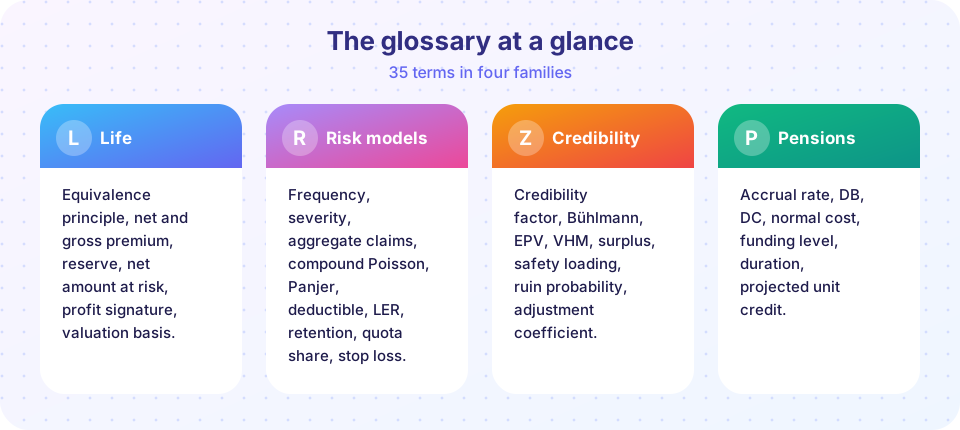
Glossary families: life insurance (premiums and reserves), risk models, credibility and ruin, and pensions.
Formula notation: ä is an annuity-due, A an insurance present value, S a sum insured or aggregate claims depending on context.
Convention: all figures in the course are invented examples; definitions are general.
The glossary
| Term | Meaning |
|---|---|
| Accrual rate | Fraction of salary earned as pension per year of service, for example 1/60 |
Adjustment coefficient R |
Positive root of λ(M_X(R) − 1) = c·R; gives the Lundberg bound ψ(u) ≤ e^(−Ru) |
Aggregate claims S |
Total claim cost in a period, S = X₁ + … + X_N |
Annuity-due ä |
Present value of 1 paid at the start of each year while the life survives |
| Bühlmann credibility | Linear credibility with Z = n/(n + K) and K = v/a |
| Collective premium | Expected claim cost of the whole group of similar risks |
| Compound Poisson | Aggregate claims with Poisson claim count |
Credibility factor Z |
Weight, between 0 and 1, given to a risk's own experience |
| Deductible | Part of each loss the policyholder bears, so the insurer pays (X − d)⁺ |
| Defined benefit (DB) | Pension plan promising a formula; the sponsor carries the risk |
| Defined contribution (DC) | Pension plan with fixed contributions; the member carries the risk |
| Duration | Sensitivity of a present value to the interest rate |
| Equivalence principle | Set the premium so the expected loss at issue is zero |
Expected process variance v |
Average within-risk variance in the Bühlmann model |
| Frequency | Number of claims N |
| Funding level | Assets divided by liabilities |
| Gross premium | Premium including expenses and profit |
| Limited expected value | E[X ∧ d], the mean of the loss capped at d |
| Loss elimination ratio | E[X ∧ d] / E[X] |
| Mean excess function | e(d) = E[X − d given X > d] |
| Net amount at risk | S − (t+1)V, what a death really costs the insurer |
| Net premium | Premium from the equivalence principle without expenses |
| Normal cost | Value of pension benefits earned in one year (service cost) |
| Panjer recursion | Exact algorithm for the distribution of a compound sum |
| Profit signature | Expected profit by policy year |
| Projected unit credit | Accrued liability on projected final salary |
| Quota share | Reinsurance of a fixed fraction of every claim |
Reserve tV |
Expected value of future benefits minus future premiums at time t |
| Retention | Part of a loss the insurer keeps |
Ruin probability ψ(u) |
Probability the surplus ever falls below zero |
Safety loading θ |
Proportion by which the premium exceeds expected claims |
| Severity | Size X of one claim |
| Stop loss | Reinsurance paying (S − a)⁺ of the aggregate |
| Surplus process | U(t) = u + c·t − S(t) |
Variance of hypothetical means a |
Variance of the true means between risks |
| Valuation basis | Assumptions used to compute reserves and liabilities |
Try it
Common misconceptions
"Net and gross premium are interchangeable words." Net excludes expenses and profit, gross includes them.
"Reserve and capital are the same." The reserve is the liability for a policy; capital is extra money held against adverse deviations.
"Frequency and severity are properties of a single policy." They are model components of the whole portfolio's claim process.
Check your understanding
Quick check · 5 questions
of 5 answered You scored / 5 · perfect!
-
1. Which term means the part of a loss the insurer keeps after reinsurance?
Retention is the insurer's own share. -
2. The Bühlmann K equals
The expected process variance divided by the variance of hypothetical means. -
3. Which term is the ratio of assets to liabilities of a pension plan?
A funding level below 100% means a deficit. -
4. The mean excess function e(d) is
It is the expected excess over d given that the loss exceeds d. -
5. Normal cost in a pension plan is
It is the service cost of the year.
Summary
- The vocabulary falls into four families: life insurance, risk models, credibility and ruin, pensions.
- Many terms are ratios or expectations: loss elimination ratio, funding level,
K = v/a. - Practise with the search box and flashcards until the words feel natural.
Next: Cheat sheet
Track your progress
Create a free account to tick off lessons and pick up where you left off on any device.
of Actuarial Mathematics lessons completed