


















Lesson 14 of 43 · Survival Models and Life Tables
Select tables and fractional ages
Handle mortality between birthdays with the uniform distribution of deaths and constant force assumptions, and understand select and ultimate mortality tables.
Two practical problems remain before we can price insurance. First, life tables give probabilities for whole years, but real events happen at any moment: a policyholder dies in March, a policy is issued on a 40-year-old's 40.4th birthday. To handle fractions of a year we need an assumption about how deaths are spread within a year. Second, a person who has just passed a medical examination to buy insurance is healthier than the average person of the same age, at least for a while. A select table captures that effect.
Both topics are about adding realism to the simple l(x) table without changing the machinery.
What you will learn
- The uniform distribution of deaths (UDD) and constant force assumptions, and their formulas.
- How to compute
s q x,s p xand the force at a fractional age. - What select, ultimate and select-and-ultimate tables are.
- How to compute probabilities for a newly selected life.
Key terms
UDD: uniform distribution of deaths: within each year of age, deaths are spread evenly, so l(x+s) is linear in s.
Constant force: the force of mortality is constant within each year of age.
Select mortality: the lower mortality of newly underwritten lives, which gradually wears off.
Select period: the number of years over which the effect lasts.
Ultimate table: the mortality after the select period, depending on attained age only.
Fractional ages: two assumptions
A life table gives l(x) and l(x+1) but not l(x + 0.5). We choose a rule to fill in between.
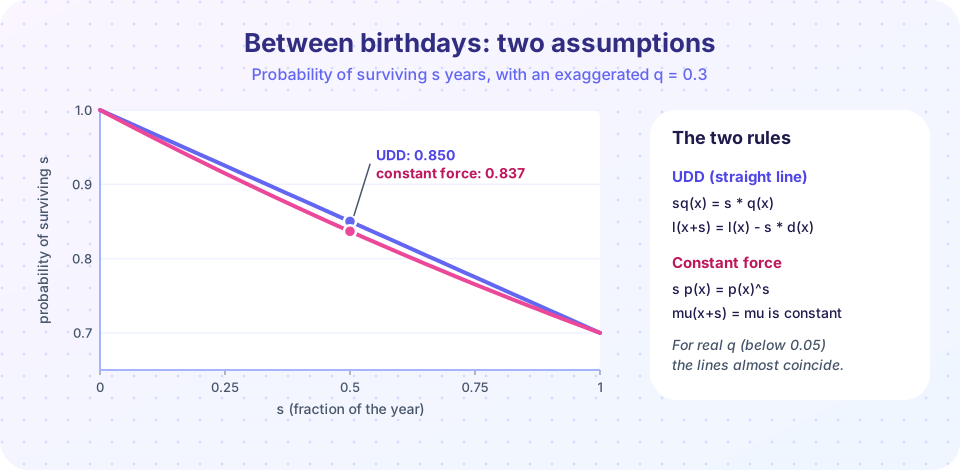
Uniform distribution of deaths (UDD). l(x + s) falls linearly from l(x) to l(x+1), so l(x+s) = l(x) - s d(x) for 0 <= s <= 1. Therefore
s q x = s * q x(the probability of dying withinsyears isstimes the annual probability),s p x = 1 - s q x,mu(x + s) = q x / (1 - s q x)(the force rises through the year as the pool of survivors shrinks), and- the density of deaths is constant over the year:
s p x mu(x+s) = q x.
Constant force. If mu(x + s) = mu for 0 <= s < 1, then p x = e^(-mu), so mu = -ln p x and s p x = (p x)^s. Then s q x = 1 - (p x)^s.
A third assumption, Balducci, makes 1/l(x+s) linear, so (1-s) q (x+s) = (1-s) q x. It was popular historically but produces a force of mortality that falls within a year, which is unnatural, so it is used less now.
Worked example. Take q x = 0.1. For s = 0.5: UDD gives 0.5 q x = 0.05 and 0.5 p x = 0.95; constant force gives 0.5 p x = 0.9^0.5 = 0.948683, so 0.5 q x = 0.051317. For realistic annual probabilities the difference is tiny, here 0.0013. At very high ages, where q x is large, the choice matters more.
Life expectancy link. Under UDD, e x = curtate e x + 1/2 exactly. That is the "plus one half" rule from lesson 3.3.
Press Run (or Ctrl + Enter) to see the result here.
Program input · what you'd type while the program runs
Type the answers before you press Run, one per line. Each time the program reads a line (with input()), it gets the next line from this box.
Select and ultimate mortality
When someone buys life insurance, they usually answer health questions and may take a medical test. A person passing underwriting at age 40 is, on average, healthier than a random 40-year-old, because those with known serious illness have been declined or rated. Their mortality in the first year or two is therefore lower than that of the general population of the same age. The advantage fades as time passes and hidden conditions appear, until after the select period (often 2 to 5 years) they die at the ultimate rate for their age.
A select-and-ultimate table is indexed by both age at selection [x] and duration t: q [x] + t is the death probability at attained age x + t for someone selected at x. After the select period r, q [x] + t = q x + t for t >= r, the ultimate table. In printed tables, each row starts at the selection age and rows run into the ultimate column on the right.
Useful facts about using them:
- Probabilities for a newly selected life of age
xuse the select rates on the firstrsteps, then ultimate:2 p [x] = (1 - q [x])(1 - q [x]+1), and3 p [x] = 2 p [x] * p (x+2)whenr = 2. - A person aged 42 might be at duration 2 after selection at 40, or at duration 0 after selection at 42. They are not the same risk, which is why the select age matters.
- Select effects are bigger for life insurance than for annuities, where buyers are self-selected to be healthy anyway.
An illustrative select table
For teaching, we build an invented select table from our ultimate model: duration 0 mortality is 60% of the ultimate rate, duration 1 is 80%, and from duration 2 on it equals the ultimate rate. These factors are made up for the example; real factors come from company experience.
Press Run (or Ctrl + Enter) to see the result here.
Program input · what you'd type while the program runs
Type the answers before you press Run, one per line. Each time the program reads a line (with input()), it gets the next line from this box.
Common misconceptions
"UDD means the force of mortality is constant in the year." No: under UDD the density is constant and the force rises. Under constant force the force is constant and the density falls.
"Select mortality lasts forever." It wears off. After the select period the person is treated like any other life of their attained age.
"The choice of fractional-age rule matters a lot." At ordinary ages it makes a tiny difference; it matters at advanced ages and when many payments occur mid-year.
Check your understanding
Quick check · 5 questions
of 5 answered You scored / 5 · perfect!
-
1. q 70 = 0.04. Under UDD, what is the probability a 70-year-old dies within 3 months (s = 0.25)?
UDD: s q x = s * q x = 0.25 * 0.04 = 0.01. -
2. Under constant force with p 60 = 0.98, what is 0.5 p 60?
0.98^0.5 = 0.989949. (UDD would give 0.99 exactly.) -
3. Under UDD, how does the force of mortality behave within a year of age?
mu(x+s) = q x / (1 - s q x) increases with s, because the density is constant while the survivor pool shrinks. -
4. Why is mortality lower just after selection?
Underwriting excludes known poor health; the effect fades over the select period. -
5. In a select table with a 2-year select period, q [x] + 2 equals
After the select period, mortality depends only on attained age.
Summary
- Between birthdays we assume UDD (
s q x = s q x, rising force) or constant force (s p x = (p x)^s). - UDD implies
complete e x = curtate e x + 1/2; the assumptions differ little at ordinary ages. - Select mortality is lower right after underwriting and converges to the ultimate rate after the select period.
- Select-and-ultimate tables are indexed by age at selection and duration.
Next: Chapter 3 review
Track your progress
Create a free account to tick off lessons and pick up where you left off on any device.
of Actuarial Mathematics lessons completed