


















Lesson 42 of 43 · Projects and Practice
Actuarial Mathematics Cheat Sheet
One page of the key actuarial formulas: premiums, reserves, loss models, aggregate claims, reinsurance, credibility, ruin theory and pensions, with a Python toolbox.
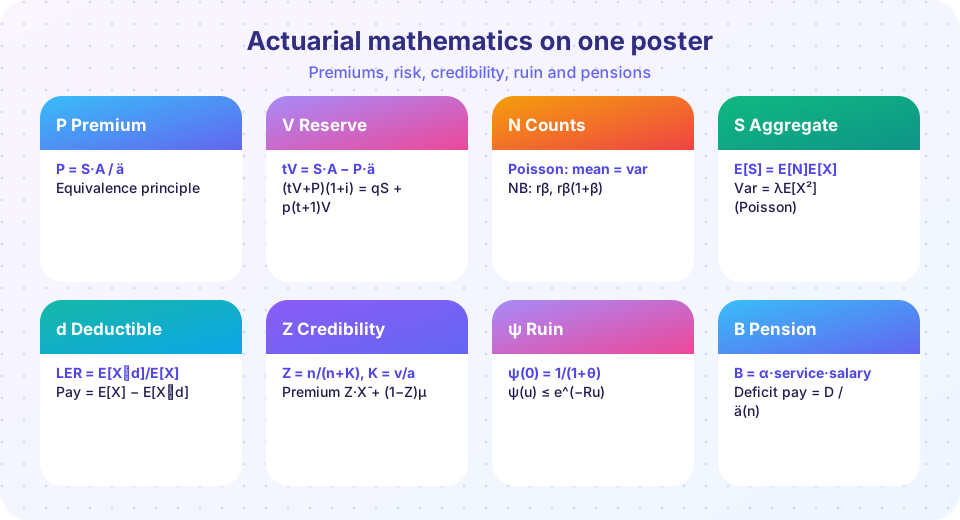
This page puts every working formula of the second half of the course in one place, with the question each formula answers. Keep it next to you when solving problems, and when you are unsure which formula applies, read the "when" column first: choosing the right tool is most of the work.
What you will learn
- Find any key formula quickly and know when to use it.
- Reuse the formulas as a small Python toolbox.
- Review the course with a short quiz.
Key terms
v: the discount factor 1/(1 + i).
ä: annuity-due, the value of 1 at the start of each year while alive.
A: insurance present value, the value of 1 paid at the end of the year of death.
E[X ∧ d]: the expected value of X capped at d.
θ: the safety loading, premium over expected claims.
Premiums and reserves
| When | Formula |
|---|---|
| Net premium from the equivalence principle | P = S · A / ä |
Gross premium with initial expense e₀, fixed expense f and percentage r |
G = (S·A + e₀ + f·ä) / ((1 − r)·ä) |
| Prospective reserve | tV = S·A(x+t) − P·ä(x+t) |
| Rolling the reserve forward | (tV + P)(1 + i) = q·S + p·(t+1)V |
| Net amount at risk | S − (t+1)V |
Risk models
| When | Formula |
|---|---|
| Poisson count | E = Var = λ |
| Negative binomial count | E = rβ, Var = rβ(1 + β) |
| Exponential, Pareto means | θ and θ/(α − 1) |
| Mean and variance of a compound sum | E[S] = E[N]E[X], Var[S] = E[N]Var[X] + Var[N]E[X]² |
| Compound Poisson variance | Var[S] = λ·E[X²] |
| Panjer (Poisson, claims 1, 2, …) | g₀ = e^(−λ), g_s = (λ/s) Σ j·f_j·g_(s−j) |
| Deductible | E[(X − d)⁺] = E[X] − E[X ∧ d], LER = E[X ∧ d]/E[X] |
| Reinsurance | Quota q·X; excess of loss (X − M)⁺; stop loss (S − a)⁺ |
Credibility and ruin
| When | Formula |
|---|---|
| Full credibility standard | λ_F = (z/k)² |
| Partial credibility | Z = min(1, √(n/λ_F)) |
| Bühlmann | Z = n/(n + K), K = v/a, premium Z·X̄ + (1 − Z)·μ |
| Surplus | U(t) = u + c·t − S(t), c = (1 + θ)·λ·μ |
| Ruin at zero | ψ(0) = 1/(1 + θ) |
| Lundberg | ψ(u) ≤ e^(−Ru); exponential claims R = θ/((1 + θ)μ), ψ(u) = e^(−Ru)/(1 + θ) |
Pensions
| When | Formula |
|---|---|
| DB pension | B = α · service · final salary |
| APV of deferred pension | B · v^(r−x) · (r−x)p_x · ä_r |
| Funding level | assets / liabilities |
Deficit repayment over n years |
D / ä(n) |
Liability change for a rate move Δi |
≈ −D_mod · Δi |
Try it
Press Run (or Ctrl + Enter) to see the result here.
Program input · what you'd type while the program runs
Type the answers before you press Run, one per line. Each time the program reads a line (with input()), it gets the next line from this box.
Common misconceptions
"A cheat sheet replaces understanding." Formulas are only useful with their conditions: independence, light tails, the same basis for premium and reserve.
"One formula fits every claim distribution." Compound variance and ψ(0) are general; the closed-form ruin probability needs exponential claims.
Check your understanding
Quick check · 4 questions
of 4 answered You scored / 4 · perfect!
-
1. Which formula gives the exact distribution of a compound Poisson sum with discrete claim sizes?
Panjer's recursion computes the probabilities g_s exactly. -
2. For a deficit D repaid over n years at interest i by level payments in advance, the payment is
The present value of the payments must equal the deficit. -
3. Which pair is correct for exponential claims of mean μ and loading θ?
These are the exact exponential-claims results. -
4. The credibility premium for Z = 0.25, own average 200 and group mean 100 is
0.25 × 200 + 0.75 × 100 = 125.
Summary
- Premiums:
P = S·A/ä; reserves: future benefits minus future premiums, rolled by the recursion. - Risk: counts times sizes, compound moments, Panjer, deductibles and reinsurance.
- Credibility and ruin:
Z = n/(n + K),ψ(0) = 1/(1 + θ),ψ(u) ≤ e^(−Ru). - Pensions: accrual formula, deferred annuity value, funding level and deficit payment.
Next: Further study
Track your progress
Create a free account to tick off lessons and pick up where you left off on any device.
of Actuarial Mathematics lessons completed