


















Lesson 37 of 43 · Pensions and Applications
Pensions and Applications: Chapter Review
Review defined benefit and defined contribution plans, PUC liabilities, funding levels, deficit contributions and duration, with two worked applications and ten quiz questions.
Pension mathematics reuses the tools you already know: survival probabilities, interest, annuities and the idea of a reserve. What is new is the scale of time and the way the pieces interact. A DB plan converts a salary formula into a liability, a funding plan converts a deficit into contributions, and duration converts an interest rate view into a risk number.
What you will learn
- Recall the key pension formulas in one table.
- Apply them in two short applications: the contribution needed in a DC plan and the funding level's sensitivity to rates.
- Test yourself with ten mixed questions.
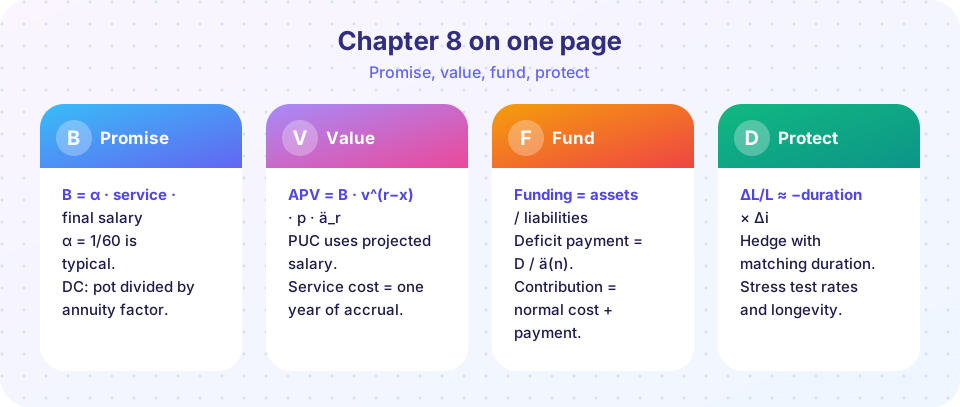
The chapter in one table
| Topic | Formula | Notes |
|---|---|---|
| DB benefit | B = α · service · final salary |
α = 1/60 is typical |
| APV of deferred pension | B · v^(r−x) · (r−x)p_x · ä_r |
Discount, survival, annuity |
| PUC liability | α · service · projected salary · v^(r−x) · (r−x)p_x · ä_r |
Projected salary |
| Service cost | One more year of accrual | Rises towards retirement |
| Funding level | assets / liabilities |
Below 100% means a deficit |
| Deficit payment | D / ä(n) |
n years at the valuation rate |
| Modified duration | −(1/L) · dL/di |
About 12 for this chapter's plan |
| DC outcome | pot / ä_65 |
Member carries the risk |
Application 1: what DC contribution replaces a DB pension?
A DB member earns 35/60 ≈ 58.3% of final salary after 35 years. What constant percentage of salary must a DC member save to reach the same pension, if returns are 4% a year, salary grows 3%, and the pot buys an annuity at the factor ä₆₅ ≈ 10.50 from the previous lessons? The code solves it: the pot needed is 0.583 × final salary × 10.50, and the pot from contributing a fraction c of salary is c × S₀ × Σ 1.03^t × 1.04^(35−t).
Application 2: rate shocks and funding volatility
If the discount rate moves by a random shock, a plan holding short-dated assets sees its funding level wobble, a hedged plan much less. The second TryIt simulates a year of rate shocks with a standard deviation of one percentage point. The liabilities are stylised as a payment of 1 in each year from year 5 to year 25, and the hedge is a single zero-coupon bond whose maturity equals their duration.
Try it
Press Run (or Ctrl + Enter) to see the result here.
Program input · what you'd type while the program runs
Type the answers before you press Run, one per line. Each time the program reads a line (with input()), it gets the next line from this box.
Press Run (or Ctrl + Enter) to see the result here.
Program input · what you'd type while the program runs
Type the answers before you press Run, one per line. Each time the program reads a line (with input()), it gets the next line from this box.
Common misconceptions
"A DC plan has no cost to the sponsor." The sponsor pays contributions and bears reputation and adequacy risk, but not the investment or longevity risk after contribution.
"Duration is a number of years of payments." It is a sensitivity measure, even though it is measured in years.
Check your understanding
Quick check · 10 questions
of 10 answered You scored / 10 · perfect!
-
1. A member with 36 years of service in a 1/60 plan has a pension of what fraction of final salary?
36/60 = 0.6. -
2. The APV factor v^(r−x)·(r−x)p_x·ä_r contains
Discount to today, probability of reaching retirement, value of the annuity. -
3. Under PUC, the service cost for a member is
It is the liability increase from another year of service. -
4. A plan has assets 80 and liabilities 100. A 5-year recovery plan at 0% interest requires deficit payments of
20/5 = 4. -
5. Which asset strategy reduces the plan's funding sensitivity to interest rates?
Assets with a duration similar to the liabilities move together with them. -
6. A DC member's retirement income depends on the pot and on
The same pot buys less pension when annuity rates are low. -
7. If liabilities have modified duration 14 and the discount rate falls by 0.5 percentage points, they rise by about
14 × 0.5% = 7%. -
8. Which is NOT part of the contribution under a recovery plan?
Contributions are the normal cost plus deficit payments. -
9. Compared with TUC, PUC liabilities for an active final salary member are normally
PUC allows for future salary growth. -
10. A longevity improvement (lower mortality) makes pension liabilities
Pensions are paid for longer.
Summary
- A DB pension is a deferred annuity valued with interest, survival and annuity factors; PUC and the service cost split it by year.
- Contributions combine normal cost and deficit recovery; duration measures interest rate risk and hedging reduces it.
- A DC plan shifts investment and longevity risk to the member: the contribution rate needed for a given replacement ratio can be solved directly.
Track your progress
Create a free account to tick off lessons and pick up where you left off on any device.
of Actuarial Mathematics lessons completed