


















Lesson 22 of 43 · Premiums and Reserves
Equivalence Principle Premiums
Learn how actuaries turn a promise into a price with the equivalence principle: net premiums, expense loadings and gross premiums, with worked numbers and code.
You now know how to value a death benefit: multiply the sum insured by the probability that death falls in each year and discount. The remaining question is how the policyholder pays for that benefit. Almost nobody pays a lump sum on day one, so the insurer needs a level premium paid for as long as the policy runs, and the equivalence principle is the rule that fixes its size.
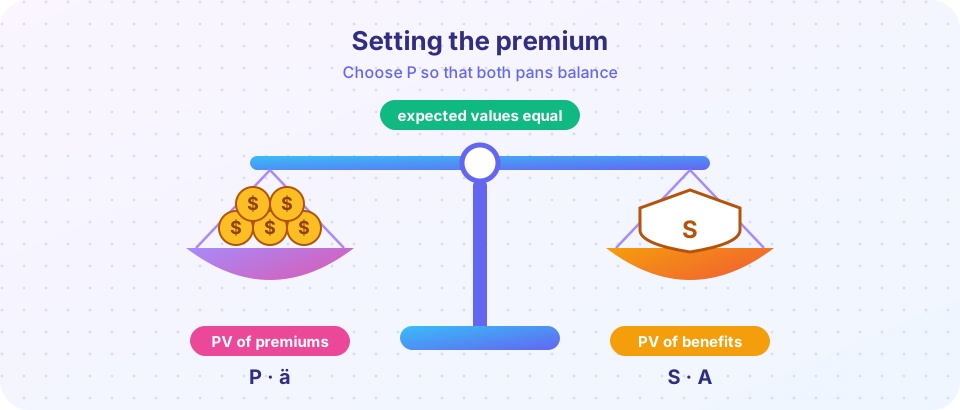
The principle is so simple that it fits on one line: on average, what comes in must equal what goes out, both measured in today's money. Everything else in this lesson is bookkeeping on top of that line.
What you will learn
- State the equivalence principle in terms of a random loss variable.
- Compute a net premium for term, whole life, endowment and limited-pay policies.
- Add expenses to obtain a gross premium.
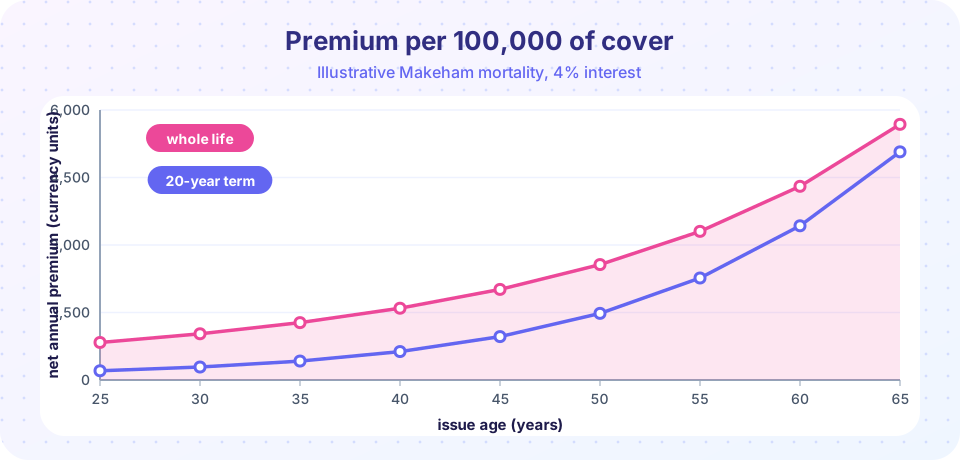
- Explain how age, term and interest move a premium.
Key terms
Net premium: the premium that satisfies the equivalence principle using only benefits, with no expenses or profit.
Gross (office) premium: the premium actually charged; it also pays expenses and contributes to profit.
Loss at issue: L = PV(benefits) − PV(premiums), a random variable because it depends on when death occurs.
Annuity-due ä: the present value of 1 paid at the start of each year while the life survives.
Expense loading: the part of the gross premium that covers expenses.
The loss random variable
Let K be the number of complete years the insured survives after the issue age x. For a policy paying a sum insured S at the end of the year of death, with level annual premium P paid at the start of each year while the insured is alive, the loss at issue is
L = S · v^(K+1) − P · ä(K+1)
where v = 1/(1+i) and ä(K+1) is the certain annuity-due for the K+1 premiums actually paid (K+1 years of cover were bought). If the insured dies early, the benefit is paid soon and few premiums were collected: L is large and positive. If the insured lives long, premiums pile up and L is negative.
The equivalence principle says: choose P so that E[L] = 0. Taking expectations term by term gives the working formula
P · ä_x = S · A_x so P = S · A_x / ä_x
Here A_x is the expected present value of 1 paid at the end of the year of death, and ä_x is the expected present value of 1 paid at the start of each year survived. For a term policy, both sums stop after n years and carry the subscript x:n.
A two-year example by hand
Take a 2-year term policy with S = 100,000, interest 5%, and invented death probabilities q₀ = 0.002 in year 1 and q₁ = 0.003 in year 2.
- Expected present value of the benefit:
100,000 × (0.002/1.05 + 0.998 × 0.003 / 1.05²). - The first term is about
190.48and the second about271.56; together about462.04. - Expected present value of premiums per unit:
ä = 1 + 0.998/1.05 ≈ 1.9505. - Premium:
P = 462.04 / 1.9505 ≈ 236.88.
Notice how the premium is more than the first year's cost of cover (100,000 × 0.002 / 1.05 ≈ 190.48) and less than the second year's cost for someone alive at its start (100,000 × 0.003 / 1.05 ≈ 285.71): the level premium sits between them.
Policy types in one table
Different products only change what is in the benefit stream and how long premiums last. The principle never changes.
| Product | Benefit | Premium payable | Net premium |
|---|---|---|---|
| n-year term | S if death within n years |
n years or until death |
S · A¹_x:n / ä_x:n |
| Whole life | S at death whenever |
whole life | S · A_x / ä_x |
| n-year endowment | S on death or survival to n |
n years |
S · A_x:n / ä_x:n |
| n-pay whole life | S at death |
n years only |
S · A_x / ä_x:n |
The endowment is the same as term plus a pure endowment (a payment if the insured survives). The n-pay whole life shortens only the premium period: the denominator becomes smaller, so each premium is larger.
From net to gross premium
A net premium ignores the cost of running the company. A real policy has expenses: the first year is costly (commission, underwriting, setting up the record) and each later year has smaller administration costs. A practical model uses
- an initial expense
e₀at issue, - a renewal expense of a percentage
rof each premium, - a fixed per-policy cost
feach year.
Applying the equivalence principle to the gross loss gives
G · ä = S · A + e₀ + f · ä + r · G · ä
G = (S · A + e₀ + f · ä) / ((1 − r) · ä)
The first-year commission is sometimes much bigger than r; when that happens you replace the percentage with a different rate in year one, and the algebra is the same: solve the equality of present values for G. A profit loading is added the same way, either as a margin on the premium or as a required return on capital.
Why the principle is "in expectation"
For one policyholder the loss is never zero: it is a big positive number or a smaller negative number. Equivalence only makes the average zero. A large portfolio of independent lives makes the average loss per policy close to zero because of the law of large numbers, which is why insurance works. The risk in the portfolio comes from mis-estimating mortality or interest, not from the random timing of individual deaths. You will measure the leftover variance in the second TryIt.
Try it
The first TryIt computes premiums for several products from the same life table and the gross premium with expenses.
Press Run (or Ctrl + Enter) to see the result here.
Program input · what you'd type while the program runs
Type the answers before you press Run, one per line. Each time the program reads a line (with input()), it gets the next line from this box.
The second TryIt simulates 100,000 independent policyholders to show that the equivalence principle makes the average loss small while individual losses are wild.
Press Run (or Ctrl + Enter) to see the result here.
Program input · what you'd type while the program runs
Type the answers before you press Run, one per line. Each time the program reads a line (with input()), it gets the next line from this box.
Common misconceptions
"The premium for each year is the expected claim for that year." That is a natural (yearly renewable) premium, which rises every year. The level premium is a weighted average of those yearly costs.
"A net premium is what the customer pays." Customers pay the gross premium. The net premium is only the benefit part.
"If the principle sets the average loss to zero, the insurer cannot lose." Only the average over many independent lives is near zero; wrong assumptions or bad luck on a small portfolio can still produce losses.
Check your understanding
Quick check · 5 questions
of 5 answered You scored / 5 · perfect!
-
1. A 2-year term policy has net premium 236.88 per 100,000. Which statement is correct about the first year?
Mortality rises, so the level premium exceeds the cost of year one and falls below the cost of year two. -
2. The equivalence principle sets which quantity to zero?
E[L] = 0, where L is the present value of benefits minus the present value of premiums. -
3. Compared with a whole life policy payable for life, a 20-pay whole life policy has
The same benefit is paid for by fewer premiums, so each premium is larger. -
4. In the gross premium formula G = (S·A + e0 + f·ä) / ((1 − r)·ä), what does r represent?
r is the percentage-of-premium expense (for example commission or premium tax). -
5. Why does a large portfolio of independent policies make the equivalence principle work?
The law of large numbers makes the average loss per policy close to zero.
Summary
- The equivalence principle chooses
Pso thatE[L] = 0: expected present value of premiums equals expected present value of benefits. - Net premium =
S · A / ä, with the sums matched to the product (term, whole life, endowment, limited pay). - Gross premium adds initial, percentage and per-policy expenses (and profit) to the equation and solves again.
- Individual losses are large; the portfolio average is stable.
Next: Prospective reserves
Track your progress
Create a free account to tick off lessons and pick up where you left off on any device.
of Actuarial Mathematics lessons completed