


















Lesson 40 of 43 · Projects and Practice
Practice Set: Premiums, Risk, Credibility and Pensions
Twelve practice problems on premiums, reserves, loss models, credibility, ruin and pensions, with a runnable solutions script and a self-marking answer checker.
You learn actuarial mathematics by doing it. This set has twelve problems, three or four for each of the main parts of slice two of the course. Work each one on paper first, with a calculator or Python if you like, then check yourself with the answer checker below. If an answer does not match, the solutions script shows the working.
The problems use small numbers so that you can see the structure. Every figure is invented.
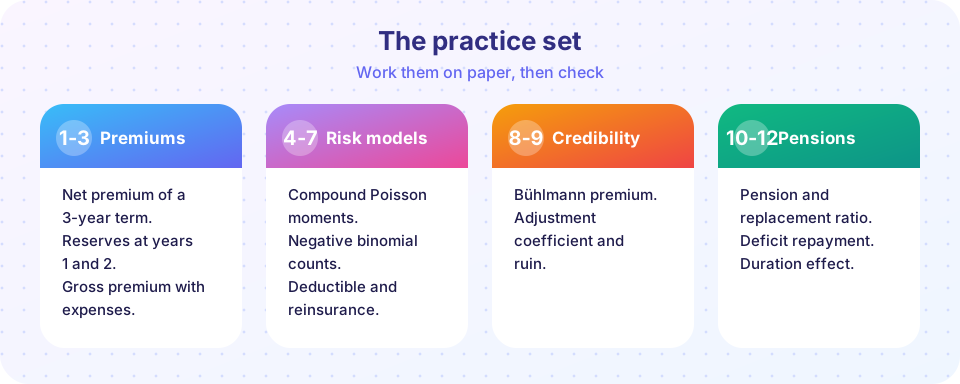
What you will learn
- Apply the equivalence principle, reserve recursion and expense loadings to concrete numbers.
- Compute moments, deductible values and reinsurance payments.
- Apply Bühlmann credibility and the exponential ruin formula.
- Value a pension and size a deficit repayment.
Key terms
Net premium: the benefit-only premium from the equivalence principle.
Terminal reserve: the reserve at the end of a policy year.
Loss elimination ratio: E[X ∧ d] / E[X].
Credibility factor: Z = n/(n + K).
Adjustment coefficient R: the exponent in the Lundberg bound.
The problems
Premiums and reserves
- A 3-year term policy pays 10,000 at the end of the year of death. Death probabilities are
q₀ = 0.01,q₁ = 0.02,q₂ = 0.03for the three years (each conditional on being alive at the start of the year). Interest is 5%. Find the level annual net premium, payable in advance. - For the policy in problem 1, find the net premium reserve at the end of year 1 and at the end of year 2 (just before the next premium is due).
- The company adds an initial expense of 50 and an expense of 10% of every premium (including the first). Find the gross premium.
Risk models
- Claims follow a compound Poisson process with
λ = 5per year; each claim has mean 200 and variance 10,000. FindE[S],Var[S]and the standard deviation. - The number of claims is negative binomial with
r = 2andβ = 1.5. Find its mean and variance. - Claims are exponential with mean 800 and the policy has a deductible of 300. Find the expected payment per loss and the loss elimination ratio.
- A claim of 5,000 is covered by a 25% quota share, or alternatively by a per-claim excess of loss treaty with retention 1,000. How much does the reinsurer pay in each case?
Credibility and ruin
- A risk has
n = 4years of data averaging 130; the group mean is 100,v = 2,000anda = 500. FindK,Zand the credibility premium. - Claims are exponential with mean 500, the loading is
θ = 25%and initial capital is 2,500. Find the adjustment coefficient and the ruin probability.
Pensions
- A plan accrues 1/80 of final salary per year of service. A member retires with 32 years of service on a final salary of 70,000. Find the pension and the replacement ratio.
- A plan has assets 540 and liabilities 600. The deficit is repaid by six level payments in advance at 5% interest. Find the payment.
- Liabilities have modified duration 11. By about how much do they rise if the discount rate falls by 0.75 percentage points?
Try it
Press Run (or Ctrl + Enter) to see the result here.
Program input · what you'd type while the program runs
Type the answers before you press Run, one per line. Each time the program reads a line (with input()), it gets the next line from this box.
Common misconceptions
"Reserves are computed with the first-year probabilities only." A reserve at time t uses the probabilities of the remaining years, not of year 1.
"Variance of a compound sum is λ · Var[X]." For a compound Poisson it is λ · E[X²], which includes the square of the mean.
"A deficit repayment is deficit divided by the number of years." With interest it is the deficit divided by the annuity factor.
Check your understanding
Quick check · 5 questions
of 5 answered You scored / 5 · perfect!
-
1. In problem 1, the first-year net cost of cover (expected benefit discounted one year) is
10,000 × 0.01 / 1.05 ≈ 95.24, which is below the level premium of 186.43. -
2. If a deductible removes 31% of expected losses, the insurer's expected payment per loss is
Payment = E[X] × (1 − LER). -
3. With Z = 0.5, own average 130 and group mean 100, the credibility premium is
0.5 × 130 + 0.5 × 100 = 115. -
4. Doubling the capital u in the exponential ruin formula changes e^(−Ru) to
e^(−2Ru) = (e^(−Ru))². -
5. A pension accrual of 1/80 for 40 years gives a replacement ratio of
40/80 = 0.5.
Summary
- Premium problems rest on
P = S · A / ä; reserves on the prospective formula or the recursion. - Loss-model problems use compound moments, limited expected values and reinsurance definitions.
- Credibility and ruin have one-line formulas; pensions combine accrual formulas with annuity factors.
- Checking answers with a script is a good habit: it catches arithmetic slips.
Next: Glossary
Track your progress
Create a free account to tick off lessons and pick up where you left off on any device.
of Actuarial Mathematics lessons completed