


















Lesson 30 of 43 · Credibility and Ruin Theory
Credibility and Ruin Theory: Chapter Overview
A map of two classic actuarial questions: how much to trust a risk's own claims history, and how likely an insurer is to run out of money.
Two questions sit at the heart of running an insurance business after the pricing is done. The first is a question about evidence: a small company has had unusually few claims for three years, so should its premium drop? The second is a question about survival: given the premiums coming in and the claims going out, how likely is it that the insurer's money will ever run out?
Credibility theory answers the first by blending a risk's own experience with the experience of the wider group. Ruin theory answers the second by studying the surplus as a random process. Both are mathematically neat, and both are everyday tools for pricing teams and for risk managers who must hold capital.
What you will learn
- Why a premium should usually be a weighted average of own experience and the group mean.
- The difference between limited fluctuation and Bühlmann credibility.
- How the surplus process is built and what ruin probability means.
- How the Lundberg bound links loading, capital and survival.
Key terms
Credibility factor Z: the weight, between 0 and 1, given to a risk's own experience.
Collective premium: the expected claim cost of the whole group of similar risks.
Surplus process U(t): initial capital plus premiums received minus claims paid by time t.
Ruin: the event that U(t) falls below zero at some time.
Adjustment coefficient R: the exponent in the Lundberg bound ψ(u) ≤ e^(−Ru).
The big picture
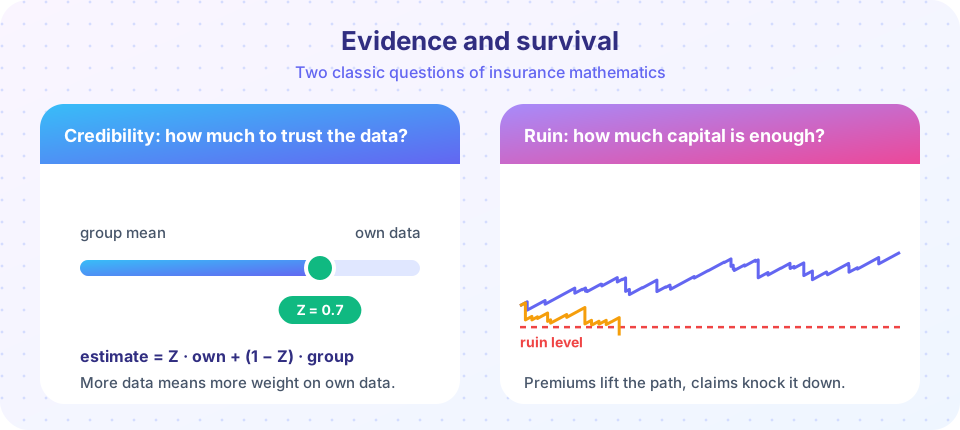
Imagine a delivery firm with a fleet of five vans. Its claims over the last two years were low. Should the insurer cut its premium to match? If the firm were a fleet of 5,000 vans, almost yes; with five vans, a good run could be luck. Credibility theory turns that intuition into a formula: estimate = Z × own experience + (1 − Z) × group mean, with Z increasing as the evidence grows more reliable.
Ruin theory looks at the whole company. Start with capital u, collect premiums at a steady rate, pay random claims at random times. Ruin means capital goes negative. If premiums barely exceed expected claims, ruin is certain in the long run; with a safety loading, ruin is a probability that shrinks exponentially in u. This tells a regulator how much capital is enough.
Two questions
Credibility
Ruin
The result
What each lesson covers
| Lesson | What you will be able to do |
|---|---|
| Credibility theory | Compute limited fluctuation and Bühlmann credibility premiums. |
| Ruin probability | Model the surplus, compute ruin probabilities and the adjustment coefficient. |
| Chapter review | One picture and ten mixed questions. |
Try it
The first TryIt shows why a small risk's own experience is noisy: five fleets with the same true claim cost, observed for three years each.
Press Run (or Ctrl + Enter) to see the result here.
Program input · what you'd type while the program runs
Type the answers before you press Run, one per line. Each time the program reads a line (with input()), it gets the next line from this box.
Press Run (or Ctrl + Enter) to see the result here.
Program input · what you'd type while the program runs
Type the answers before you press Run, one per line. Each time the program reads a line (with input()), it gets the next line from this box.
Common misconceptions
"A risk with no claims should get a free policy." Zero observed claims with little exposure is weak evidence; credibility pulls the estimate towards the group.
"Ruin means the company goes bankrupt on the spot." In the model it means the surplus has become negative; real companies react with capital injections, reinsurance and regulation, but the model measures how close to that edge a business runs.
Check your understanding
Quick check · 4 questions
of 4 answered You scored / 4 · perfect!
-
1. A credibility estimate has the form
It is a weighted average of the specific and the general. -
2. When a risk has more years of data, the credibility factor Z
More evidence deserves more weight. -
3. Ruin theory models the surplus as
U(t) = u + ct − S(t). -
4. If premiums only equal expected claims (no loading), the long-run ruin probability is
With no positive drift, the random walk of the surplus eventually goes below any level.
Summary
- Credibility theory blends specific and general experience with a weight that grows with data volume.
- Ruin theory studies the surplus
U(t) = u + ct − S(t)and measures the probability that it ever becomes negative. - Positive safety loading and enough capital make ruin exponentially unlikely.
Next: Credibility theory
Track your progress
Create a free account to tick off lessons and pick up where you left off on any device.
of Actuarial Mathematics lessons completed