


















Lesson 6 of 43 · Interest and Annuities
Chapter 2 overview: Interest and annuities
The big picture of the time value of money: simple versus compound interest, the accumulation function, the effective rate and what chapter 2 will teach you.
An insurer collects premiums today and pays claims years from now. In between, the money earns interest. A pension fund collects contributions for forty years and pays benefits for another thirty. Without a clear understanding of how money grows and how future payments are valued today, no actuarial calculation can even begin. This chapter builds that foundation.
If you have seen compound interest at school, much will be familiar, but actuaries use it in a precise and slightly different notation (i, v, d, delta, a_n) that makes long calculations short. We introduce it step by step.
What you will learn
- The difference between simple and compound interest, and why compound is the default.
- What the accumulation function and the effective annual rate mean.
- How the chapter's four lessons fit together.
- The rule of 72 and a feel for how fast money doubles.
Key terms
Principal: the amount originally invested or borrowed.
Accumulation function A(t): the value at time t of 1 invested at time 0.
Effective annual rate i: the interest earned in one year per unit invested at the start of the year.
Simple interest: interest calculated on the principal only.
Compound interest: interest calculated on principal plus previously earned interest.
Simple versus compound
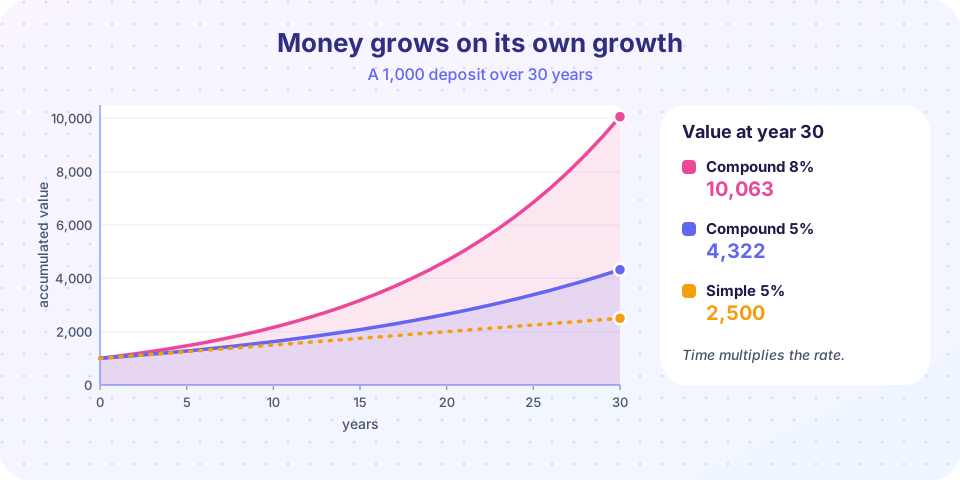
With simple interest at rate i, an investment of 1 grows to 1 + i t after t years: a straight line. With compound interest it grows to (1 + i)^t: each year's interest is added to the balance and earns interest itself. In the picture the two curves start together, and the gap widens. After 30 years at 5%, 1,000 becomes 2,500 under simple interest and about 4,322 under compound interest; at 8% compound it becomes about 10,063. Small rate differences, repeated over decades, give very large differences. That is why actuaries are so careful about the interest assumption in a 40-year pension calculation.
Compound interest is the standard in actuarial work: money in a bank or bond fund really does earn interest on interest. Simple interest appears only for short periods, or for specific contracts.
The accumulation function
Let A(t) be the accumulated value at time t of one unit invested at time 0. For compound interest, A(t) = (1 + i)^t. The effective annual rate is i = A(1) - A(0), which is the interest earned in the first year. Throughout, we assume the effective rate is constant unless told otherwise, and we measure time in years.
The reverse question is just as important. If you will receive 1 at time t, what is it worth today? The answer is (1 + i)^(-t), called the discount and written v^t with v = 1 / (1 + i). Lesson 2 of this chapter develops it, with the related quantities d (discount rate) and delta (force of interest).
Chapter 2 in four steps
Why actuaries need it
What each lesson covers
- Compound interest and discount rates: effective, nominal and discount rates,
v,d, force of interest, present values. - Annuities-certain: streams of equal payments,
a_n,s_n, annuity-due, perpetuities. - Loans and amortization: level payments, outstanding balances, interest and principal splits.
- Chapter 2 review: one-page summary and a mixed quiz.
Try it
Compare simple and compound growth and work out doubling times. The code also shows the rule of 72: money doubles in roughly 72 / (rate in percent) years.
Press Run (or Ctrl + Enter) to see the result here.
Program input · what you'd type while the program runs
Type the answers before you press Run, one per line. Each time the program reads a line (with input()), it gets the next line from this box.
The next example is an interactive growth explorer. Move the sliders and watch how the two kinds of interest separate.
Common misconceptions
"Doubling the rate doubles the final amount." Growth is exponential in time: at 5% 1,000 becomes 4,322 over 30 years, but at 10% it becomes about 17,449, four times as much, not twice.
"Simple interest is just compound interest with a different rate." The two are different functions of time; no single rate makes simple interest match compound for all t.
Check your understanding
Quick check · 4 questions
of 4 answered You scored / 4 · perfect!
-
1. What is 1,000 worth after 10 years of simple interest at 6%?
Simple interest: 1,000 x (1 + 0.06 x 10) = 1,600. Compound would be 1,000 x 1.06^10 = 1,790.85. -
2. Under compound interest at effective rate i, what is the accumulation function A(t) for 1 invested?
Each year multiplies the balance by (1 + i). -
3. About how long does money take to double at 6% compound (rule of 72)?
72 / 6 = 12 years. The exact value is ln 2 / ln 1.06, about 11.9 years. -
4. Which quantity is the value TODAY of 1 payable in t years?
Discounting reverses accumulation: v^t is how much must be invested now to have 1 at time t.
Summary
- Compound interest earns interest on interest;
A(t) = (1 + i)^t. - Over long periods small differences in the rate make very large differences in results.
- Discounting reverses accumulation: the present value of 1 due at time
tisv^t. - This chapter covers rates and discounting, annuities, and loans, ending with a review.
Track your progress
Create a free account to tick off lessons and pick up where you left off on any device.
of Actuarial Mathematics lessons completed