


















Lesson 18 of 43 · Life Insurance Benefits
Endowments and pure endowments
Value pure endowments n E(x) and endowment insurance as term plus pure endowment, with payoff pictures, variance comparisons and runnable examples.
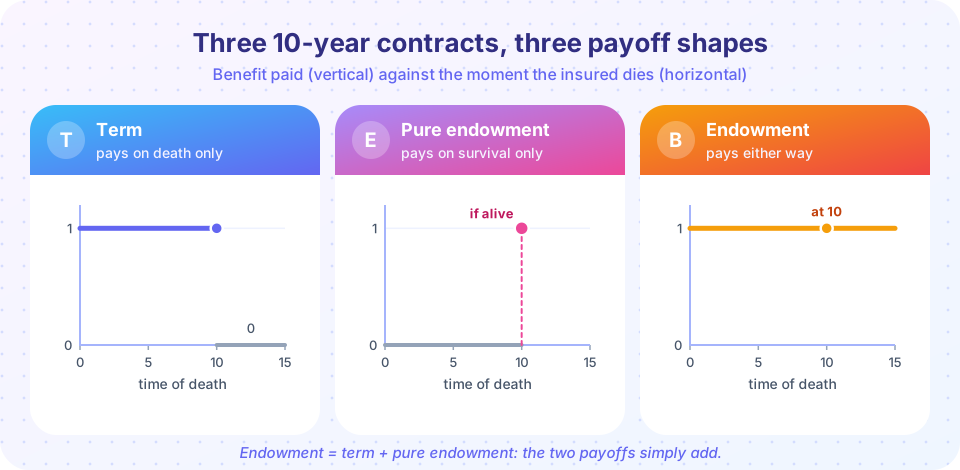
Insurance protects against dying too soon. A pure endowment does the opposite: it pays only if you live. If you are alive on a given date, you receive a sum; if not, you receive nothing. It is the simplest "survival" benefit and the building block of pension and annuity mathematics. Combine it with term insurance and you have an endowment insurance: a policy that pays the sum assured either at death within the term or at the end of the term if the person is still alive. Savings-linked life policies, children's education plans and many traditional "with-profits" contracts are endowments.
The valuation idea is identical to the previous lesson: a payment, a time and an event. The difference is the event, "alive at time n", and a payment that happens at a known time but only with some probability.
What you will learn
- The formula
n E x = v^n * n p xand why it has two discounts. - How to value endowment insurance as term plus pure endowment.
- The variance of each benefit and why endowments are much less risky.
- How APVs change with the term and the starting age.
Key terms
Pure endowment n E x: APV of 1 paid at time n if the person aged x is alive then.
Endowment insurance A x:n: APV of 1 paid on death within n years or on survival to n, whichever comes first.
Maturity: the date at which an endowment pays if the life survives.
Actuarial discount factor: v^n * n p x, which discounts for both interest and survival.
Mortality credit: the extra effective return because those who die do not collect.
Pure endowment
The payment is 1 at time n, and it is made only if the person survives, probability n p x. The present value is Z = v^n with probability n p x and 0 otherwise, so
n E x = v^n * n p x.
This is the actuarial discount factor: it discounts for interest (v^n) and for the chance of not surviving (n p x). A useful way to read it is "the value today of 1 payable in n years to someone who is alive then". Because the person might not collect, it is smaller than v^n.
In the course model at i = 5%: 10 E 40 = 0.58699 (against v^10 = 0.61391), and 10 E 65 = 0.40459: a 65-year-old's chance of reaching 75 is only about 66%, which reduces the value substantially. Using n p x = l(x+n)/l(x), you can write n E x = v^n l(x+n) / l(x); tables of "commutation functions" once exploited this, defining D x = v^x l(x) so that n E x = D(x+n) / D x.
The variance is that of a two-point random variable: Var(Z) = v^(2n) * n p x * (1 - n p x). For n p x near 0 or 1 the risk is small; it is largest when survival is a coin flip.
Endowment insurance
An n-year endowment insurance pays 1 at the end of the year of death if death is within n years, and 1 at time n if the person survives. So the benefit is paid for sure, and the present value is
Z = v^(min(K+1, n)), with APV A x:n = A^1 x:n + n E x.
For a 40-year-old with n = 10: A 40:10 = 0.03285 + 0.58699 = 0.61984; for a 65-year-old: 0.25783 + 0.40459 = 0.6624. Both are above v^10 = 0.61391, because deaths before maturity bring the payment earlier, and the 65-year-old's is higher because early death is more likely. The payment is certain, so mortality changes only the timing, and the values stay close to v^10. This is why endowment premiums are high and the insurance element is small: most of the premium is savings.
The variance is also much lower than for whole life, because Z is confined to v^1 to v^n and nearly always sits close to v^n. The next code block shows this by comparing the standard deviations.
Press Run (or Ctrl + Enter) to see the result here.
Program input · what you'd type while the program runs
Type the answers before you press Run, one per line. Each time the program reads a line (with input()), it gets the next line from this box.
How the three APVs change with the term
For a 40-year-old, as the term lengthens the pure endowment becomes less valuable (more discounting, more chance of death), the term insurance becomes more valuable (more years of cover), and the endowment reflects both. Plot them together:
Press Run (or Ctrl + Enter) to see the result here.
Program input · what you'd type while the program runs
Type the answers before you press Run, one per line. Each time the program reads a line (with input()), it gets the next line from this box.
Common misconceptions
"A pure endowment is worth v^n." It is worth v^n * n p x, because it is paid only on survival.
"Endowment insurance is mostly protection." For ordinary ages the term element is small; the policy is mainly a savings plan that happens to pay earlier on death.
"If you die before maturity you lose all your premiums." That is true of a pure endowment, not of an endowment insurance, which pays the sum assured at death.
Check your understanding
Quick check · 5 questions
of 5 answered You scored / 5 · perfect!
-
1. A person has a 90% chance of surviving 10 years and v^10 = 0.62. What is 10 E x?
10 E x = v^10 x 10 p x = 0.62 x 0.9 = 0.558. -
2. Endowment insurance equals
A x:n = A^1 x:n + n E x. Both pieces pay at most once and together they always pay. -
3. Var of a pure endowment benefit of 1 with n p x = 0.5 and v^n = 0.6 is
v^(2n) x p x (1 - p x) = 0.36 x 0.25 = 0.09. -
4. Why is the variance of an endowment insurance small compared with whole life?
Z is confined to a narrow range because every outcome pays by time n. -
5. Which is largest for a given x and n?
n E x = v^n x n p x with n p x < 1, so it is below v^n.
Summary
n E x = v^n * n p xis the value of 1 paid at timento a survivor.- Endowment insurance
A x:n = A^1 x:n + n E xpays for sure; its variance is small. - Pure endowments have variance
v^(2n) * n p x * (1 - n p x). - Commutation functions write
n E x = D(x+n) / D xwithD x = v^x l(x).
Next: Life annuities
Track your progress
Create a free account to tick off lessons and pick up where you left off on any device.
of Actuarial Mathematics lessons completed