


















Lesson 32 of 43 · Credibility and Ruin Theory
Ruin Probability
Model an insurer's surplus as a random process, compute ruin probabilities, the adjustment coefficient and the Lundberg bound, and see how loading and capital protect the firm.
Pricing tells you what the average year looks like. Ruin theory asks what could happen over many years: premiums come in steadily, claims arrive at random and can be large, so the insurer's capital wanders up and down. How likely is it that it ever goes below zero?
The classical answer is the Cramér–Lundberg model, proposed by the Swedish actuaries Filip Lundberg (1903) and Harald Cramér (1930s). Its mathematics is clean enough to give exact formulas in a few cases and a neat universal bound in all the others. It is also the starting point for modern solvency regulation.
What you will learn
- Write the surplus process and the net profit condition.
- State the ruin probability and its value at zero capital.
- Compute the adjustment coefficient and use the Lundberg bound.
- Find the capital needed for a target ruin probability.
Key terms
Surplus process: U(t) = u + c·t − S(t), with initial capital u, premium rate c and aggregate claims S(t).
Safety loading θ: the premium rate satisfies c = (1 + θ)·λ·μ, where μ = E[X].
Ruin probability ψ(u): the probability that U(t) < 0 for some t.
Adjustment coefficient R: the positive root of λ(M_X(r) − 1) = c·r, where M_X is the moment generating function of a claim.
Lundberg inequality: ψ(u) ≤ e^(−R·u).
The surplus process
Claims arrive as a Poisson process with rate λ per year, each of size X (mean μ), while premium flows in continuously at rate c. The surplus at time t is
U(t) = u + c·t − (X₁ + X₂ + … + X_N(t))
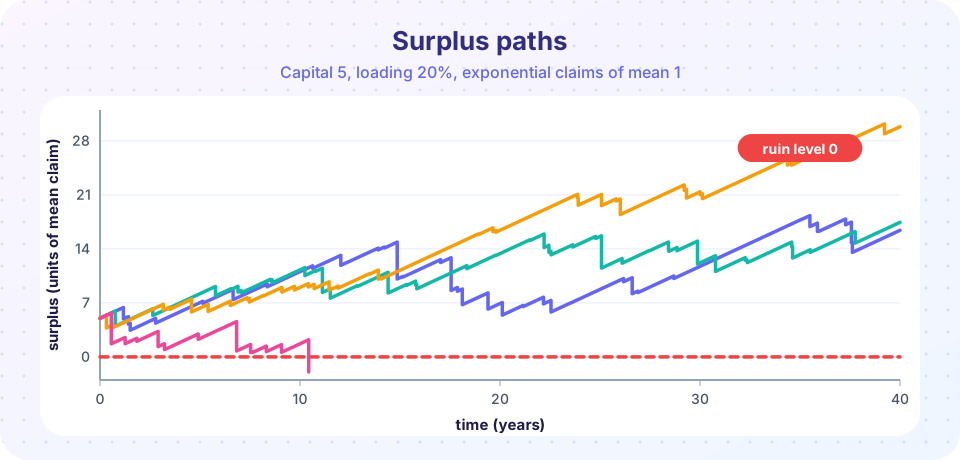
Between claims the path rises along a straight line of slope c; each claim makes it jump down. Because the surplus only decreases at claim times, ruin can only happen at a claim.
The net profit condition
Over a long time the surplus drifts by c − λμ per year. If c ≤ λμ (no loading, θ ≤ 0), ruin is certain: ψ(u) = 1 for every u. We therefore always assume θ > 0. The loading is the insurer's protection, and the capital u is the buffer that lets it survive bad luck early on.
A pleasing exact fact holds for every claim distribution with finite mean:
ψ(0) = λμ / c = 1 / (1 + θ)
Even with no initial capital, there is a chance of surviving forever, and it equals θ/(1 + θ).
The adjustment coefficient and the Lundberg bound
Let M_X(r) = E[e^(rX)]. The adjustment coefficient R > 0 solves
λ · (M_X(R) − 1) = c · R
It exists for light-tailed claims (where the moment generating function is finite for some r > 0). The Lundberg inequality says
ψ(u) ≤ e^(−R·u) for all u ≥ 0
So ruin probability decays at least exponentially with capital. A larger R (bigger loading, smaller claims) means faster decay.
Exponential claims: everything in closed form
If claims are exponential with mean μ, then M_X(r) = 1/(1 − μr) and solving gives
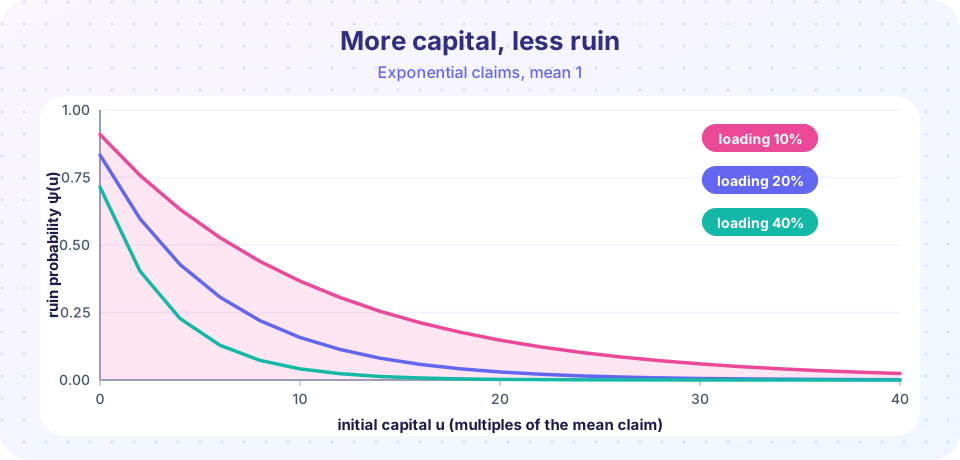
R = θ / ((1 + θ)·μ) ψ(u) = (1 / (1 + θ)) · e^(−R·u)
Worked example. Let λ = 1, μ = 1 and θ = 0.2. Then R = 0.2/1.2 ≈ 0.1667 and ψ(u) = 0.8333·e^(−0.1667·u). With capital u = 10 (ten times the mean claim), ψ(10) ≈ 0.8333 × 0.1889 ≈ 0.157: about one chance in six of ever being ruined. To bring ruin to 1%, solve ψ(u) = 0.01 to get u = ln(1/(0.01 × 1.2)) / R ≈ 4.42/0.1667 ≈ 26.5: about 26.5 mean claims of capital.
Heavy tails change everything
The Lundberg bound needs R to exist. For heavy-tailed claims such as the Pareto, M_X(r) is infinite for every r > 0, no adjustment coefficient exists, and ruin probability decays only polynomially in u. In such lines, extra capital buys far less safety, and reinsurance of large claims becomes essential. You will see this in the simulation below.
Discrete-time view
Companies measure results annually. If the annual net result P − S of a portfolio is roughly normal with mean m = P − E[S] and variance σ², the Lundberg coefficient for the random walk of year-end surplus is approximately R = 2m/σ². This is the origin of simple rules of thumb that tie capital to the standard deviation of annual claims.
Try it
Press Run (or Ctrl + Enter) to see the result here.
Program input · what you'd type while the program runs
Type the answers before you press Run, one per line. Each time the program reads a line (with input()), it gets the next line from this box.
Press Run (or Ctrl + Enter) to see the result here.
Program input · what you'd type while the program runs
Type the answers before you press Run, one per line. Each time the program reads a line (with input()), it gets the next line from this box.
Common misconceptions
"If the loading is positive, ruin cannot happen." A positive loading makes ruin avoidable with positive probability, not impossible. Even with θ = 0.2 and zero capital, ruin has probability about 83% in the exponential case.
"Ruin probability is the same as the probability of a loss in a year." Ruin is about ever falling below zero over all future time, not about one year's result.
"More capital always helps at the same rate." With light tails the benefit is exponential; with heavy tails it is far weaker.
Check your understanding
Quick check · 5 questions
of 5 answered You scored / 5 · perfect!
-
1. For any claim distribution with mean μ, ψ(0) equals
ψ(0) = λμ/c = 1/(1 + θ). -
2. With θ = 0.25 and exponential claims of mean 1, the adjustment coefficient R is
R = θ/((1 + θ)μ) = 0.25/1.25 = 0.20. -
3. The Lundberg inequality states that
It is an upper bound on the ruin probability. -
4. If θ ≤ 0 (premiums at most equal expected claims), then
With no positive drift the surplus eventually goes below any level. -
5. For Pareto claims, the adjustment coefficient
The moment generating function is infinite for all r > 0, so the Lundberg equation has no positive root.
Summary
- The surplus is
U(t) = u + c·t − S(t); the loadingθmust be positive for ruin to be avoidable. ψ(0) = 1/(1 + θ)for every claim distribution with finite mean.- The Lundberg bound
ψ(u) ≤ e^(−Ru)shows ruin shrinks exponentially with capital for light-tailed claims; exponential claims give the exactψ(u) = e^(−Ru)/(1 + θ). - Heavy tails remove the bound and demand reinsurance or much more capital.
Track your progress
Create a free account to tick off lessons and pick up where you left off on any device.
of Actuarial Mathematics lessons completed