


















Lesson 3 of 43 · Getting Started
Pooling, risk and insurance
Understand risk pooling, the law of large numbers, adverse selection and moral hazard, and simulate how a larger pool makes claims more predictable.
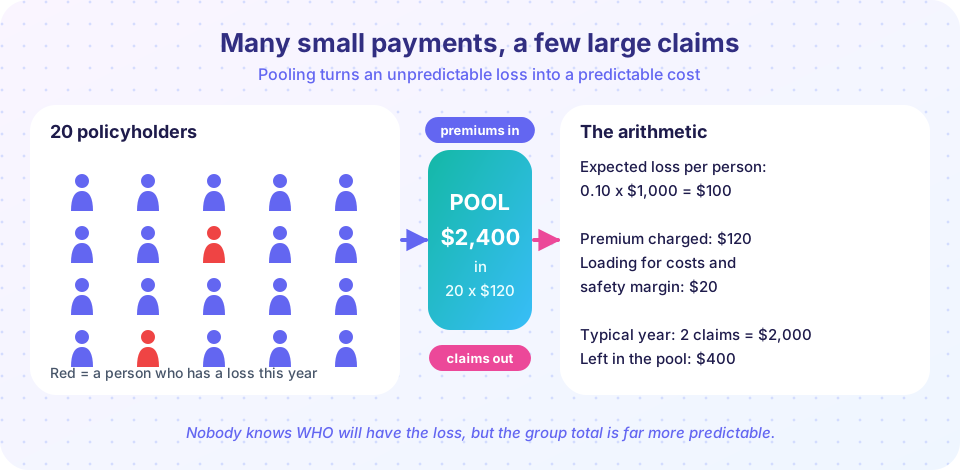
Imagine 20 neighbors, each of whom has a 1-in-10 chance this year of losing something worth 1,000: a stolen bicycle, a flooded cellar, a broken phone. For one neighbor the outcome is a gamble: most likely nothing, sometimes a painful 1,000. Now suppose all 20 agree to put 120 each into a shared pot, and the pot pays whoever has a loss. Each neighbor now faces a certain, small cost instead of an uncertain, large one. That agreement is the essence of insurance.
Insurance works not because the insurer is a better gambler but because pooling many similar, independent risks makes the total predictable. This lesson explains why, and also why real pools can go wrong.
What you will learn
- What risk means in actuarial work and which risks are insurable.
- How the law of large numbers makes a big pool more predictable than a small one.
- What adverse selection and moral hazard are, and how insurers respond.
- How to simulate a pool and measure the chance it loses money.
Key terms
Risk: a situation in which the outcome is uncertain and some outcomes cost money.
Exposure: one unit of risk, such as one insured car-year or one policyholder-year.
Pooling: combining many exposures so losses are shared.
Adverse selection: the tendency for people who expect higher losses to buy more cover.
Moral hazard: a change in behavior because someone else bears the cost of a loss.
The arithmetic of a pool
In the picture, each of the 20 people loses 1,000 with probability 0.1 and 0 otherwise. For one person the expected loss is 0.1 x 1000 = 100, and the standard deviation is 1000 x sqrt(0.1 x 0.9) = 300. The spread (300) is three times the mean (100): the outcome is very uncertain.
Now take the average loss per person across a pool of n independent people. The mean stays 100, but the standard deviation shrinks to 300 / sqrt(n). With 20 people it is about 67; with 100 it is 30; with 10,000 it is only 3. The relative uncertainty falls from 300% of the mean for one person to 3% for 10,000. This is the law of large numbers in action, and the square root is the reason: variances of independent risks add, standard deviations do not.
The insurer charges a premium above the mean (here 120) so the typical pool has a small surplus to cover costs and bad years. How large the surplus must be is the question of chapters 5 to 7.
Common misconceptions
"A bigger pool eliminates risk." It reduces the risk per person, but the total risk (the standard deviation of the pool's total claims, 300 x sqrt(n)) actually grows with n. What shrinks is the risk relative to the mean, and what the insurer cares about is whether the premium income covers the claims.
"Independence is a detail." If the risks are linked (everyone in a flood zone floods at once), the square-root shrinkage fails. That is why insurers limit exposure to one earthquake zone or buy reinsurance.
What makes a risk insurable?
Insurers generally want risks with these features:
- Many similar exposures, so the law of large numbers applies.
- Mostly independent losses, so one event does not hit everyone.
- A definite, measurable loss, so claims can be paid fairly.
- Accidental, not chosen, so the insured cannot cause the loss deliberately.
- An affordable premium compared with the potential loss.
- Estimable probabilities, so a premium can be set at all.
Some risks fail these tests. A near-certain loss cannot be priced affordably, and a risk where everyone is hit together (a global pandemic, a major war) is too correlated for a private pool. Governments sometimes step in as insurer of last resort for those.
Adverse selection and moral hazard
Adverse selection. Imagine a health plan charging everyone the same price. People who know they are ill are most eager to buy; healthy people see a poor deal and drop out. The pool then contains more high-risk people than the price assumed, the average claim rises, and the price must rise, which drives out even more healthy people. Insurers answer with underwriting (questions, medical checks), pricing by age and risk class, waiting periods, and, in some countries, compulsory participation so everyone is in the pool.
Moral hazard. A driver with full cover might park less carefully. Insurers answer with deductibles (the first part of each loss is paid by the policyholder), co-payments, no-claims bonuses, and policy conditions. These also reduce small claims, whose handling cost exceeds their value.
Both are examples of a deeper truth: the numbers in an actuary's model describe human behavior as well as chance, so the model has to anticipate how people respond to the product.
Simulating a pool
Run the experiment. We use a pool where each person has a 10% chance of a 1,000 loss and pays a 120 premium, and ask how often the pool's claims exceed its premium income.
Press Run (or Ctrl + Enter) to see the result here.
Program input · what you'd type while the program runs
Type the answers before you press Run, one per line. Each time the program reads a line (with input()), it gets the next line from this box.
The table shows the effect: with 20 people the pool fails roughly a third of the time, but with a few thousand the chance is tiny, because the margin of 20 per person (20% of the expected claim) outweighs the shrinking relative spread.
Try it: watch the average settle
Plot the average claim per person for pools of growing size. The wobble narrows and settles near the expected 100.
Press Run (or Ctrl + Enter) to see the result here.
Program input · what you'd type while the program runs
Type the answers before you press Run, one per line. Each time the program reads a line (with input()), it gets the next line from this box.
Reinsurance and diversification
Insurers also pool among themselves. A reinsurer takes part of an insurer's risk, usually the largest losses, for a premium. This protects the insurer against concentration (many policies hit by one storm) and is why large catastrophes are shared across the world market. Diversification is the same idea inside one company: write many kinds of risk in many places, so one bad area does not decide the year.
Check your understanding
Quick check · 5 questions
of 5 answered You scored / 5 · perfect!
-
1. Each of n independent policies has mean loss 100 and standard deviation 300. What is the standard deviation of the AVERAGE loss per policy?
Variances of independent risks add, so the total has variance n x 300^2 and the average has variance 300^2 / n, giving a standard deviation of 300 / sqrt(n). -
2. Why do insurers prefer losses that are mostly independent?
If losses are strongly linked (one flood hits everyone), a large pool is no safer than a small one. -
3. A plan charges everyone the same price and the healthiest members leave. This is an example of
Higher-risk people are more likely to stay or join, so the pool becomes riskier than the price assumed. -
4. A driver with full cover drives less carefully. This is
Behavior changes because someone else bears the cost. Deductibles and no-claims bonuses are typical responses. -
5. As the pool grows, the standard deviation of TOTAL claims
Total claims have standard deviation 300 x sqrt(n), which grows, but the mean grows faster (100n), so the relative spread falls.
Summary
- Pooling many similar, independent risks makes the average loss predictable: its standard deviation shrinks like
1 / sqrt(n). - The premium sits above the expected loss so the pool has a margin for costs and bad years.
- Insurable risks are numerous, independent, measurable, accidental and affordable.
- Adverse selection and moral hazard are the human side of insurance; underwriting, deductibles and bonuses respond to them.
- Reinsurance and diversification extend pooling beyond one company.
Track your progress
Create a free account to tick off lessons and pick up where you left off on any device.
of Actuarial Mathematics lessons completed