


















Lesson 5 of 43 · Getting Started
Chapter 1 review: Getting started
A one-page recap of what actuaries do, pooling, expected value and the law of large numbers, with a mixed ten-question quiz and two quick calculators.
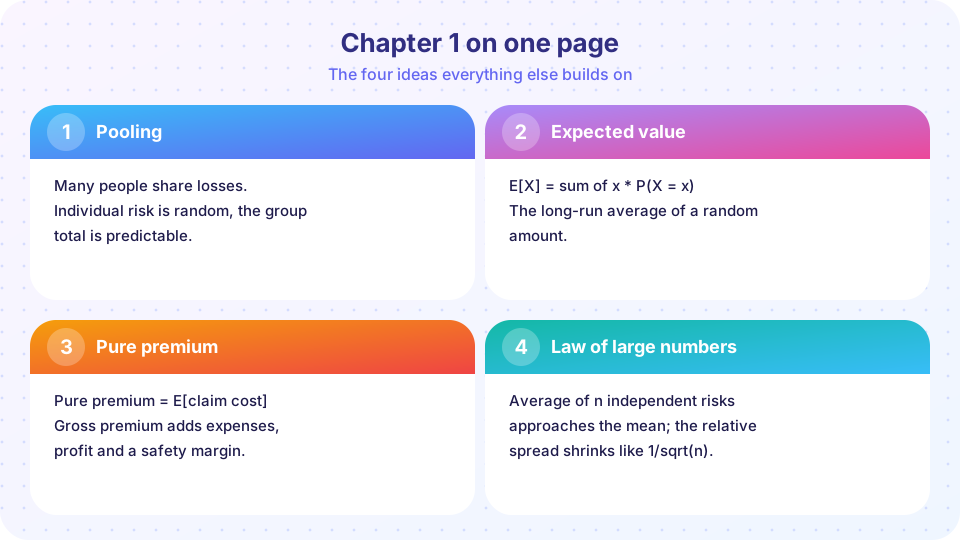
Chapter 1 gave you the vocabulary and the first tools: what actuaries do, why pooling makes risk predictable, and the probability that every later formula uses. This review pulls the chapter onto one page, lets you test your numbers with two calculators, and ends with a mixed quiz.
What you will learn
- How the four big ideas of the chapter fit together.
- Which formula answers which type of question.
- Where you are strong and where to re-read before chapter 2.
Key terms
Net premium: expected claim cost, no expenses.
Gross premium: what the customer pays, with expenses and margin.
Pooling: sharing losses among many exposures.
Law of large numbers: the average of many independent risks converges to the mean.
Indicator: a 0/1 variable for an event, with mean equal to the event's probability.
The chapter in a table
| Lesson | Big idea | Formula to remember |
|---|---|---|
| What actuaries do | Price, reserve, manage risk; control cycle | gross premium P = net / (1 - expense ratio) |
| Pooling, risk and insurance | Independent risks pool; adverse selection and moral hazard exist | std. dev. of average = sigma / sqrt(n) |
| Probability refresher | Expectation is linear; conditional probability handles groups | E[X] = sum x P(X = x), Var = E[X^2] - E[X]^2 |
Three habits to carry forward: write a payment that depends on an event as amount x indicator, remember that the premium needs both a mean and a margin, and always ask which assumption the answer depends on.
Try it
Check the two most common calculations of the chapter. First the gross premium for a different policy; then the relative spread of an average over a pool.
Press Run (or Ctrl + Enter) to see the result here.
Program input · what you'd type while the program runs
Type the answers before you press Run, one per line. Each time the program reads a line (with input()), it gets the next line from this box.
Press Run (or Ctrl + Enter) to see the result here.
Program input · what you'd type while the program runs
Type the answers before you press Run, one per line. Each time the program reads a line (with input()), it gets the next line from this box.
The last printed line is the key insight of pricing: charging exactly the expected claim is not enough, because half the time the claims come out above average.
Common misconceptions
"Pure premium is what the customer pays." It is only the expected claim. The gross premium is higher.
"More policies means the total becomes certain." The total's absolute spread grows; only the relative spread shrinks.
Check your understanding
Quick check · 10 questions
of 10 answered You scored / 10 · perfect!
-
1. Net premium 300, expenses 25% of the gross premium. What is the gross premium?
P x 0.75 = 300 gives P = 400. Adding 25% of 300 (giving 375) wrongly takes the expense share from the net premium. -
2. Standard deviation of one policy's loss is 400. For a pool of 100 independent identical policies, the standard deviation of the average loss is
400 / sqrt(100) = 40. -
3. A payment of 5,000 if event A occurs, with P(A) = 0.02, has expected value
5,000 x I_A has mean 5,000 x 0.02 = 100. -
4. Which statement about Var(X + Y) is correct?
Variances add only for independent (or uncorrelated) variables. -
5. Which is the best example of adverse selection?
Adverse selection is when higher-risk people are more likely to buy cover at a given price. -
6. Charging a premium equal to the expected claim for a small pool means the pool
With only the mean, claims exceed premium income in a large share of years, which is why a margin is added. -
7. 30% of drivers are young (claim probability 0.20) and 70% are experienced (0.05). P(claim) is
0.3 x 0.20 + 0.7 x 0.05 = 0.06 + 0.035 = 0.095. -
8. In the control cycle, what comes after developing the solution?
Specify, develop, monitor, and the loop begins again. -
9. Which risk is hardest for a private insurer to pool?
Strongly correlated losses defeat the square-root shrinkage of relative risk. -
10. For a Poisson claim count with mean 3, the variance is
A Poisson variable has equal mean and variance.
Summary
- Actuaries price, reserve and manage risk, with a control cycle that never ends.
- Pooling independent risks shrinks relative uncertainty like
1/sqrt(n). - Expectation is linear; variance adds for independent risks; indicators write event-dependent payments.
- A sound premium is the expected claim plus a margin plus expenses.
Next: Interest overview
Track your progress
Create a free account to tick off lessons and pick up where you left off on any device.
of Actuarial Mathematics lessons completed