


















Lesson 24 of 43 · Premiums and Reserves
Premiums and Reserves: Chapter Review
Review the equivalence principle, net and gross premiums, prospective and retrospective reserves and the recursion, then test yourself with ten mixed questions.
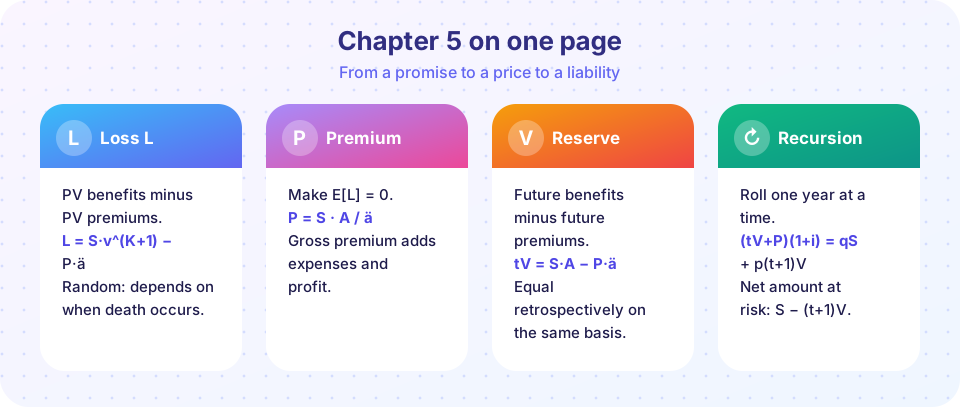
This chapter had one big idea and three tools. The big idea: price a promise by making the expected present value of what comes in equal the expected present value of what goes out. The tools: the net premium, the gross premium with expenses, and the reserve that records, at every moment, how far a policy has drifted from that balance.
What you will learn
- Recall every formula of the chapter in one place.
- Spot which tool a question needs.
- Check your understanding with ten mixed questions.
The chapter in one table
| Idea | Formula | When you use it |
|---|---|---|
| Loss at issue | L = S·v^(K+1) − P·ä(K+1) |
Defining the principle, studying risk |
| Equivalence principle | E[L] = 0 |
Setting any premium |
| Net premium | P = S·A / ä |
Benefit-only price |
| Gross premium | G = (S·A + e₀ + f·ä) / ((1−r)·ä) |
Real price with expenses |
| Prospective reserve | tV = S·A(x+t) − P·ä(x+t) |
Valuation at time t |
| Retrospective reserve | tV = (P·ä(x:t) − S·A¹(x:t)) / tE_x |
A check, or when history is easier |
| Recursion | (tV + P)(1+i) = q·S + p·(t+1)V |
Rolling reserves forward, profit analysis |
| Net amount at risk | S − (t+1)V |
What a death really costs |
Worked review example
A 30-year-old buys a 10-year endowment policy with sum 50,000. You want the premium and the reserve after 5 years. The method has four steps, and the code below carries them out.
- Build the survival model from the table (here the illustrative Makeham law).
- Compute
Afor the term part,nEfor the survival part, andä. - Premium =
S · (A + nE) / ä. - Reserve at
t = 5=S · (A + nE)evaluated at age 35 for the remaining 5 years, minusP · äat age 35.
Try it
Press Run (or Ctrl + Enter) to see the result here.
Program input · what you'd type while the program runs
Type the answers before you press Run, one per line. Each time the program reads a line (with input()), it gets the next line from this box.
Press Run (or Ctrl + Enter) to see the result here.
Program input · what you'd type while the program runs
Type the answers before you press Run, one per line. Each time the program reads a line (with input()), it gets the next line from this box.
Common misconceptions
"Pricing basis and reserving basis must be identical." They often differ: pricing is best-estimate plus margins, regulatory reserves use prescribed, prudent assumptions. Using a different basis can make reserves positive even at issue.
"A reserve only matters at the end of the year." Companies track it continuously for solvency and report it at least at every balance-sheet date.
Check your understanding
Quick check · 10 questions
of 10 answered You scored / 10 · perfect!
-
1. Which condition defines the equivalence principle?
The expected present value of premiums equals the expected present value of benefits. -
2. A whole life policy and a 20-pay whole life policy with the same sum insured and issue age: which has the larger annual premium?
The 20-pay policy collects premiums for only 20 years, so each premium is larger. -
3. The terminal reserve of a 20-year endowment with sum insured S at t = 20 is
At maturity the full sum is due. -
4. In the gross premium G = (S·A + e0 + f·ä) / ((1 − r)·ä), increasing the initial expense e0 will
More up-front cost must be recovered by a larger premium. -
5. The net amount at risk in policy year t+1 is
When the insured dies, the reserve for that policy is released, so the extra cost is the sum insured minus the reserve. -
6. Prospective and retrospective reserves are equal when
Both are derived from the equivalence principle, so with identical assumptions they must agree. -
7. If death probabilities are doubled while everything else is unchanged, the net premium for a term policy roughly
The benefit part doubles while the annuity changes only slightly, so the premium roughly doubles. -
8. Why do insurers need a reserve for a level-premium term policy?
The early surplus is the policyholder's prepayment for the more expensive later years. -
9. In the recursion, which quantity is multiplied by (1 + i)?
The fund at the start of the year, reserve plus premium, accumulates with interest. -
10. A negative net premium reserve for a policy is usually treated how in regulatory valuations?
Regulators generally do not allow a negative liability to be counted as an asset.
Summary
- Premiums come from the equivalence principle:
P = S·A/ä(net) and an expense-adjusted formula for the gross premium. - The prospective reserve
tVis future benefits minus future premiums; the retrospective reserve is the same number computed from the past. - The recursion and the net amount at risk explain how reserves move and where mortality profit comes from.
- Lower valuation interest always raises reserves.
Track your progress
Create a free account to tick off lessons and pick up where you left off on any device.
of Actuarial Mathematics lessons completed