


















Lesson 2 of 43 · Getting Started
What actuaries do
Learn the three core jobs of an actuary (pricing, reserving, risk management), the main fields, the control cycle, and price a simple policy in code.
If you buy car insurance, join a pension scheme or take out a life policy, a promise is made about money in the future. Someone has to decide how much to charge for that promise, how much to hold back so it can be kept, and what happens if the world turns out worse than expected. Those someones are actuaries. The profession is over 250 years old: the Equitable Life Assurance Society in London, founded in 1762, was a pioneer of pricing life cover by age and gave the title "actuary" to its chief officer.
This lesson gives you a map of the work. It also shows the first actual calculation, pricing a one-year life policy, so you see how little math you need to start and how many judgments surround it.
What you will learn
- The three core jobs of an actuary and an example of each.
- The main fields where actuaries work and how they differ.
- The actuarial control cycle that frames every project.
- How to price a one-year term policy from a death probability and an expense assumption.
Key terms
Claim: a request for payment under an insurance contract after a covered event.
Net (pure) premium: the premium that covers expected claims only, with no expenses or profit.
Gross premium: the premium actually charged, including expenses, commission and a profit margin.
Loading: the amount or percentage added to the net premium to reach the gross premium.
Assumption: a chosen value (such as a death probability or an interest rate) the calculation depends on.
Job 1: pricing
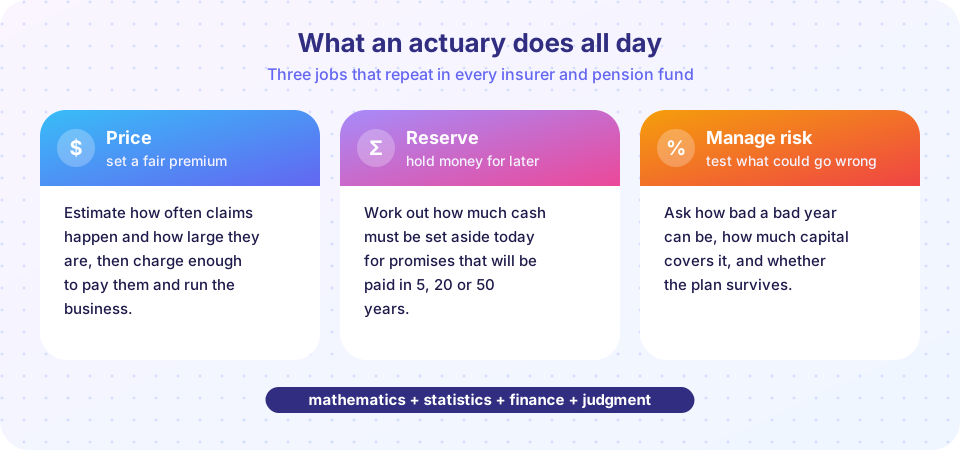
Pricing means finding a premium that is fair to the customer and sustainable for the insurer. The starting point is the expected cost of the claims. Suppose a company sells one-year term life insurance paying 100,000 on death. If a group of 40-year-olds has a probability of death within the year of 0.002 (two in a thousand), the expected claim per policy is 0.002 x 100,000 = 200. That 200 is the net premium.
The insurer then has costs: commissions, administration, regulation and a margin for profit and for bad luck. If these are 15% of the gross premium, the gross premium P must satisfy P - 0.15 P = 200, so P = 200 / 0.85 = 235.29. The customer pays about 235 so that the insurer receives 200 net of expenses to meet expected claims.
Press Run (or Ctrl + Enter) to see the result here.
Program input · what you'd type while the program runs
Type the answers before you press Run, one per line. Each time the program reads a line (with input()), it gets the next line from this box.
That last calculation previews the real difficulty: the death probability is an assumption, not a fact, and being 25% wrong on it moves the profit from a small gain to a loss. Judgment about assumptions is as important as arithmetic.
Job 2: reserving
When a policy is sold, the insurer receives premiums now but must pay claims later. For a one-year policy the gap is tiny. For a 30-year life policy, a pension or a liability insurance claim that takes years to settle, the insurer holds a reserve: a sum of money, invested, that together with future premiums will meet future claims on average. Reserving is also the actuary's way of answering "how much would we need today to be sure we can keep every promise?" We calculate life reserves in chapter 5.
Reserving matters to regulators too. If an insurer reserves too little, it may look profitable until the claims arrive, and then fail. Many insurance failures in history trace back to understated reserves, which is why actuaries often have a formal legal duty to sign off on them.
Job 3: managing risk
Even with a good premium and a good reserve, bad years happen: an earthquake, a pandemic, a stock-market crash that cuts the value of assets backing pension promises. Risk management asks how large a bad outcome can be, how likely it is, and how much extra capital to hold. Tools include stress tests (what if mortality is 20% worse?), simulation (run thousands of random futures), reinsurance (buy cover from another company) and diversification (spread risk over many independent policies).
Where actuaries work
| Field | Typical question | Time horizon |
|---|---|---|
| Life insurance | What premium for a 30-year policy at age 35? | decades |
| Health insurance | What will next year's medical claims cost per member? | 1-3 years |
| General (property and casualty) insurance | How large should reserves for unsettled car-accident claims be? | months to years |
| Pensions and benefits | Can the scheme pay everyone who retires over the next 60 years? | decades |
| Investment and banking | How risky is this portfolio of loans or bonds? | days to years |
| Enterprise risk management | What combination of events could threaten the whole company? | any |
| Data science and analytics | Which customers are most likely to cancel? | short |
The same core math sits under all of them: probability for the events, and interest for the timing. This course focuses on life contingencies and risk theory, then returns to pensions in chapter 8.
The actuarial control cycle
Actuaries describe a project as a loop, usually drawn as three connected steps:
- Specify the problem. What decision is this number for? Who will use it?
- Develop the solution. Choose a model, choose assumptions, calculate, test sensitivity.
- Monitor the results. Compare what actually happens with what the model predicted, and update.
The loop never ends. Mortality changes, interest rates move, new diseases appear, and the actuary adjusts the model. A good habit from the start of this course: after every calculation, ask "what assumption does this depend on, and what happens if it is wrong?"
Professionalism and ethics
Actuaries are professionals in the same sense as doctors and accountants. The professional bodies set examinations, require continuing education and publish codes of conduct that put the public interest and honest communication first. Typical duties include being competent for the task, being clear about uncertainty, and not letting a client or employer pressure you into misleading figures. A premium or reserve is a number with consequences for real people, so the profession treats it seriously.
Common misconceptions
"The premium is just the expected claim." That is the net premium only. The gross premium must also cover expenses and a margin for profit and risk.
"If the assumptions are reasonable, the answer is certain." The answer is only as good as the assumptions, and good practice always tests how much the result moves when they change.
"Actuaries only work in life insurance." The majority of actuaries work in life, health, general insurance and pensions, but a growing number work in banking, data science and consulting.
Try it
Plot how the gross premium for the policy above changes with the death probability and the expense ratio. The picture shows why even small changes in assumptions matter to the business.
Press Run (or Ctrl + Enter) to see the result here.
Program input · what you'd type while the program runs
Type the answers before you press Run, one per line. Each time the program reads a line (with input()), it gets the next line from this box.
Press Run (or Ctrl + Enter) to see the console output here.
No output.
Check your understanding
Quick check · 5 questions
of 5 answered You scored / 5 · perfect!
-
1. A one-year policy pays 50,000 on death. The probability of death in the year is 0.004. What is the net premium?
Net premium equals the expected claim, 0.004 x 50,000 = 200. -
2. Expenses are 20% of the gross premium and the net premium is 200. What is the gross premium?
P - 0.2P = 200 gives P = 200 / 0.8 = 250. Adding 20% to the net premium (240) is a common mistake, because the expense share is of the gross premium. -
3. Which step of the control cycle compares what happened with what the model predicted?
Monitoring closes the loop: the experience is compared with expectation and the assumptions are revised. -
4. Why does a life insurer hold a reserve for a 30-year policy?
Reserves bridge the timing gap between premiums received and claims paid, together with future premiums and investment income. -
5. Which statement about assumptions is best?
Assumptions are judgments. Good practice tests how much the answer moves when they change.
Summary
- Actuaries price products, reserve for future payments and manage risk.
- The net premium is the expected claim cost; the gross premium adds expenses and margins.
- Fields include life, health, general insurance, pensions, investment and enterprise risk.
- The control cycle (specify, develop, monitor) never ends because the world changes.
- Every number rests on assumptions, so always ask how sensitive the answer is.
Track your progress
Create a free account to tick off lessons and pick up where you left off on any device.
of Actuarial Mathematics lessons completed