


















Lesson 12 of 43 · Survival Models and Life Tables
The survival function and force of mortality
Learn S(x), the density f(x), the force of mortality mu(x), the probabilities t p x and t q x, and life expectancy, with de Moivre and Gompertz examples and code.
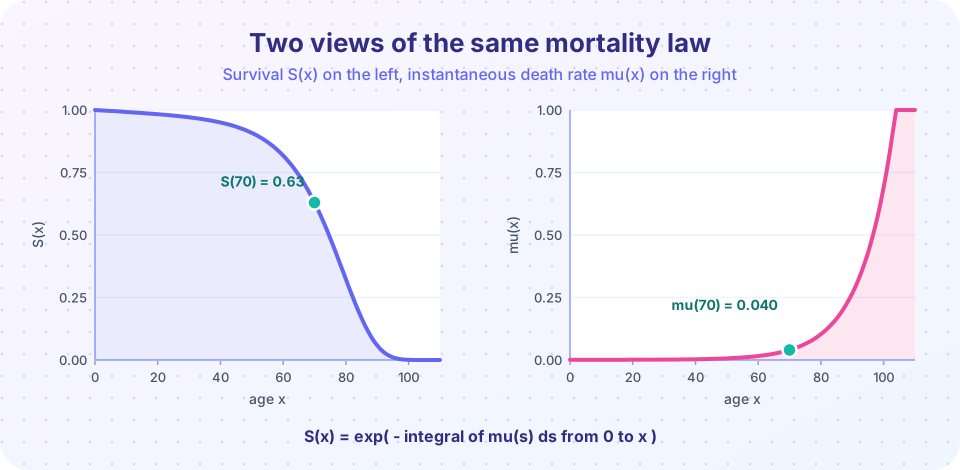
There are many equivalent ways to describe a lifetime, and actuaries move between them constantly. You can give the probability of surviving to each age (the survival function), the probability of dying at each age (the density), or the instantaneous rate of dying among those still alive (the force of mortality). Each determines the others. The force of mortality is the most useful in practice: it is directly interpretable ("at age 70, about 4% of those alive die within a year"), it is the parameter that mortality laws are written in, and it mirrors the force of interest you met in chapter 2.
This lesson builds the dictionary between the descriptions and the probabilities t p x and t q x that every later formula uses.
What you will learn
- The definitions of
S(x),F(x),f(x)andmu(x)and how they relate. - How to compute
t p x,t q xand the deferred probability frommu. - How the force of mortality builds
S(x) = exp(-integral mu). - How to compute life expectancy from the survival function.
Key terms
Survival function S(x): P(X > x), the probability a newborn survives to age x.
Density f(x): the density of the age at death; f(x) = -S'(x).
Force of mortality mu(x): f(x)/S(x), the instantaneous death rate at age x among survivors.
t p x: probability a person aged x survives t more years.
t q x: probability a person aged x dies within t years.
The four descriptions
Let X be the age at death. Then:
- Distribution function
F(x) = P(X <= x), and survival functionS(x) = 1 - F(x).S(0) = 1,Sdecreases, andS(x)tends to 0 for largex. - Density
f(x) = F'(x) = -S'(x). - Force of mortality
mu(x) = f(x) / S(x) = -S'(x)/S(x) = -d/dx ln S(x).
The last form is the key. Integrate both sides: ln S(x) = -integral from 0 to x of mu(s) ds, hence
S(x) = exp( - integral from 0 to x of mu(s) ds ).
Interpretation: for a small interval h, P(dies in the next h years | alive at x) ≈ mu(x) h. The force of mortality is a rate per year, like an interest rate. And just as v^t = exp(-integral delta) discounts money, S(x) is the "discount" for survival.
Worked example 1 (constant force). If mu(x) = 0.02 for all ages, then S(x) = exp(-0.02 x): an exponential lifetime with mean 50. Constant force means "no ageing": the chance of dying next year is the same at every age. It is a poor model for humans but excellent for machine failures from random shocks.
Worked example 2 (de Moivre). If mu(x) = 1/(110 - x) for 0 <= x < 110, then integral mu = -ln(110 - x) + ln 110, so S(x) = (110 - x)/110: everyone's age at death is uniform on 0 to 110. The rate rises as the survivors thin out. This law is unrealistic but its simple algebra makes it ideal for hand calculation and checking.
Probabilities for a person aged x
Condition on survival to x. The probability of surviving t more years is
t p x = S(x + t) / S(x) = exp( - integral from 0 to t of mu(x + s) ds ),
and of dying within t years is t q x = 1 - t p x. When t = 1 we drop the prefix: p x, q x. Two more building blocks:
- Deferred death. The probability a person aged
xsurvivestyears and then dies within the nextuyears ist|u q x = t p x - t+u p x = t p x * u q (x+t). - Density of the future lifetime. The density of
T(x)attist p x mu(x + t): survive tot, then die at that instant. Integrating it from 0 to infinity gives 1.
The multiplication rule t+u p x = t p x * u p (x+t) says that to survive t + u years you must survive t and then u more. Survival probabilities multiply along the timeline, just as discount factors do.
Worked example (de Moivre). For x = 60 under mu = 1/(110 - x): 5 p 60 = S(65)/S(60) = 45/50 = 0.9, 10 q 60 = 1 - 40/50 = 0.2, and the probability of surviving 5 years and then dying in the following 5 is 0.9 - 0.8 = 0.1.
Life expectancy
The complete expectation of life at age x is the mean of T(x):
e x = E[T(x)] = integral from 0 to infinity of t p x dt.
(Integrating by parts: E[T] = integral of P(T > t) dt.) For de Moivre at age 60: t p 60 = 1 - t/50, so e 60 = integral from 0 to 50 of (1 - t/50) dt = 25: half of the remaining 50 years. The curtate expectation counts only whole years survived: K(x) = floor(T(x)) has mean sum over k >= 1 of k p x. For smooth mortality, e x ≈ curtate + 1/2.
Press Run (or Ctrl + Enter) to see the result here.
Program input · what you'd type while the program runs
Type the answers before you press Run, one per line. Each time the program reads a line (with input()), it gets the next line from this box.
How mortality behaves: the shape of mu
For human populations mu(x) has a characteristic shape: high just after birth, falling to a minimum in childhood, a small hump in young adulthood (accidents), then an exponentially rising curve from the 30s onward. Gompertz noticed that the log of mortality is nearly a straight line in age during adult life, so mortality roughly doubles every 8 to 9 years (here every ln 2 / ln 1.1 = 7.3 years in the exponential part). That rule of thumb explains why insurance premiums for a 70-year-old are many times those for a 40-year-old.
Use the explorer to see how the three parameters shape the curves. It is a visual demonstration of the Gompertz-Makeham formula, not of any real population.
Common misconceptions
"mu(x) is a probability." It is a rate, and it can exceed 1 (at very old ages in some models). The probability of dying within a year, q x, cannot.
"t p x = S(t)." The survival probability for a person aged x uses the ratio S(x+t)/S(x), not S(t).
"Constant force means the person never dies." It means the chance of dying in the next instant is the same at every age, giving exponential lifetimes with no ageing.
Check your understanding
Quick check · 5 questions
of 5 answered You scored / 5 · perfect!
-
1. If S(x) = (100 - x)/100 for 0 <= x <= 100, what is 10 p 30?
S(40)/S(30) = 60/70 = 0.857143. -
2. If mu(x) = 0.02 for all x, then t p x equals
With a constant force, t p x = exp(-integral of 0.02 ds from 0 to t) = exp(-0.02 t), whatever the age x. -
3. Which formula is correct?
mu = f/S with f = -S'. The minus sign makes mu positive since S is decreasing. -
4. The probability a person aged x survives t years and then dies within the following u years is
Survive to t, minus survive to t + u, is the probability of dying in the interval (t, t+u). -
5. For the uniform (de Moivre) law on 0 to 110, the complete life expectancy at age 60 is
T(60) is uniform on (0, 50), with mean 25.
Summary
S(x) = P(X > x),f(x) = -S'(x),mu(x) = f(x)/S(x), andS(x) = exp(-integral of mu).t p x = S(x+t)/S(x) = exp(-integral of mu(x+s) ds);t q x = 1 - t p x.- Survival probabilities multiply along time:
t+u p x = t p x * u p (x+t). - Complete life expectancy is
e x = integral of t p x dt. - Real adult mortality roughly follows an exponential increase with age (Gompertz).
Next: Life tables
Track your progress
Create a free account to tick off lessons and pick up where you left off on any device.
of Actuarial Mathematics lessons completed