


















Lesson 12 of 46 · Memory and Retrieval Practice
Working memory: the mental workbench
Learn how working memory holds and manipulates information, why its capacity is small, how the Baddeley and Hitch model works, and how chunking lets experts do more.
Try to multiply 47 by 6 in your head. You probably split the problem: 40 times 6 is 240, 7 times 6 is 42, and 240 plus 42 is 282. While you did that, you held partial results in mind, kept track of the next step and ignored distractions. That mental workbench is working memory, and its small size is one of the most important facts about human learning. It limits how much a new idea can contain before it overwhelms you, which is why a good explanation breaks things into pieces.
This lesson explains what working memory is, how big it is, the model that psychologists use to describe it, and the tricks, especially chunking, that let experts seem to have a much bigger workbench than the rest of us.
What you will learn
- How working memory differs from the older idea of short-term memory.
- The four components in Baddeley's model and the evidence for each.
- How much working memory can hold, and why chunking changes the answer.
- What working memory limits mean for studying and teaching.
Key terms
Working memory: the limited-capacity system that temporarily holds and manipulates information for ongoing tasks.
Chunk: a unit of information that has meaning for you, such as a word, a date or a familiar pattern.
Phonological loop: the part of working memory that holds sounds and words, often by silent rehearsal.
Central executive: the control system that directs attention and coordinates the other parts.
Memory span: the longest list a person can repeat back correctly right after hearing it.
From short-term memory to working memory
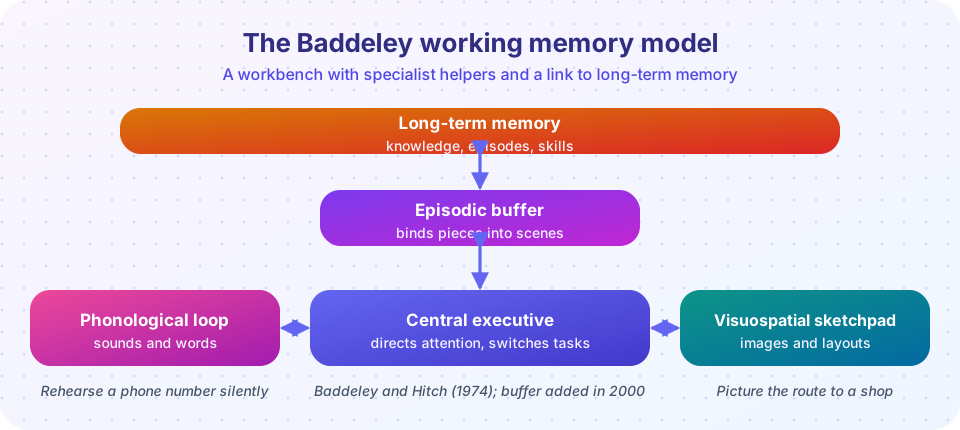
Early models treated short-term memory as a passive holding area. In 1974 Alan Baddeley and Graham Hitch argued that this was too simple, because people can hold some items while doing other mental work, which a single store could not easily explain. They proposed a working memory with several parts that actively process information.
The components
- The phonological loop holds speech-based information. Silently repeating a phone number keeps it alive: this "articulatory rehearsal" refreshes the trace in about two seconds' worth of speech. Evidence includes the phonological similarity effect (lists like "B, C, D, G, P, T" are harder to recall in order than dissimilar letters) and the word-length effect (short words are recalled better than long ones). If you are forced to repeat "the, the, the" aloud (articulatory suppression), the loop is occupied and memory for lists drops.
- The visuospatial sketchpad holds images and layouts, such as a map or the arrangement of furniture in a room. Tasks such as tracking a moving dot interfere with it, but not with the loop. That pattern of interference, where the two tasks hurt different systems, is part of the evidence for separate components.
- The central executive is not a store but a control system: it focuses and divides attention, switches between tasks and links working memory with long-term memory. Brain-imaging studies associate it with frontal regions.
- The episodic buffer, added by Baddeley in 2000, is a limited-capacity space that combines information from the other parts and from long-term memory into coherent episodes, such as a short story you just heard.
The model is not the only one. Nelson Cowan, for example, treats working memory as the activated part of long-term memory plus a focus of attention. What both approaches agree on is the limit of capacity.
How big is working memory?
In a famous 1956 paper titled "The Magical Number Seven, Plus or Minus Two", George Miller reported that people could hold about seven items in immediate memory. The paper also introduced the term chunk, a unit that can be a single digit or a whole familiar word. When researchers later prevented rehearsal and chunking, they found a smaller figure. In a 2001 review Nelson Cowan argued that the true capacity is around four chunks, with individual differences.
Two ideas explain the gap between seven and four. People often chunk without noticing (grouping digits in pairs), and rehearsal in the phonological loop extends what can be kept. Memory span tests, in which you hear a list and repeat it, usually involve those helping strategies.
Capacity differs between individuals. Researchers measure it with "complex span" tasks, in which a person has to remember items while doing a second task such as solving simple equations. Higher working memory capacity is correlated with reading comprehension, following directions and some kinds of problem solving. This does not mean it is fixed destiny: stress, fatigue, anxiety about the subject and multitasking all lower effective capacity, and strategies can raise how much you accomplish with it.
Chunking: how experts do more with the same workbench
Consider the string 1 4 9 2 1 7 7 6 1 9 4 5. As twelve separate digits it exceeds most people's span. As three well-known years, 1492, 1776 and 1945, it is three chunks. What changes is not the size of working memory, but what you can store in each slot, because chunks are built from knowledge in long-term memory.
The classic study is by William Chase and Herbert Simon (1973). Chess masters and beginners looked briefly at a chess position and tried to reproduce it. Masters were far better when the pieces were arranged as in a real game, and not much better than beginners when the pieces were placed at random. The masters were not equipped with a bigger working memory. They recognized familiar patterns that bundled several pieces into one chunk.
An even more striking example is the experiment by K. Anders Ericsson, Chase and Steve Faloon (1980). A student known as S.F., an average-memory runner, trained for about 230 hours over roughly twenty months and increased his digit span from around seven to 79 digits. His method was to code digits into running times and ages, which are familiar chunks, and then organize those into a hierarchy. When the material changed from digits to letters, his span fell back to normal. Skill with chunks does not transfer automatically to a different kind of material, which is a theme of the later chapter on transfer.
What working memory means for learning
- Cut the load. If a new topic has too many new elements at once, working memory overflows and nothing sticks. Break it down, and teach prerequisites first. Chapter 4 develops this as cognitive load theory.
- Write it down. External notes, diagrams and worked examples act as extra memory.
- Practice until it chunks. Facts and procedures practiced to fluency become single chunks that free up space for higher-level thinking. This is why times tables matter: they turn many steps into one.
- Avoid dual tasks. Reading while listening to speech both use the verbal systems and compete for the loop; background music with lyrics can hurt reading.
- Lower the pressure. Anxiety consumes working memory with worry, which is a documented contributor to maths anxiety effects.
Common misconceptions
"Everyone can hold seven items." Seven is a rough value for easy material and rehearsal. When chunking and rehearsal are controlled, the limit is nearer to four.
"Brain-training games enlarge working memory." People improve on the trained tasks, but meta-analyses (such as Melby-Lervåg and colleagues, 2016) find little evidence that the gains transfer to everyday cognition or school performance.
"Working memory is the same as intelligence." They correlate, but they are distinct constructs, and strategies matter a great deal.
Try it
First, a digit-span game. Digits appear one at a time. Type them back in order. The length rises by one after each success. The game ends after two mistakes in a row. It is a demonstration of span, not a test of ability. Try again using chunking (group the digits in your head) and compare.
Second, a chunking calculator in the console. It splits a digit string into groups and counts how many chunks you need to hold. If the groups are familiar (years, area codes), they count as one chunk each. Change the string or the group size to explore.
Press Run (or Ctrl + Enter) to see the console output here.
No output.
Check your understanding
Quick check · 5 questions
of 5 answered You scored / 5 · perfect!
-
1. Which component of Baddeley's model holds speech-based information through silent rehearsal?
The phonological loop stores sounds and words, refreshed by rehearsal. -
2. Cowan's review suggests working memory capacity is about:
When rehearsal and chunking are controlled, capacity is around four chunks. -
3. In Chase and Simon's chess study, why were masters not better at random positions?
Expert chunks are built from familiar patterns, so random arrangements remove the advantage. -
4. S.F. in Ericsson's study raised digit span to 79. What does this show?
His gains depended on a mnemonic coding of digits and did not transfer to letters. -
5. Which classroom practice best respects working memory limits?
Reducing the number of new elements at a time keeps load within capacity.
Summary
- Working memory holds and manipulates information for ongoing tasks and has a small capacity of about four chunks.
- Baddeley's model has a central executive, phonological loop, visuospatial sketchpad and episodic buffer.
- Chunking lets learners store more per slot, and expertise is largely a library of chunks.
- To learn well, cut unnecessary load, use notes and practice until skills become automatic.
Next: Encoding and elaboration
Track your progress
Create a free account to tick off lessons and pick up where you left off on any device.
of The Psychology of Learning lessons completed