


















Lesson 45 of 46 · Projects and Practice
Cheat sheet: the one-page recap
A one-page recap of the psychology of learning: eight habits, numbers worth remembering, a decision guide for common study situations and the cautions that go with them.
This page compresses the course into something you can read in five minutes and pin above your desk. It will not replace the lessons, because the reasons and the caveats are in them. But when you sit down to study and wonder what to do, this is the page to open.
What you will learn
- Eight habits that sum up the evidence on how people learn
- A few numbers worth remembering, and what they do and do not mean
- A decision guide for common situations
- The cautions that should travel with every rule
Key terms
Retrieval: recalling from memory without looking.
Spacing: gaps between sessions.
Interleaving: mixing problem types.
Calibration: matching confidence to performance.
Stretch: working at the edge of your current ability.
The eight habits
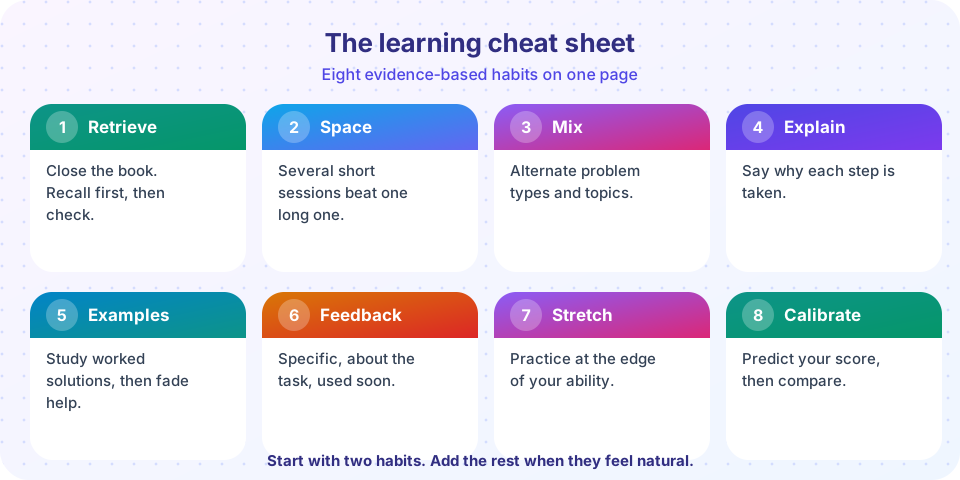
- Retrieve. Close the book and write or say what you remember before you check. Quizzing yourself beats rereading, even if it feels worse.
- Space. Spread sessions over days and weeks. For a test days to a few months away, a gap of roughly 10 to 30 percent of the time until the test is a good rule of thumb.
- Mix. Alternate problem types and topics, so that you practice choosing the method, not only using it. Block briefly at first when something is brand new.
- Explain. Ask why each step or fact is true, in your own words. Self-explanation turns studying examples into understanding.
- Use examples. When you are new to a procedure, study worked solutions first and then try faded ones. Reduce support as you improve.
- Get feedback. Look for feedback that is specific, about the task or the method, and quick enough to use. Praise about the person helps little.
- Stretch. Practice at the edge of your ability, with a specific goal for each session. Routine repetition leads to a plateau.
- Calibrate. Predict your score, test without notes after a delay, and compare. Treat fluency and familiarity with suspicion.
Numbers worth remembering
| Fact | What it means | Source |
|---|---|---|
| About 4 chunks | A typical limit on what working memory holds at once | Cowan, 2001 |
| About 20 seconds | How long unrehearsed items last in short-term memory | Peterson and Peterson, 1959 |
| 10 to 30 percent | Rough ratio of best study gap to time until the test, days to months ahead | Cepeda and colleagues, 2008 |
| About 63% against 20% | Approximate interleaved and blocked test scores a week later in one math study | Rohrer and Taylor, 2007 |
| d of about 0.4 to 0.5 | Average effect of feedback, with over a third of effects negative in one review | Kluger and DeNisi, 1996. Wisniewski and colleagues, 2020 |
| 26, 21, 18, 4 and under 1 percent | Variance in performance explained by deliberate practice in games, music, sports, education and professions | Macnamara and colleagues, 2014 |
| About 0.8 SD | Approximate effect of human tutoring, a lower figure than Bloom's 2 SD | VanLehn, 2011 |
Each number comes with caveats, which are in the lessons: study populations, short delays and the fact that averages are not predictions for a single person.
Which technique for which situation?
Choose a situation in the widget to see a short plan. It is a decision aid built from the lessons, not a personalized prescription.
Cautions that travel with the rules
- Most findings come from experiments with students and short delays. The advice is a strong starting hypothesis for you, not a law.
- Effects are averages. Individuals differ, so test a method on your own material when it matters.
- Methods need understanding first. Spacing and retrieval strengthen what you have understood. They do not substitute for clear explanations.
- Difficulty must be survivable. A desirable difficulty is one you can succeed at with effort.
- Practice scores are not learning. With help or AI available, check what you can do alone.
- Welfare matters. Sleep, health and motivation affect all of this. If learning problems are persistent and severe, consult a teacher or a qualified professional. This course gives educational information and not diagnosis or treatment.
Common misconceptions
"The best technique is the one that feels best." Feelings of fluency mislead. Use evidence and delayed tests.
"I need to do all eight habits at once." Start with retrieval and spacing, which have the strongest support.
"Cheat sheets replace understanding." They point to the lessons, which carry the reasons and the limits.
Check your understanding
Quick check · 4 questions
of 4 answered You scored / 4 · perfect!
-
1. Your test is in three days. Which plan best matches the cheat sheet?
Retrieval, mixing and spreading what time you have are the best-supported options. -
2. What is a rough rule of thumb for the best gap between study sessions when a test is days to months away?
Cepeda and colleagues found that the best gap grows with the time to the test, as a shrinking fraction. -
3. Why does the cheat sheet say to treat fluency with suspicion?
That is the illusion of knowing. -
4. What should you do first when you use an AI assistant to study?
Trying first preserves retrieval and generation.
Summary
- Eight habits: retrieve, space, mix, explain, use examples, get feedback, stretch and calibrate.
- A few numbers are worth knowing, always with their caveats.
- Match the technique to the situation, and start with retrieval and spacing.
- Treat every rule as a hypothesis to test on your own material.
Next: Further study
Track your progress
Create a free account to tick off lessons and pick up where you left off on any device.
of The Psychology of Learning lessons completed