


















Lesson 19 of 46 · Attention, Motivation and Mindset
Cognitive load: fitting learning to the mind
Understand cognitive load theory: intrinsic, extraneous and germane load, the worked example and split-attention effects, expertise reversal, and how to design clearer explanations.
Have you ever opened a page of instructions with a diagram on one side, a block of text on the other, and tiny letters linking them, and found yourself flipping back and forth with growing frustration? Or listened to a teacher who showed ten new terms, three formulas and a graph on one slide, and felt your brain simply stop? In both cases, the material may not be too hard in itself. It was presented in a way that used up the mental workbench before understanding could happen.
This is the central observation of cognitive load theory, developed by the Australian educational psychologist John Sweller and colleagues since the 1980s. The theory takes the small capacity of working memory (chapter 3) seriously and asks: how should instruction be designed so that the limited mental resources of a learner are spent on learning rather than on decoding the instruction?
What you will learn
- The three types of cognitive load and how they combine.
- Key instructional effects: worked examples, split attention, redundancy, modality and expertise reversal.
- Mayer's practical principles for multimedia learning.
- Where the theory is debated and how to use it wisely.
Key terms
Cognitive load: the demand that a task places on working memory.
Intrinsic load: the load that comes from the inherent complexity of the material and from how many elements must be processed together (element interactivity).
Extraneous load: load caused by how information is presented, which does not help learning.
Germane load: in classic accounts, the effort devoted to forming schemas. In newer accounts, it is the share of working memory used for the essential processing of the material.
Worked example: a fully solved problem with the steps shown.
The theory in brief
Sweller's argument runs like this. Working memory can handle only a few new elements at once, but long-term memory holds huge schemas, organized knowledge that can be brought into working memory as single chunks. Learning is the building of such schemas. A novice who has no schema must process every element separately and quickly overloads. An expert processes the same task as a few chunks.
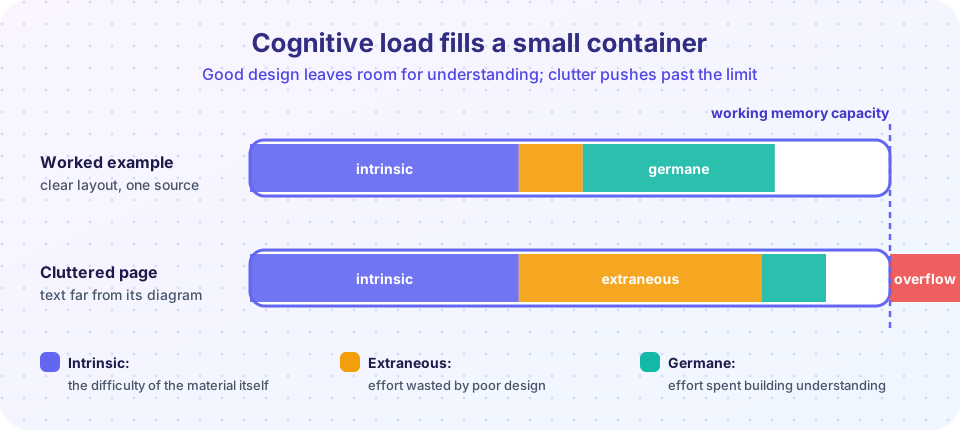
Three kinds of load add up in working memory.
- Intrinsic load depends on the material and the learner's prior knowledge. Learning to add fractions has low intrinsic load for someone who knows division and high for someone who does not. A key concept is element interactivity: topics whose elements must be understood together (such as the balancing of a chemical equation) are heavier than topics whose elements can be learned one by one (such as the names of bones).
- Extraneous load comes from poor design: confusing wording, irrelevant decoration, forcing learners to hunt for information. It should be reduced.
- Germane load, in the original theory, was the productive effort of building schemas. Sweller (2010) later suggested treating it as the working memory resources devoted to the intrinsic load rather than a third independent source, since it is hard to measure separately. Researchers still debate the best way to define and measure the three types.
The practical aim stays the same: keep the total within capacity, cut what is wasted, and keep the effort that builds understanding.
Instructional effects with good evidence
The worked example effect
Sweller and Graham Cooper (1985) found that students learning algebra who studied worked examples did better, and took less time, than students who spent the same time solving problems themselves. For a novice, solving a problem by search (trying things until something works) uses working memory on the search, not on learning the solution pattern. A worked example directs attention to the steps. This does not mean that solving problems is useless: it means novices should see examples first, then move gradually to problems.
Fading and completion problems
Alexander Renkl and others found that a good sequence is to give a full example, then one with a step removed (a completion problem), then more steps removed, and finally a full problem. This fading matches the shift from novice to more capable learner.
The expertise reversal effect
Slava Kalyuga and colleagues (2003) found that techniques that help beginners, such as detailed worked examples, can harm more experienced learners, because the guidance duplicates what they already know and has to be reconciled with their own schemas. The remedy is to adapt to the learner: more support for novices, less as expertise grows.
Split attention
Paul Chandler and Sweller (1991) showed that when a diagram and its explanatory text are separate and must be mentally integrated, learning suffers. Placing the labels within the diagram, at the points they refer to, removes the extra search. Whenever two sources of information are useless alone, put them together.
Redundancy
If the same information is presented twice in different forms, such as a diagram that fully explains itself plus text that says the same thing, the learner must process both, and the repetition can hurt. Reading text aloud while the same text is displayed is a common example. Remove what is not needed.
The modality effect
When explaining a diagram, presenting the explanation as narration rather than as on-screen text can reduce load, because spoken words use the auditory channel while the diagram uses the visual one (Mousavi, Low and Sweller, 1995). The effect is strongest when the material is complex, is paced by the presenter, and the text and diagram must be processed together.
Richard Mayer's multimedia principles
Richard Mayer's cognitive theory of multimedia learning, which overlaps with cognitive load theory, offers design guidelines drawn from many experiments:
- Coherence: remove interesting but irrelevant material, such as decorative graphics or "seductive details".
- Signaling: highlight the essential parts with cues such as headings and arrows.
- Spatial contiguity: put related text and images close together.
- Segmenting: split a complex lesson into learner-paced chunks.
- Pre-training: teach the names and basic parts first.
- Personalization: a conversational style can help a little.
Individual effects vary in size, and there are many boundary conditions, so treat them as defaults to test, not laws.
Debates and limits
Cognitive load theory has attracted useful criticism. Instrument problems exist: load is hard to measure, and the three-part split is not always clear. In 2006, Paul Kirschner, Sweller and Richard Clark argued that minimally guided instruction, such as pure discovery learning, does not work for novices. Critics such as Cindy Hmelo-Silver and colleagues (2007) replied that problem-based and inquiry learning, when properly scaffolded, can work. Meta-analyses (such as Alfieri and colleagues, 2011) found that discovery-based learning tends to be effective when learners get guidance and feedback, and weak when it is unguided. Manu Kapur's "productive failure" research found that struggling with a problem before instruction can improve conceptual understanding in some topics. The shared conclusion is that novices need structure, and that challenges should be tuned to the learner.
The theory also does not say that learning should be easy. Desirable difficulties (chapter 1) add effort that builds memory. The aim is to eliminate wasted effort, not all effort.
Common misconceptions
"Cognitive load theory means make everything easy." It means remove wasted effort, while keeping the effort of thinking.
"Worked examples are for weak students only." They help novices at any age. Experts do better with problems.
"More media is always better." Extra graphics, music or animation can raise extraneous load.
"Discovery learning always fails." Unguided discovery is weak for novices, while guided inquiry with feedback can work well.
Try it
First, a load balancer. Set the intrinsic difficulty of a topic, how much clutter the presentation has (extraneous), and how much effort goes into building understanding (germane). The bar shows the total against a fixed capacity. The numbers are arbitrary units: it is an illustration of the idea, not a measurement.
Second, a toy performance model. Learning success is modeled as an S-shaped curve that falls once total load passes capacity. Cutting extraneous load slides a learner from the overloaded zone to the productive zone. The shape of the curve is assumed, because real performance depends on the learner and the task.
Press Run (or Ctrl + Enter) to see the result here.
Program input · what you'd type while the program runs
Type the answers before you press Run, one per line. Each time the program reads a line (with input()), it gets the next line from this box.
Check your understanding
Quick check · 5 questions
of 5 answered You scored / 5 · perfect!
-
1. Which type of load should instructional design try to reduce?
Extraneous load comes from presentation and does not help learning. -
2. What did Sweller and Cooper (1985) find?
Worked examples reduce search, leaving working memory for schema building. -
3. A diagram sits on one page and its labels on another. Which effect is this?
Having to integrate separated sources increases load; put related information together. -
4. What does the expertise reversal effect say?
Detailed support can duplicate what experts already know and increase their load. -
5. Which statement reflects the current balanced view of discovery learning?
Meta-analyses suggest guidance and feedback make the difference.
Summary
- Cognitive load theory says instruction must fit limited working memory; load splits into intrinsic, extraneous and (debated) germane parts.
- Worked examples, integrated text and diagrams, and removal of redundant or decorative material reduce extraneous load.
- Expertise reversal means that support should fade as skill grows.
- The theory is debated; novices need structure, and challenge should still be tuned to the learner.
Next: Motivation theories
Track your progress
Create a free account to tick off lessons and pick up where you left off on any device.
of The Psychology of Learning lessons completed