


















Lesson 35 of 46 · Skills, Expertise and Transfer
Transfer of learning
Will what you learn carry over to new problems? A tour of identical elements, analogical transfer, near and far transfer, brain training and teaching for transfer.
Every school makes an unspoken bet: that what students learn in a lesson will be used outside it. We teach fractions so that people can handle recipes and loans. We teach proofs so that people reason clearly. We teach programming so that people think computationally. All this depends on transfer, the use of knowledge or skill in a situation other than the one in which it was learned. The uncomfortable finding of a century of research is that transfer is much rarer, and much more fragile, than teachers and learners expect.
This lesson follows the research from the early disputes over "mental discipline" to today's practical recommendations: how to make transfer more likely, and why brain-training games do not deliver what they promise.
What you will learn
- What transfer is, and the difference between near and far transfer
- Why early educators believed in mental discipline and what Thorndike found
- How analogies help, and why people often fail to use them
- What the evidence says about brain training, chess and music
- Practical ways to teach and study for transfer
Key terms
Transfer: applying knowledge or skill learned in one context to a different context.
Near transfer: transfer to a similar situation. Far transfer: transfer to a very different one.
Identical elements: Thorndike's idea that transfer happens to the extent that two tasks share specific components.
Analogical reasoning: using the structure of a familiar situation to solve a new one.
Preparation for future learning: judging learning by how well it helps you learn something new.
Formal discipline and Thorndike's reply
In the nineteenth century, a common view held that the mind is like a muscle. Studying Latin, geometry or logic was believed to train general mental powers such as reasoning and memory, whatever the content. This doctrine of formal discipline helped to justify school curricula for generations.
Edward Thorndike and Robert Woodworth (1901) tested the idea. People practiced a task, such as estimating the areas of rectangles, and were then tested on similar but different tasks, such as estimating the areas of triangles or the lengths of lines. Improvement transferred little, except where the tasks shared specific features. Thorndike's theory of identical elements says that transfer is a matter of shared components: the more two tasks have in common, the more learning one helps with the other. In a 1924 study of high-school students, Thorndike also reported that the particular subjects studied (Latin, say, or geometry) made little difference to later gains in general reasoning.
Thorndike was probably too pessimistic and too narrow. Some transfer clearly depends on shared principles, not shared surface features. In an experiment by Charles Judd (reported in 1908), boys practiced throwing darts at a target under water. One group had been taught the principle of light refraction first. When the water depth changed, those who knew the principle adapted faster. Knowing why helped them transfer.
Analogies: a bridge people do not cross by themselves
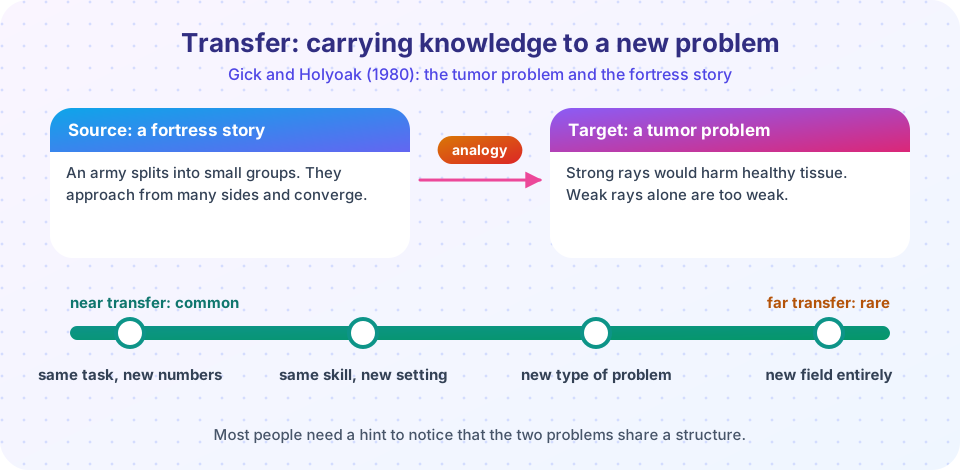
Karl Duncker's radiation problem (1945) goes like this. A patient has an inoperable stomach tumor. Rays strong enough to destroy it will also destroy the healthy tissue they pass through, while rays weak enough to spare tissue will not hurt the tumor. How can the tumor be destroyed without harming the tissue?
In a classic set of experiments, Mary Gick and Keith Holyoak (1980, 1983) first had people read a story about a general who wants to capture a fortress. The roads are mined so that a large force would set them off, so the general divides the army into small groups that approach by different roads and converge on the fortress. The story contains the solution to the tumor problem: send weak rays from several directions so that they converge on the tumor.
The results are among the most cited in the psychology of thinking.
- Only about one in ten people solved the tumor problem with no story at all.
- People who read the fortress story and were told to use it mostly solved the problem.
- People who read the story but were not told that it was relevant often did not notice. Only a minority transferred spontaneously.
The knowledge was in their heads. They failed to retrieve it because the two problems look different on the surface (army and fortress against rays and tumor). Retrieval of analogies is driven by surface similarity, while the useful match is structural. Gick and Holyoak found that people were more likely to form an abstract schema, and to use it later, if they read two analogous stories and compared them, and if they were asked to write down what the stories had in common. Later work by Dedre Gentner, Jeffrey Loewenstein and Leigh Thompson (2003) found the same in business students learning negotiation tactics: comparing two cases made them far more likely to apply the principle in a new negotiation than reading the cases separately.
A taxonomy: near, far and everything in between
Transfer is not one thing. Susan Barnett and Stephen Ceci (2002) proposed organizing it by two questions. What is transferred (a specific procedure, a general principle, an attitude)? And how far is the new situation from the old, along several dimensions: knowledge domain, physical setting, time gap, functional setting (school or work?), social setting (alone or in a group?) and mode (written or spoken)? Transfer between near points on all dimensions is common. The farther the target, the less likely transfer is, which is why a skill learned in a classroom can fail to appear at work.
David Perkins and Gavriel Salomon (1992) distinguished low-road transfer, which is automatic and happens with highly practiced skills in similar contexts (a driver adapting to a new car), from high-road transfer, which is deliberate and needs conscious abstraction (applying a design principle in a new field). The second kind has to be taught.
Does brain training transfer?
If transfer is hard, can we train general abilities directly? Commercial "brain training" says yes. The evidence says: improvement on the trained task, little beyond it.
- In 2010 Adrian Owen and colleagues published a large online study in Nature with more than 11,000 participants who trained for six weeks on tasks involving reasoning, memory or attention. People improved on the tasks they practiced, but there was no sign of improvement on untrained tasks, even closely related ones.
- Monica Melby-Lervåg and Charles Hulme, and later with Thomas Redick (2016), reviewed studies of working-memory training. They found short-term gains on similar memory tests and no convincing gains in reasoning, reading or arithmetic.
- Giovanni Sala and Gobet (2017) reviewed studies of chess and music instruction, where the hope was that the skill would improve general thinking. Their meta-analysis found little evidence of far transfer, with benefits mostly limited to the trained domain, and noted that studies with stronger designs found smaller effects. A review by Daniel Simons and colleagues (2016) reached a similar overall verdict about brain-training claims.
None of this says that chess, music or puzzles are not worth doing. They are enjoyable and build real skills. The claim that is not well supported is that they also make you better at unrelated things.
How to promote transfer
Research suggests several ways to improve the odds. They work on the "identical elements and shared principles" idea: make the shared structure visible and widen the contexts in which it is used.
- Teach the principle with several varied examples. Learn each idea in at least two different contexts, so the surface features vary and the structure stays the same.
- Compare cases. Put two examples side by side and ask what they have in common. Abstraction is built by comparison.
- Ask "when would I use this?" Practice recognizing which problems call for the method, as in interleaving (Chapter 6).
- Practice in the setting of use, or one similar to it, and include some variety.
- Space and retrieve. Transfer, like retention, benefits from spaced retrieval.
- Prepare for future learning. John Bransford and Daniel Schwartz (1999) argued that a good test of learning is whether it makes new learning easier. Exploring a problem before instruction (Chapter 5) is one way to prepare.
- Do not assume. If you want learners to apply an idea in a new setting, teach and practice that application explicitly.
The second demonstration is a toy model of Thorndike's identical elements. Each task is a set of elements, and transfer from one skill to another is the share of the target's elements that the learner already has. Real skills are not just lists, so this only shows the logic of the idea.
Press Run (or Ctrl + Enter) to see the result here.
Program input · what you'd type while the program runs
Type the answers before you press Run, one per line. Each time the program reads a line (with input()), it gets the next line from this box.
Common misconceptions
"Learning difficult things trains the mind in general." Evidence for general mental discipline is weak. Skills transfer to the degree that they share elements or principles.
"If someone knows the solution, they will notice when it applies." The Gick and Holyoak studies show that people often fail to retrieve relevant knowledge when surface features differ.
"Brain-training games make you smarter." They improve performance on the games, with little evidence of broad benefit.
Check your understanding
Quick check · 6 questions
of 6 answered You scored / 6 · perfect!
-
1. What does Thorndike's theory of identical elements predict?
The more two tasks share, the more learning one helps with the other. -
2. In Gick and Holyoak's experiments, why did many people fail to use the fortress story?
Retrieval is driven by surface similarity, while the useful match is structural. -
3. What did Judd's dart experiment suggest?
Learners who were taught the principle of refraction adapted faster to a different water depth. -
4. What was the main finding of Owen and colleagues' (2010) large online study?
Practice improved the practiced tasks, with no sign of transfer to others. -
5. Which teaching method best promotes transfer?
Comparison builds an abstract schema that can be recognized in new settings. -
6. What is far transfer?
Far transfer crosses large differences in domain, setting, time or other dimensions, and is rare.
Summary
- Transfer is the use of learning in a new situation. It is rarer and more fragile than people assume.
- Thorndike showed that transfer follows shared elements. Principles can help too, as in Judd's study.
- People often fail to notice analogies unless prompted. Comparing varied cases helps them form abstract schemas.
- Brain training and similar programs improve the trained tasks with little far transfer.
- To promote transfer, teach principles with varied examples, compare cases, practice in context and teach application explicitly.
Next: Chapter 7 review
Track your progress
Create a free account to tick off lessons and pick up where you left off on any device.
of The Psychology of Learning lessons completed