


















Lesson 3 of 46 · Getting Started
A short history of learning research
Trace how psychologists came to study learning, from Ebbinghaus and Pavlov through behaviorism and the cognitive revolution to modern memory science and neuroscience.
The scientific study of learning is only about 140 years old, but it has already gone through several dramatic changes of mind. Early researchers argued that psychology should study only what can be observed. Later researchers insisted that you cannot understand learning without studying the invisible thinking in between. Today most scientists accept a blend of both, together with the brain's biology.
Knowing this history is not just trivia. Each school of thought discovered something real, and each one overreached. Understanding where ideas came from will help you judge claims you meet in books, schools and social media, and it explains why this course is organized the way it is.
What you will learn
- The key figures and experiments in the history of learning research, with dates.
- What behaviorism got right and why the cognitive revolution challenged it.
- How neuroscience and classroom experiments reshaped the field.
- Why replication and large reviews matter in modern research.
Key terms
Behaviorism: the approach that explains behavior through observable stimuli, responses and consequences, without relying on inner mental states.
Cognitive revolution: the shift, starting in the 1950s, toward studying mental processes such as attention, memory and thinking.
Law of effect: Thorndike's principle that actions followed by satisfying results tend to be repeated.
Nonsense syllable: a made-up letter group such as "ZOV" used to study memory without the influence of existing meaning.
Replication: repeating a study to see whether the original result holds.
Memory in the laboratory: Ebbinghaus (1885)
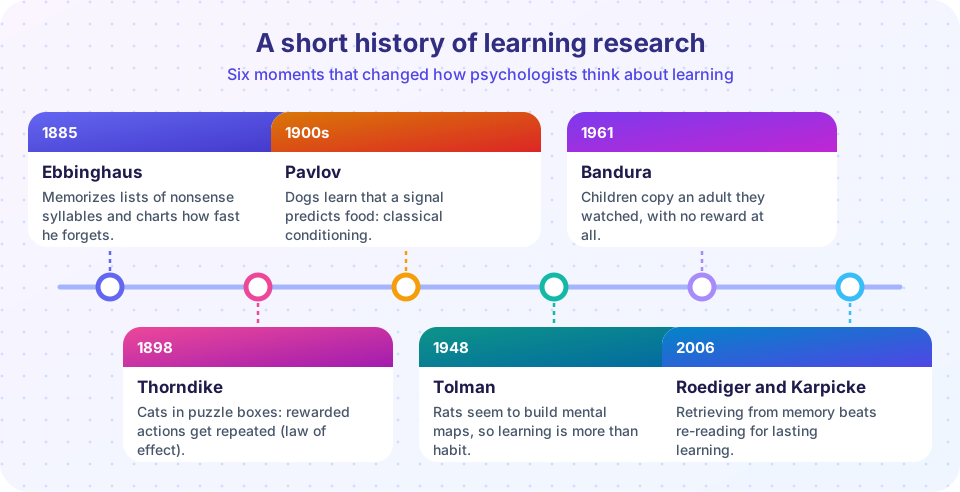
Before the 1880s, thinkers wrote about memory but nobody had measured it carefully. The German psychologist Hermann Ebbinghaus changed that. Working alone, he invented lists of nonsense syllables (consonant, vowel, consonant, such as "BAK" or "ZOV") so that his results would not be muddied by words he already knew. He memorized hundreds of lists himself, timed how long it took, and tested himself after different delays.
His book Über das Gedächtnis (1885, "On Memory") showed three lasting findings. Forgetting is fast at first and slows down. Longer lists take disproportionately longer to learn. And even when a list seems to be forgotten, relearning it is quicker than learning a fresh list, a measure he called savings. You will see his curve in chapter 3.
Ebbinghaus's study had a weakness, too. He was the only participant, and nonsense syllables are unlike real learning. Still, he proved that memory could be an experimental science.
The behaviorist era (about 1900 to 1950s)
Pavlov and classical conditioning
The Russian physiologist Ivan Pavlov won the 1904 Nobel Prize in Physiology or Medicine for work on digestion. While studying salivation in dogs, he noticed that the animals began to salivate at the sight of the lab assistant who fed them, before any food arrived. He turned that observation into a research program on "conditional reflexes", now called classical conditioning, and described how the effect builds up, fades and sometimes returns. You will study it in chapter 2.
Thorndike and the law of effect
In 1898 the American psychologist Edward Thorndike published research in which cats learned to escape from "puzzle boxes". At first they clawed and pushed at random. Over many trials, the time to escape fell. Thorndike proposed that actions followed by satisfying results are "stamped in". He later called this the law of effect. It became a foundation for operant conditioning.
Watson, Skinner and strict behaviorism
John B. Watson's 1913 article "Psychology as the Behaviorist Views It" argued that psychology should study only observable behavior. B. F. Skinner developed the approach with his 1938 book The Behavior of Organisms and an apparatus later nicknamed the Skinner box. He showed how the pattern of rewards (schedules of reinforcement) shapes behavior with remarkable precision.
Behaviorism gave learning research its experimental discipline. It produced real tools, from animal training to applied behavior analysis in classrooms and clinics. But as a complete account of learning it left out a lot: language, planning, insight, and the way people learn by watching.
Cracks in strict behaviorism
Several lines of research showed that learning could not be reduced to stimulus-response links.
- Wolfgang Köhler (1917) described chimpanzees solving problems by suddenly "seeing" the solution, such as stacking boxes to reach fruit. He called it insight.
- Edward Tolman argued that rats form cognitive maps. In experiments with Honzik (1930), rats that explored a maze without reward quickly performed as well as rewarded rats once a reward was introduced. Tolman called this latent learning. His 1948 paper "Cognitive Maps in Rats and Men" is a classic.
- Albert Bandura (Bandura, Ross and Ross, 1961) showed that children who watched an adult act aggressively toward an inflatable doll later copied specific behaviors, with no reward given to the children at all.
- Noam Chomsky's 1959 review of Skinner's book on language argued that children produce sentences they have never heard, which simple reinforcement could not explain.
The cognitive revolution (1950s to 1970s)
The new wave borrowed an idea from computers: the mind processes information. George Miller (1956) wrote about the limits of short-term memory. Donald Broadbent (1958) described attention as a filter. Ulric Neisser's 1967 book Cognitive Psychology named the movement. Richard Atkinson and Richard Shiffrin (1968) proposed a three-store model of memory, Fergus Craik and Robert Lockhart (1972) proposed that deeper processing gives stronger memories, and Alan Baddeley and Graham Hitch (1974) split short-term memory into a working memory with several parts.
In education, Jean Piaget described how children build schemas, and Lev Vygotsky (writing in the 1930s, widely read in the West after 1978) stressed learning through social interaction and support. Chapter 2 returns to both.
The brain and the classroom (1950s to today)
Two further strands run in parallel. First, neuroscience linked learning to physical change. In 1957 William Scoville and Brenda Milner reported that the patient known as H.M., who had parts of his temporal lobes removed, could no longer form new long-term memories of events. Donald Hebb (1949) had proposed that connections strengthen when neurons fire together, and Timothy Bliss and Terje Lømo (1973) later demonstrated long-term potentiation in the rabbit hippocampus.
Second, researchers brought memory science into the classroom and the lab together. Robert Bjork introduced "desirable difficulties" in the 1990s. In 2006 Henry Roediger and Jeffrey Karpicke published a striking study on the testing effect, showing that students who practiced retrieving a passage remembered more a week later than students who simply restudied it. In 2013, John Dunlosky and colleagues reviewed ten popular study techniques and rated practice testing and distributed practice as the highest in utility, and highlighting and rereading among the lowest.
Replication and the modern field
In 2015 a large team, the Open Science Collaboration, tried to replicate 100 published psychology studies. A much smaller share of the replications reached statistical significance than of the originals, and the effects were typically smaller. This does not mean psychology is worthless. It means single studies must be treated cautiously, and that findings backed by many replications (such as the testing effect and the spacing effect) deserve more trust than flashy one-off results. The next lesson shows how to read such evidence.
Common misconceptions
"Behaviorism was simply wrong." Its core findings about reinforcement and conditioning are robust and widely used. What failed was the claim that they explain everything.
"Psychology invented learning styles long ago." The idea of matching teaching to a preferred style became popular in the 1970s to 1990s, but controlled experiments have repeatedly failed to show a benefit.
"The brain is an exact computer." The information-processing metaphor is useful, but neurons, bodies and emotions are not just software.
Try it
First, a simulated learning curve in the style of Thorndike's puzzle boxes. The numbers are generated by a simple formula with random noise, so they show the shape of the pattern, not his data.
Press Run (or Ctrl + Enter) to see the result here.
Program input · what you'd type while the program runs
Type the answers before you press Run, one per line. Each time the program reads a line (with input()), it gets the next line from this box.
Second, an interactive timeline explorer. Click an era to see its main idea, key people, and what is still considered true today.
Check your understanding
Quick check · 5 questions
of 5 answered You scored / 5 · perfect!
-
1. Why did Ebbinghaus use nonsense syllables?
Nonsense syllables have little prior meaning, so they gave a cleaner measure of learning and forgetting. -
2. What did Thorndike's puzzle-box cats help establish?
Actions followed by satisfying results became more likely, which Thorndike called the law of effect. -
3. Which finding challenged strict behaviorism most directly by showing learning without reward?
Rats explored mazes without reward yet had learned the layout, showing learning that was not yet visible in behavior. -
4. What did the 2015 Open Science Collaboration project mainly show?
The replication rate was well below that of the original papers, which is why findings backed by many studies deserve more trust. -
5. Which two strategies did Dunlosky and colleagues (2013) rate as highest in utility?
Practice testing and distributed (spaced) practice received the top ratings; highlighting and rereading were rated low.
Summary
- Ebbinghaus (1885) made memory measurable; Pavlov, Thorndike, Watson and Skinner built the science of conditioning.
- Köhler, Tolman, Bandura and Chomsky showed that insight, maps, imitation and language need more than simple stimulus-response links.
- The cognitive revolution added information-processing models of attention and memory.
- Neuroscience linked learning to physical change, and classroom experiments established the testing and spacing effects.
- Replication projects remind us to trust well-replicated findings over one-off results.
Next: Reading the evidence
Track your progress
Create a free account to tick off lessons and pick up where you left off on any device.
of The Psychology of Learning lessons completed