


















Lesson 6 of 46 · How Learning Works
How learning works: the big picture
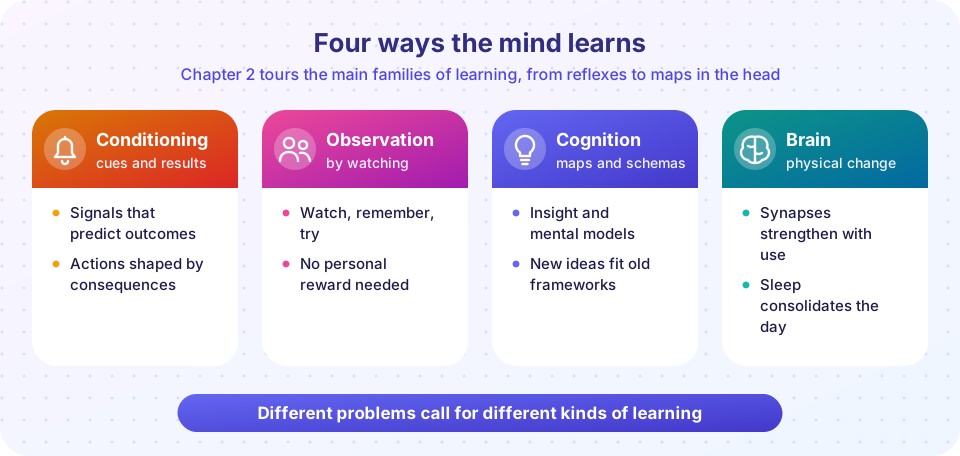
Chapter 2 overview: four routes to learning, conditioning, observation, cognitive insight and brain plasticity, with a quick scenario sorter to test your understanding.
Think about three things you learned recently. Maybe you learned to feel a twinge of dread when a particular notification sound plays. Maybe you picked up a cooking technique by watching a video. Maybe you suddenly understood a math idea after being stuck for a week. These three experiences feel completely different, and psychologists indeed explain them with different mechanisms. This chapter is a tour of those mechanisms.
What you will learn
- The four families of learning this chapter covers and how they differ.
- Which lesson covers which idea.
- How to tell the families apart in everyday examples.
The four families
Conditioning
Observation
Cognition
Brain
What each lesson covers
- Conditioning basics. Pavlov's classical conditioning and Skinner's operant conditioning: how we learn that signals predict events and that actions have consequences. You will also run a simple model of how associations grow.
- Observational and cognitive learning. Bandura's studies of learning by watching, Tolman's rats and their mental maps, Köhler's insight, and Piaget and Vygotsky on how thinking develops.
- The brain and plasticity. Neurons, synapses, Hebb's rule, the hippocampus, sleep, and the "neuromyths" that float around popular education.
- Chapter 2 review. One picture, a recap and ten questions.
How the families fit together
It is tempting to ask "which type of learning is the real one?". The better question is "which one is doing most of the work in this situation?". Learning to fear dogs after being bitten is largely conditioning. Learning to bake bread from a video is mostly observation plus practice. Understanding why bread rises is cognitive: you need a mental model of yeast, gas and gluten. Underneath all three, the brain changes: synapses strengthen, circuits reorganize and, during sleep, the day's learning is replayed and stabilized.
Key idea for the whole chapter. The families are tools for thinking, not boxes that real learning neatly fits into. Skilled teachers and learners combine them on purpose: a worked example (observation), practice with feedback (conditioning-like shaping), a concept map (cognitive) and a good night's sleep (brain).
Why these families matter for study habits
The families are not only for textbooks. Each one suggests something practical.
- From conditioning: feedback should be immediate and specific, and the emotional tone of studying matters. If every session ends in dread, you may condition yourself to avoid the subject. Pair practice with small, honest signs of progress.
- From observation: learn from good models. Watch an expert solve a problem while thinking aloud, then try one yourself. A strong model shows not only the answer but also the mistakes and repairs along the way.
- From cognitive learning: build understanding, not just habits. Draw the map, explain the why, and connect the new idea to something you already know. Insight is more likely after serious preparation.
- From the brain: connections strengthen with repeated, spaced use, and sleep helps to consolidate. Plan to revisit material over several days rather than once.
A useful exercise is to take something you are learning now and ask which family is doing the most work, and which family you are neglecting. A student learning a musical instrument, for example, might discover that they are doing plenty of repetition (conditioning-like practice) but little listening to expert recordings (observation) and almost no thinking about the structure of the music (cognition).
Try it
Here is a scenario sorter. For each situation, pick the family that seems to be doing most of the work, then see an explanation. There are sometimes good arguments for more than one family; that is the point.
Check your understanding
Quick check · 4 questions
of 4 answered You scored / 4 · perfect!
-
1. Learning that a notification sound predicts a message is mainly:
A neutral cue becomes a signal for an outcome because the two occur together. -
2. Learning to tie a knot by watching someone else is mainly:
Observational learning means learning from a model without trying it first. -
3. What is the best way to think about the four families of learning?
Real learning mixes association, observation, understanding and brain change. -
4. Which lesson in this chapter covers neurons and synapses?
The brain and plasticity lesson explains neurons, synapses and Hebb's rule.
Summary
- Learning comes in four overlapping families: conditioning, observation, cognition and brain change.
- Each family explains different everyday experiences.
- Skilled learning combines them, so ask which one is doing most of the work.
- The rest of the chapter takes each family in turn.
Next: Conditioning basics
Track your progress
Create a free account to tick off lessons and pick up where you left off on any device.
of The Psychology of Learning lessons completed