


















Lesson 37 of 46 · Learning Technology and Projects
Chapter 8 overview: learning technology
What technology can and cannot do for learning: Clark's delivery-truck argument, evidence on online learning and laptops, and a preview of multimedia, adaptive and AI tools.
Every new technology arrives with a promise to transform education. Film was going to replace textbooks, radio and television were going to bring great teachers to every village, computers would individualize instruction, MOOCs would put elite universities online for everyone, and now AI assistants promise a personal tutor for each learner. History has been less kind than the forecasts, but it has not been empty: some technologies do help, and the reasons are instructive. This chapter asks what the psychology you have learned so far says about when a tool helps.
What you will learn
- The long-running argument about whether media affect learning
- What the evidence says about online learning, laptops and note-taking
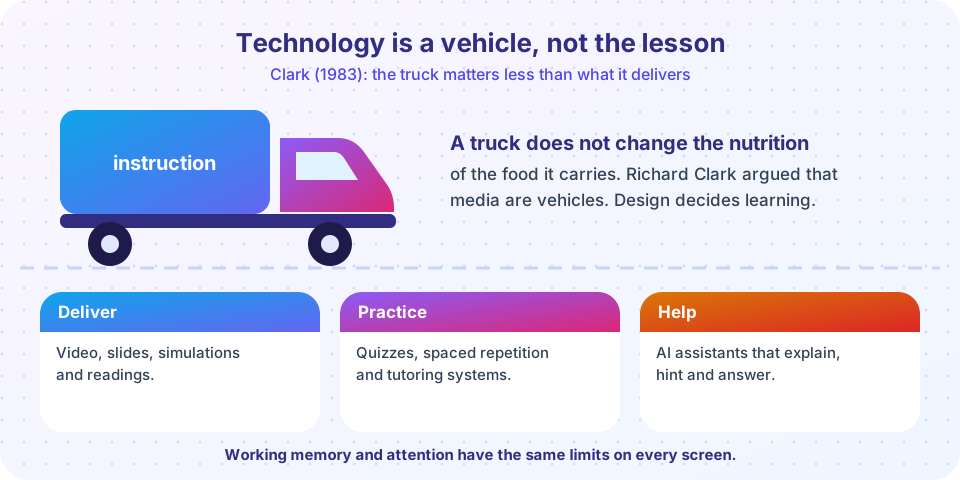
- Three roles technology can play: deliver, practice and help
- Questions to ask of any learning tool, based on the earlier chapters
Key terms
Educational technology: tools such as video, software and online platforms used to support teaching and learning.
Blended learning: a mix of online and face-to-face instruction.
Intelligent tutoring system (ITS): software that models a learner's knowledge and gives step-by-step help.
Cognitive offloading: using an external aid, such as a notebook or a search engine, to reduce mental demands.
MOOC: massive open online course.
Does the medium matter?
In 1983 the educational psychologist Richard Clark published a provocative article, "Reconsidering research on learning from media". He argued that decades of comparisons between media (television against lectures, computers against textbooks) found no benefit that came from the medium itself. Instead, he said, benefits came from the instructional method used, such as good examples and feedback, which could be delivered by any medium. His memorable image was the delivery truck: the truck carries the groceries but does not change the nutrition of the food.
Robert Kozma (1994) replied that media do differ in what they can do: only a simulation can let you vary a physical parameter and watch the result, and only an animation can show change over time. The debate has not been "won" by either side, but it left a useful rule. Ask what the technology makes the learner do. Putting a lecture on video changes little. Letting students explore a simulation, answer questions with instant feedback, or review facts on a spaced schedule can change a lot, because these use methods from this course that a human teacher cannot easily deliver at scale.
What the evidence says so far
- Online and blended learning. A review for the US Department of Education (Barbara Means and colleagues, 2010) found that students in blended courses did somewhat better on average than in face-to-face courses, while fully online courses were not reliably different from face-to-face ones. The authors noted that the blended advantage was linked to extra time on task and additional materials, not just to the technology.
- MOOCs. Large open courses attracted millions of learners, but completion rates were typically low, often below ten percent. Most learners who enroll are not aiming to finish, though the figures show how hard it is to sustain motivation without structure and contact.
- Laptops in class. Faria Sana, Tina Weston and Nicholas Cepeda (2013) found that students who multitasked on a laptop during a lecture comprehended less, and so did students sitting near them who could see the screen.
- Typing or handwriting notes. A 2014 study by Pam Mueller and Daniel Oppenheimer reported that handwriting beat typing for conceptual understanding, because typists transcribe instead of summarizing. Later replications have found weaker or no differences, so the sensible reading is that how you take notes (processing and not copying) matters more than the tool.
The pattern is typical of this field: tools produce small average effects that vary with how they are used.
Three roles for technology
Questions to ask
Watch out for
Convenient is not the same as effective
What each lesson covers
- Multimedia learning shows how to combine words and pictures without overloading working memory.
- Adaptive tutoring and spaced-repetition software explains how software can personalize practice and schedule reviews.
- AI and learning looks at what the early evidence says about generative AI as a helper and as a shortcut.
- Chapter 8 review pulls it together.
Four questions to ask of any tool
- Does it make me retrieve, practice and get feedback? Tools that make learners do more of what research supports are better than tools that merely present material.
- Does it respect working memory? Cluttered screens, decorative animation and text read aloud over identical text on screen add load without adding learning.
- Will I be able to do it without the tool? Practice scores can measure the tool's help. What you can do alone is the measure of your learning.
- Is there evidence beyond the marketing? Look for independent, controlled studies, with a measure of learning that was not the tool's own built-in score.
A word on evidence
Technology studies often have limits that make strong conclusions risky. Many are short, run by the developers, compared against weak alternatives (no instruction at all) and measured by tests that match what the software practices. Treat early claims as hypotheses. The fast pace of change is another problem: by the time a rigorous study of one product is published, the product has changed.
Check your understanding
Quick check · 4 questions
of 4 answered You scored / 4 · perfect!
-
1. What was Clark's (1983) delivery-truck argument?
He argued that comparisons between media found no effects of the medium itself. -
2. What did Kozma add to the debate?
Some activities are only possible with certain media. -
3. According to Sana, Weston and Cepeda (2013), what happened to students near a classmate who multitasked on a laptop?
The distraction affected peers who could see the screen. -
4. Why is a high practice score with a learning tool not enough evidence that learning occurred?
A later test without the tool is the real measure of learning.
Summary
- Clark argued that the medium is a vehicle and the method carries the benefit. Kozma pointed out that some media enable activities that others cannot.
- Evidence on online learning, MOOCs, laptops and note-taking shows small, variable effects that depend on how tools are used.
- Technology helps most when it makes learners retrieve, practice with feedback and see well-designed material.
- Ask whether you can perform without the tool, and look for independent evidence.
Next: Multimedia learning
Track your progress
Create a free account to tick off lessons and pick up where you left off on any device.
of The Psychology of Learning lessons completed