


















Lesson 32 of 46 · Spaced Practice and Study Strategies
Chapter 6 review: spaced practice and study strategies
Review spacing, interleaving, practice testing and metacognition with a recap table, a one-picture summary, a weekly study routine and a ten-question quiz.
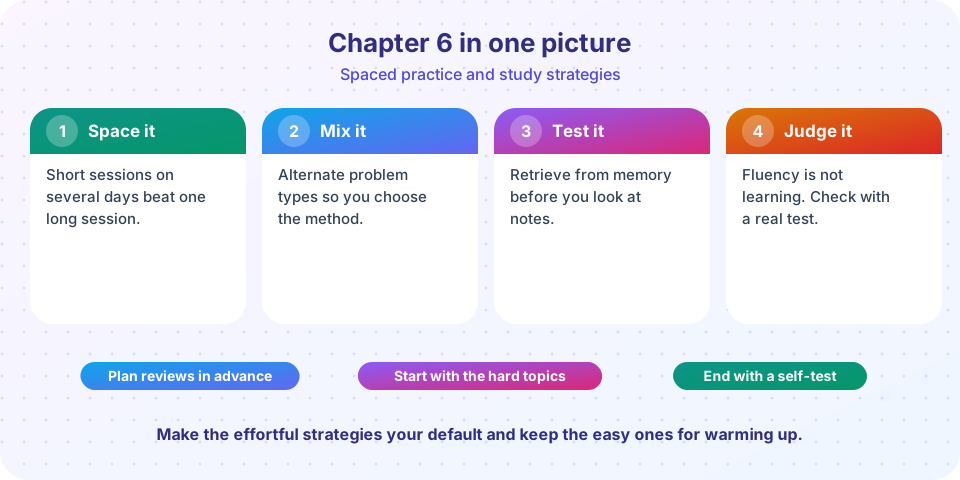
This chapter turned the science of memory into choices you can make tomorrow. Spacing, mixing, self-testing and honest self-assessment are the four pillars. Here they are in one place, followed by a routine that combines them and a quiz to check what stuck.
What you will learn
- The key findings of the chapter in a single table
- How to combine the techniques into one weekly routine
- Which ideas to apply first, and which cautions to remember
Recap table
| Idea | Who and when | Key finding | Caveat |
|---|---|---|---|
| Forgetting curve | Ebbinghaus, 1885 | Forgetting is steep, then slows. Reviews flatten it | One participant, nonsense syllables |
| Spacing effect | Cepeda and colleagues, 2006 and 2008 | Spread sessions beat cramming at equal study time. Best gap grows with the test delay | Best gap depends on material. About 10 to 30 percent of the interval is a rough rule |
| Long-term spacing | Bahrick and colleagues, 1993 | Longer gaps gave better retention over years | Small sample of four people |
| Spacing feels worse | Kornell, 2009 | Most learners did better spaced but did not believe it | Based on flash-card tasks |
| Interleaving | Rohrer and Taylor, 2007. Kornell and Bjork, 2008 | Mixed practice scores lower in practice but higher later | Weak or negative for some verbal material. Block briefly at first |
| Study technique ratings | Dunlosky and colleagues, 2013 | Practice testing and distributed practice rated highest. Rereading, highlighting, summarizing lowest | Ratings are judgments from the evidence, which is thin for some techniques |
| Testing effect | Roediger and Karpicke, 2006 | Retrieval practice beat rereading after a week | Rereading won at five minutes |
| Judgments of learning | Koriat and Bjork, 2005. Nelson and Dunlosky, 1991 | Fluency misleads. Delayed, cue-only judgments are accurate | Calibration varies between people |
| Desirable difficulties | Bjork, 1994 | Some effort-raising conditions improve long-term learning | A difficulty is desirable only if you can succeed with effort |
Putting it together: a weekly routine
Here is one way to combine the techniques. Adjust it to your subject and your calendar.
- Monday: first pass. Learn the new material in a block, with a worked example or two. Take brief notes.
- Tuesday: first review. Without notes, write down everything you remember. Then check, and mark the gaps.
- Thursday: mixed practice. Do problems from this week and earlier weeks, shuffled. Before each, say which method you will use.
- Saturday: delayed self-test. Predict your score, take a closed-book quiz on the whole unit and compare.
- Next week: repeat the cycle with new material, and bring the weak items from the Saturday test into the Thursday set.
This routine uses spacing (sessions on different days), retrieval (steps 2 and 4), interleaving (step 3) and calibration (step 4). It is built from the research but is not itself a tested program, so treat it as a template to try.
Quick rules
- Start the retrieval. Close the book before you open it.
- Spread wider when in doubt. A gap that is slightly too long costs less than one that is too short.
- Do not trust fluency. A smooth session may be a weak one.
- Use easy methods for orientation only. Skimming and highlighting can help you plan what to test.
- Keep the plan simple enough to follow. A routine that you actually keep beats a perfect one that you abandon.
Cautions
Three limits apply to everything in this chapter.
- Most studies are short and use students. The advantages shown after a week do not guarantee the same advantage after a year or for other age groups.
- Averages are not individuals. Some people do better with a different pattern, and you can only find out by checking.
- Spacing, testing and interleaving all need initial understanding. They strengthen what you have learned. They do not replace good explanations, which you studied in Chapter 5.
Common misconceptions
"Cramming does not work at all." It works for a test tomorrow. The cost appears later, in how much you keep.
"The best technique is the same for everyone." The ratings describe the average pattern across many learners.
"If I use these methods I will feel like I am learning more." Often the reverse is true. Expect the feeling of effort.
Check your understanding
Quick check · 10 questions
of 10 answered You scored / 10 · perfect!
-
1. A student studies the same amount as a friend but in four sessions across two weeks while the friend studies in one evening. One week after both finish, who is likely to remember more?
At equal study time, spacing usually gives better retention after a delay. -
2. Which finding supports the claim that spacing feels worse than it is?
That mismatch appeared in Kornell's flash-card study. -
3. In Rohrer and Taylor's (2007) study, how did the blocked group do during practice and on the later test?
Blocked practice looked better while practicing but did poorly a week later. -
4. Which technique earned a low utility rating from Dunlosky and colleagues?
Rereading gave small benefits and was usually outperformed by retrieval practice. -
5. What does the delayed-JOL effect recommend?
Delay and retrieval make the judgment depend on real evidence. -
6. Which of these is an example of interleaving?
Mixing problem types forces you to choose the method each time. -
7. A student feels sure she knows a chapter after rereading it three times. What is the most likely issue?
Rereading produces familiarity that feels like knowing, without retrieval practice. -
8. What did Bahrick's family study find about gaps of 14, 28 and 56 days?
Despite similar learning at first, the longest gap produced the best retention over the years. -
9. Why does a desirable difficulty need to be 'successful with effort'?
If you cannot succeed even with effort, you learn little, and the difficulty is not desirable. -
10. Which first step best begins a review session according to this chapter?
Retrieval before rereading strengthens memory and shows you your real gaps.
Summary
- Space sessions, mix problem types, test yourself and check your judgments against evidence.
- Spacing and testing earned the strongest ratings. Fluent, comfortable methods are often weak.
- Expect effortful methods to feel harder. That feeling is not a sign of failure.
- A simple weekly cycle of first pass, review, mixed practice and a delayed self-test combines all four ideas.
- The next chapter moves from studying facts to building skills: what makes experts, and when learning transfers.
Track your progress
Create a free account to tick off lessons and pick up where you left off on any device.
of The Psychology of Learning lessons completed