


















Lesson 14 of 46 · Memory and Retrieval Practice
Forgetting and interference
Understand why memories fade: Ebbinghaus's forgetting curve, decay versus interference, cue-dependent forgetting, context effects, and what you can do about each.
You walk into the kitchen and cannot remember why. You meet someone at a party and have forgotten their name by the time you have finished shaking hands. You studied hard for a test two weeks ago, and now a question about that topic looks unfamiliar. Forgetting is so common that it can feel like a flaw in the system. But forgetting is also a normal, even useful, part of memory: a brain that kept every detail would be overwhelmed. The question for a learner is not "how can I never forget?" but "how can I keep what matters, and how can I find it when I need it?"
In this lesson you will meet the curve that started the science of forgetting, the main explanations of why memories fail, and the surprising finding that many "forgotten" memories are still in there, waiting for the right cue.
What you will learn
- The shape of the forgetting curve and the idea of memory stability.
- The difference between decay, interference and cue-dependent forgetting.
- Evidence from Tulving and Pearlstone, Godden and Baddeley, and Jenkins and Dallenbach.
- Practical steps to reduce forgetting.
Key terms
Forgetting curve: a graph showing how the amount remembered falls as time since learning increases.
Interference: forgetting because other memories compete with the target memory.
Proactive interference: old learning disrupts new learning. Retroactive interference: new learning disrupts old.
Retrieval cue: anything (a word, a place, a mood) that helps you reach a stored memory.
Availability versus accessibility: whether a memory is stored versus whether you can currently retrieve it.
The forgetting curve
In 1885 Ebbinghaus reported how much he could still recall of lists of nonsense syllables after intervals from twenty minutes to a month. He found that forgetting was fast at first and then slowed: he lost around half within an hour or so and a large share within a day, but the later losses were small. He also showed that relearning a list was quicker than learning a new one, even when he could not recall any of it. In 2015 Jaap Murre and Joeri Dros repeated the experiment with a single participant over a similar schedule and reproduced the general shape, with an interesting bump after 24 hours that may be linked to sleep.
A convenient simplified description is exponential decay:
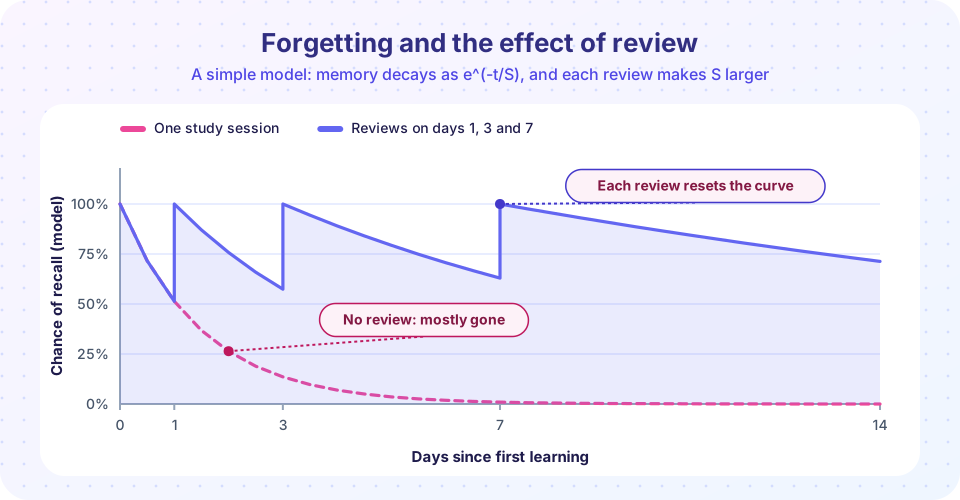
retention R = e^(-t / S)
where t is the time since learning and S is the stability of the memory. A bigger S means a flatter, slower curve. Real forgetting is better described by a power-law shape than a perfect exponential, and the numbers depend on the material, but the model captures the key idea: each successful review increases stability, which is why the dashed curve in the picture drops fast and the reviewed curve gets flatter every time. (The model is a simplification for explanation, not a fit to data.)
Two practical points follow. First, the steepest loss is right after learning, so a quick review soon after is valuable. Second, material that is meaningful, organized and used again forgets more slowly. The same pattern appears for facts, vocabulary and skills, though the speeds differ greatly.
Why do we forget?
Decay, or just fading
An old idea says that unused memory traces simply fade with time. Decay is hard to prove, because during any delay, other things happen. In a classic 1924 study, John Jenkins and Karl Dallenbach had two students learn syllables and then either sleep or stay awake for several hours. Recall was better after sleep, which suggests that time itself is not the whole story: what happens in the interval matters. Waking activity apparently interferes, while sleep protects and consolidates.
Interference
Memories compete. If you have learned a friend's old phone number and then a new one, the old one may keep popping up (proactive interference). After learning Spanish vocabulary, you may find French words are harder to retrieve (retroactive interference). Interference is stronger when the competing material is similar, which is why studying two similar subjects back to back can cause confusion (a good reason to space them out and to practice discriminating between them).
Benton Underwood (1957) analyzed many verbal-learning studies and concluded that much of the forgetting that was usually attributed to time was actually due to proactive interference from earlier lists learned in the same session. Participants who had learned many earlier lists forgot much more than those who were fresh.
Cue-dependent forgetting
Perhaps the most important explanation for learners is this: memories are often stored but not currently reachable because the right cues are missing. Endel Tulving and Zena Pearlstone (1966) had people study lists of words from categories such as animals and buildings. Some were asked for free recall, and others were given the category names as cues. The cued group remembered much more. The words had not been lost, they were available but not accessible without the cue.
Context is also a cue. Duncan Godden and Alan Baddeley (1975) had deep-sea divers learn word lists either on the beach or underwater and recall them in either the same or a different place. Recall tended to be better when the learning and testing environments matched. Later research shows that context effects are real but often modest, and are larger when the context is distinctive and when people have not been given other good cues. You do not need to study in exactly the exam room, but varying the settings in which you practice (and recalling the context to yourself) is a cheap way to create more routes back to the memory.
Other causes
- Failure to encode. Many "forgotten" things were never attended to. You cannot forget what you did not notice, and the coin example above shows this.
- Retrieval-induced forgetting. Practicing some items can make related items harder to remember (Anderson, Bjork and Bjork, 1994), a cost to consider when practicing selectively.
- Misinformation and reconstruction. Elizabeth Loftus and John Palmer (1974) found that people who heard the verb "smashed" estimated higher speeds for a filmed car collision than those who heard "hit". Memory can be altered by later information.
- Motivated forgetting. People sometimes avoid thinking about unpleasant memories, but claims that traumatic memories are routinely "repressed" and recovered remain controversial among researchers.
What can you do about it?
- Review early, then at widening gaps. The curve says the first review is the most valuable. Chapter 6 develops spaced practice.
- Test yourself rather than reread. Retrieval strengthens the memory and the cues (next lesson).
- Reduce interference. Separate similar topics, sleep after studying, and avoid cramming a second similar subject immediately afterward.
- Build many cues. Link new knowledge to examples, images, places and other concepts, and vary your study context.
- Pay attention. If it matters, give it a moment of real notice and a reason to remember.
Common misconceptions
"Forgotten means gone." Cue-dependent forgetting and savings show that forgotten material often remains stored.
"Forgetting is always a failure." It helps clear outdated information, such as where you parked yesterday.
"The curve means I will forget 70 percent in a day." Specific percentages depend on the material and tests. The shape, steep then flat, is the robust part.
Try it
First, a forgetting-curve calculator. Pick a stability S (in days) and see the chance of recall over time with the simple exponential model. Then use the "review" button: each review raises S by a factor you choose. The model is a simplification meant for exploration.
Second, a toy model of spacing. A memory's stability grows more when a review happens at a moment when it is harder to recall (lower retrievability). We compare three reviews squeezed together right after learning with three reviews spread over the first week. The rule that "harder retrieval gives more benefit" is a simplified model of desirable difficulties, and the numbers are illustrative only.
Press Run (or Ctrl + Enter) to see the result here.
Program input · what you'd type while the program runs
Type the answers before you press Run, one per line. Each time the program reads a line (with input()), it gets the next line from this box.
Check your understanding
Quick check · 5 questions
of 5 answered You scored / 5 · perfect!
-
1. What does the shape of Ebbinghaus's forgetting curve show?
Most loss happens soon after learning, then the curve flattens. -
2. Tulving and Pearlstone found that giving category names as cues:
The words were stored (available) but needed cues to be accessible. -
3. You learn a new phone number and keep reciting your old one. This is:
Old learning intrudes on new learning, which is proactive interference. -
4. What did Jenkins and Dallenbach (1924) suggest?
Recall was better after sleep, which points to interference and consolidation, not time alone. -
5. In the model R = e^(-t/S), what does increasing S do?
A larger stability value means slower decay.
Summary
- Forgetting is steep at first and then slows; each successful review increases memory stability.
- Interference and missing retrieval cues explain much forgetting; stored memories are often not lost, only inaccessible.
- Sleep, varied cues and early review reduce forgetting.
- Pay attention at encoding, because you cannot forget what you never stored.
Next: Retrieval practice
Track your progress
Create a free account to tick off lessons and pick up where you left off on any device.
of The Psychology of Learning lessons completed