


















Lesson 21 of 46 · Attention, Motivation and Mindset
Mindset and self-efficacy: what you believe about learning
Explore Dweck's mindset research, Bandura's self-efficacy and the four sources of confidence, with an honest look at small effect sizes, replication debates and grit.
Few ideas from psychology have spread through schools as fast as "growth mindset": the belief that abilities can be developed through effort, good strategies and help from others. Posters appear on classroom walls, companies hire trainers, and parents are told to praise effort. At the same time, researchers have argued about how large the effects really are. Is mindset a powerful lever, a modest nudge, or an overhyped fad?
The honest answer is "a modest nudge, with real nuance", and it is a good case study for the skills you learned in chapter 1. In this lesson you will meet Carol Dweck's mindset research and Albert Bandura's older and sturdier idea of self-efficacy, look at what large studies found, and see how to use the beliefs people hold about learning without over-selling them.
What you will learn
- What fixed and growth mindsets are, and the key studies behind them.
- What large meta-analyses and national experiments found, and what they did not.
- Bandura's self-efficacy and its four sources.
- How attributions and "grit" fit in, with their caveats.
- Practical ways to support helpful beliefs.
Key terms
Fixed mindset (entity theory): the belief that ability is a fixed trait that effort cannot change much.
Growth mindset (incremental theory): the belief that ability can be developed.
Self-efficacy: your belief in your capability to succeed at a specific task.
Attribution: the cause you give for a success or failure (ability, effort, strategy, luck, task difficulty).
Effect size: how large an effect is; small effects can still matter at scale but are not transformative.
Dweck's mindset theory
In the 1980s and 1990s, Carol Dweck and colleagues noticed that children facing a difficult task reacted in two broad ways. Some treated errors as evidence of low ability and withdrew; others treated errors as information and tried new strategies. She linked these patterns to implicit theories about intelligence: is it something you have (entity theory, now "fixed mindset") or something you can grow (incremental theory, "growth mindset")?
Three streams of evidence made the idea famous.
- Correlational studies. Students who endorse growth beliefs tend to set learning goals, persist after setbacks and use effective strategies.
- Praise experiments. In a study by Claudia Mueller and Carol Dweck (1998), fifth graders who were praised for being "smart" after a success were more likely to choose an easy follow-up task, enjoyed the tasks less after failing and, in some of the experiments, performed worse afterward than children praised for effort. Some later attempts to replicate these results found smaller or no effects, so the findings are better treated as suggestive.
- Interventions. In a study of seventh graders by Lisa Blackwell, Kali Trzesniewski and Dweck (2007), students who attended workshops on the brain's ability to grow, as opposed to study-skills workshops, showed an improved trend in their math grades. The sample was small by modern standards.
What large studies found
As the idea spread, larger and more rigorous tests followed.
- Meta-analyses. Victoria Sisk and colleagues (2018) combined hundreds of studies. They found a weak association between mindset and achievement (a correlation of about 0.1) and a small average effect of mindset interventions on academic outcomes (a Cohen's d of around 0.08). The effects were larger for students who were at risk academically or from low-income families, and for interventions with certain features.
- A national experiment. David Yeager and colleagues (2019, Nature) ran the National Study of Learning Mindsets, a preregistered randomized trial with around 12,000 US ninth graders. A short online growth-mindset program (under an hour in total) raised grades by a small amount (about 0.1 of a grade point) among lower-achieving students, and increased enrollment in advanced math courses, particularly in schools where peers supported challenge-seeking. It had little effect on average for higher-achieving students.
- Critiques. Other meta-analyses and re-analyses (for example by Brooke Macnamara and Alexander Burgoyne, 2023) argued that publication bias and weak methods inflate the apparent benefits. Dweck and her colleagues have responded that effects depend on context and implementation.
Taking the picture as a whole: beliefs about the changeability of ability matter somewhat, the average effect of a brief lesson is small, and it is largest where students are struggling and the environment supports challenge. Remember the lesson on effect sizes: a small average effect applied cheaply to millions of students can still be worthwhile, but it is not a cure.
Beware "false growth mindset". Dweck herself warns that praising effort without progress ("great try!") or labeling yourself "growth mindset" does not help. What matters is learning strategies, feedback and a school culture in which asking for help and making mistakes is safe.
Self-efficacy: the belief that works task by task
Albert Bandura introduced self-efficacy in 1977: your belief about whether you can carry out a particular task. It differs from general self-esteem ("I am a good person") and from a global mindset. You can have high efficacy for swimming and low efficacy for algebra.
Self-efficacy is one of the best-studied predictors of academic effort and persistence. A 1991 meta-analysis by Kathleen Multon, Steven Brown and Robert Lent found positive relationships between self-efficacy and academic performance and persistence. As always, a correlation cannot show the direction of cause: success raises efficacy, and efficacy raises effort. Bandura argued that both directions operate.
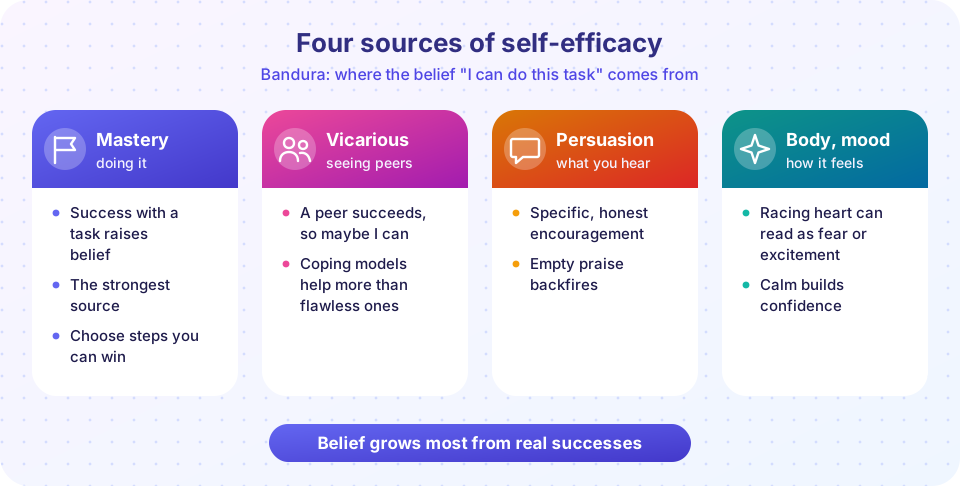
He identified four sources of self-efficacy.
- Mastery experiences. The strongest source. Succeeding at a task, especially after effort, raises your belief you can do it again. For learners, that means setting up a chain of achievable steps, so every step is a real success.
- Vicarious experiences. Seeing similar people succeed. "If she can do it, so can I." Models who struggle and then cope (coping models) are often more effective for beginners than flawless experts.
- Social persuasion. Honest, specific encouragement from people whose opinion you trust. Empty praise damages credibility.
- Physiological and emotional states. How you interpret your body's signals. A racing heart before a test can be read as fear or as readiness. Helping students reframe arousal ("your body is gearing up") has had positive effects in some studies.
Efficacy should be calibrated, matching actual ability. Underconfidence makes people avoid worthwhile challenges. Overconfidence makes them under-prepare. Honest feedback and self-testing help calibrate it.
Attributions: the stories we tell about results
Bernard Weiner's attribution theory says that the causes you assign to success and failure shape what you feel and do next. Causes vary in whether they are stable and whether they are controllable. "I failed because I am bad at math" is stable and uncontrollable, so it predicts hopelessness. "I failed because I used a weak strategy for studying" is unstable and controllable, so it predicts trying a new approach. Helping learners attribute outcomes to effort and strategy, when that is accurate, supports persistence. It is not helpful to attribute everything to effort when the real cause is a missing prerequisite or poor teaching.
Grit and perseverance
Angela Duckworth and colleagues (2007) defined grit as perseverance and passion for long-term goals, and showed that it predicted outcomes such as retention at the US Military Academy. The idea became very popular. Later meta-analyses, notably Marcus Credé, Michael Tynan and Peter Harms (2017), found that grit is strongly overlapping with the well-established personality trait of conscientiousness, and adds little beyond it for predicting performance. Perseverance clearly matters, but "grit" as a separate, trainable quality is more contested than its popularity suggests.
Supporting helpful beliefs: practical guidance
- Praise the process, with specifics. "You tried three methods before it worked" is better than "you are so smart". Dweck's group and others have found that parents' process praise to toddlers predicted children's later beliefs (Gunderson and colleagues, 2013).
- Treat mistakes as data. Build in chances to try, fail, get feedback and retry.
- Say "not yet." Frame unfinished skills as in progress.
- Teach how learning works. Understanding that memory strengthens with retrieval and that the brain changes with practice (the content of this course) gives a reason to keep going.
- Provide the strategy, not just the slogan. Belief without a way to improve is hollow.
- Fix the environment. If a class punishes mistakes, no poster will change the message.
Common misconceptions
"People are either fixed or growth mindset." Beliefs vary by domain and situation, and most people hold a mix.
"A growth mindset means anyone can learn anything with effort." Effort and good strategies matter, but there are limits, and the claim ignores prior knowledge, teaching and opportunity.
"Mindset interventions are proven to transform results." Large studies find small average effects, larger for some groups.
"Self-efficacy is the same as confidence." It is task-specific and best when accurate.
Try it
First, a short self-efficacy reflection for one skill that you are learning. Pick the skill, then rate each statement. The tool averages your ratings and suggests which of Bandura's four sources to work on. It is a reflection aid, not a validated test.
Second, an effect-size picture. Two groups with different average scores overlap heavily when the effect is small. The code draws two bell curves for effect sizes of 0.1, 0.3 and 0.8, and prints the probability that a random person from the higher group scores above a random person from the lower group (the "probability of superiority"). It shows why a "small effect" is not an exaggeration of nothing, and not a transformation either.
Press Run (or Ctrl + Enter) to see the result here.
Program input · what you'd type while the program runs
Type the answers before you press Run, one per line. Each time the program reads a line (with input()), it gets the next line from this box.
Check your understanding
Quick check · 5 questions
of 5 answered You scored / 5 · perfect!
-
1. What did Sisk and colleagues' 2018 meta-analyses find about mindset interventions?
The average effect was small, and bigger for students who were academically at risk or from low-income families. -
2. Which of these is a source of self-efficacy in Bandura's theory?
The four sources are mastery experiences, vicarious experiences, social persuasion and physiological and emotional states. -
3. Self-efficacy differs from self-esteem because it is:
Self-efficacy concerns capability for a particular task or domain. -
4. A student says, "I failed because I used a weak study method." In attribution terms, this is:
Strategy is something that can be changed, so this attribution supports further effort. -
5. What is a fair summary of the grit research?
Credé, Tynan and Harms (2017) found strong overlap with conscientiousness and weak incremental validity.
Summary
- Fixed and growth mindsets describe beliefs about whether ability can change; large studies find small average effects of mindset interventions, larger for struggling students in supportive settings.
- Self-efficacy is a task-specific belief that grows mostly from real successes, plus vicarious experience, honest persuasion and the interpretation of bodily states.
- Attributions to strategy and effort support persistence when accurate; "grit" overlaps with conscientiousness.
- Support beliefs with specific process praise, safe mistakes and real strategies, not slogans.
Next: Chapter 4 review
Track your progress
Create a free account to tick off lessons and pick up where you left off on any device.
of The Psychology of Learning lessons completed