


















Lesson 10 of 46 · How Learning Works
Chapter 2 review: How learning works
Review chapter two of the psychology of learning course: conditioning, observational and cognitive learning, brain plasticity, with a concept matcher and a ten-question quiz.
Chapter 2 covered a lot of ground: Pavlov's dogs, Skinner's schedules, Bandura's children, Tolman's rats, Piaget's schemas, Vygotsky's scaffolding and the synapses where all of it eventually shows up. In this review you will bring the pieces together and practice retrieving them. Treat it as an experiment on yourself: try to answer before you look.
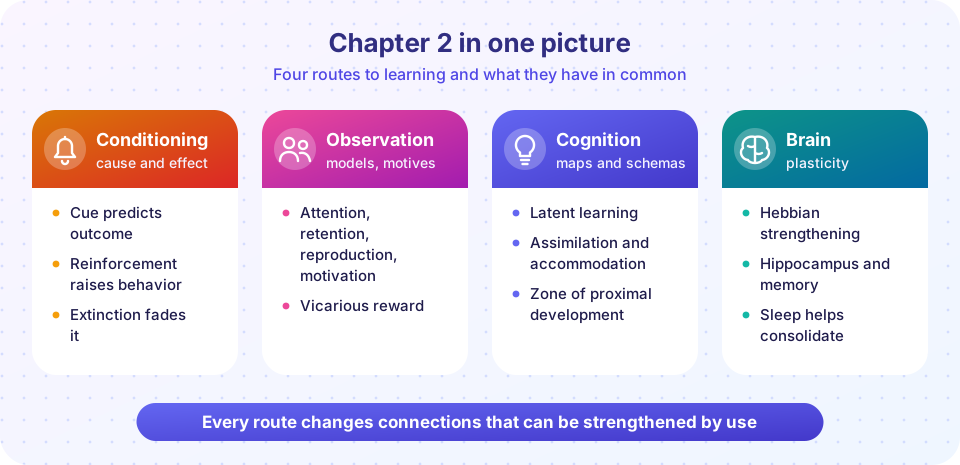
What you will learn
- A compact recap of the four families of learning.
- A table linking each idea to its key researcher and its practical use.
- A way to test your recall with a matcher and a mixed quiz.
Recap table
| Idea | Key people | Core claim | Practical use |
|---|---|---|---|
| Classical conditioning | Pavlov, Rescorla and Wagner | Cues that predict outcomes gain power; surprise drives learning | Exposure therapy uses extinction; avoid pairing study with dread |
| Operant conditioning | Thorndike, Skinner | Consequences shape behavior; schedules matter | Immediate, specific feedback; shape in small steps |
| Observational learning | Bandura | Attention, retention, reproduction, motivation | Worked examples, demonstrations, good role models |
| Latent learning and insight | Tolman, Köhler | Learning can be hidden; understanding can restructure | Let learners explore; give time to think |
| Schemas and the ZPD | Bartlett, Piaget, Vygotsky | New ideas join old frameworks; help just beyond current skill | Link to prior knowledge; scaffold, then fade |
| Plasticity | Hebb, Bliss and Lømo, Milner, Maguire | Connections strengthen with coordinated use; sleep consolidates | Practice repeatedly; sleep after studying |
Three ideas that cut across the chapter
- Prediction and surprise drive learning. From Rescorla-Wagner to dopamine to Piaget's accommodation, learning is strongest when something does not match expectations.
- Learning is not always visible. Tolman's latent learning and Ebbinghaus's savings both show that hidden knowledge exists.
- Support matters, and should fade. Shaping, scaffolding and worked examples are all forms of structured help that is gradually withdrawn.
Applying the chapter: three short cases
Case 1: the dreaded test. A student feels sick whenever she enters the exam hall, even for easy tests. Classical conditioning offers an explanation: the room and the paper have been paired with a few very stressful experiences, so they now trigger a conditioned response. Extinction suggests a remedy: gradual, repeated experiences in similar settings where nothing bad happens, such as low-stakes practice tests in the same room. Spontaneous recovery warns that the feeling may return after a break, which is normal and does not mean the progress was lost.
Case 2: the apprentice. A new baker learns by watching a master. Bandura's four processes predict which parts will go wrong. If she does not attend to the small hand movements, retention fails. If she remembers them but lacks the strength in her wrists, reproduction fails. If she does not see why a certain shape matters, motivation fails. A good teacher therefore points out the key details, lets her practice parts of the skill, and explains the purpose.
Case 3: the tricky proof. A student stares at a geometry proof for an hour with no progress, then gets it after a walk. Insight is the likely description, but notice what came before it: an hour of effortful preparation. Piaget would say that his schema for "triangle congruence" had to accommodate a new kind of case, and Vygotsky would say that a hint from a teacher at the right moment might have saved forty minutes. Neuroscience adds that the work he did, and the night's sleep afterward, would help to consolidate the new connection.
The point of the cases is that you rarely need only one idea from the chapter. Skilled learners and teachers draw on several.
Try it
A concept matcher. Choose the matching researcher or term for each description, then check. Use it as retrieval practice: answer from memory before you consult the lessons.
Check your understanding
Ten questions mix every lesson in the chapter. Try them before looking back.
Quick check · 10 questions
of 10 answered You scored / 10 · perfect!
-
1. In classical conditioning, extinction means:
Extinction is the weakening of a conditioned response when the expected outcome stops occurring. -
2. According to the Rescorla-Wagner model, learning is largest when:
The size of the prediction error, the gap between expectation and outcome, drives the change in strength. -
3. A parent stops a child's tantrum by giving in, which makes tantrums more likely. For the parent, giving in is:
Removing the unpleasant crying reinforces the parent's behavior of giving in, and giving the child what they want reinforces the tantrums. -
4. Which reinforcement schedule produces the greatest persistence, like a slot machine?
Unpredictable rewards after varying numbers of responses keep behavior going. -
5. Which of Bandura's four processes asks whether the observer has a reason to act?
Motivation covers expected rewards, observed outcomes and personal goals. -
6. What did the delayed-reward rats in Tolman and Honzik's study show?
Their errors dropped quickly once food appeared, which is evidence for latent learning. -
7. Vygotsky's zone of proximal development refers to:
Tasks in the ZPD are too hard alone but achievable with support. -
8. What does long-term potentiation represent?
LTP is the best-known cellular model of how synapses strengthen with use. -
9. Which is the best-supported advice about sleep and studying?
Evidence from classic and modern studies shows sleep supports memory consolidation. -
10. Which claim about learning styles is best supported?
Pashler and colleagues (2008) found no adequate evidence for the matching hypothesis.
Summary
- Four families of learning: conditioning, observation, cognition and brain change.
- Prediction error, hidden (latent) learning and structured support recur across them.
- Synapses strengthen with coordinated use, and sleep helps consolidation.
- Popular myths such as learning styles and left/right brain types do not hold up.
Next: Memory: the big picture
Track your progress
Create a free account to tick off lessons and pick up where you left off on any device.
of The Psychology of Learning lessons completed