


















Lesson 24 of 46 · Instruction and Feedback
Worked examples and cognitive load
Why beginners learn more from studying worked solutions than from solving problems alone, how to fade support, and when the effect reverses for experts.
Imagine you are learning to solve equations. Your teacher writes a problem on the board and says, "Now you try." You stare at it. You know some rules, you half remember a trick, and you try three different things. Twenty minutes later you have a page of crossed-out lines and a feeling that you have worked hard. Did you learn much?
One of the most reliable findings in the psychology of instruction says that, for beginners, the answer is often "less than you would have learned by studying a clear solution first". This lesson explains why, what the finding is called, and how it can be turned into a practical way of teaching and studying.
What you will learn
- What cognitive load theory says about working memory and problem solving
- What the worked example effect is, and the evidence behind it
- How to fade a worked example into independent practice
- Why the effect reverses (the expertise reversal effect) for experienced learners
- How to study from examples actively instead of passively
Key terms
Working memory: the small, temporary workspace in which you hold and manipulate information. It is severely limited for new material.
Schema: an organized chunk of knowledge in long-term memory, such as "how to isolate a variable". A schema lets you treat many elements as one.
Element interactivity: how many parts of a task must be held in mind at the same time because they depend on each other.
Intrinsic load: the load that comes from the difficulty of the material itself.
Extraneous load: load caused by poor instructional design, not by the content.
Why novices struggle: the limits of working memory
In 1956 George Miller described the "magical number seven, plus or minus two", the observation that people can hold roughly seven unconnected items in short-term memory. Later researchers, notably Nelson Cowan in 2001, argued that when rehearsal and chunking are controlled, the real capacity is closer to four chunks. Even more important for learning: information that is new and has to be processed, not just held, is even more limited. Experiments by Lloyd Peterson and Margaret Peterson in 1959 showed that without rehearsal, items vanish from short-term memory in about twenty seconds.
John Sweller, an Australian educational psychologist, built cognitive load theory from this foundation in the 1980s. The theory makes a simple but powerful claim: instruction should be designed around the fact that working memory is small and long-term memory is large. Long-term memory has no known limit, and an expert can pull a whole schema out of it into working memory as a single unit.
A beginner has no such schemas. Every element of a new problem is a separate item competing for the same few slots. An expert solving a quadratic equation sees one familiar pattern. A beginner sees the equation, the unknown, the rule for moving terms, the sign conventions, the arithmetic and the goal all at once.
The cost of searching for a solution
Sweller's 1988 paper pointed out something subtle. When a novice solves a problem by trial and error, the typical strategy is means-ends analysis: compare where you are with the goal, then look for an action that reduces the difference. This works for finding the answer, but it demands a lot of working memory (current state, goal, the difference, possible operators, the sub-goal) and leaves little left over for noticing why a step worked. The learner can solve the problem and still not store a reusable schema. Learning, in this view, is the construction of schemas, and heavy problem-solving search crowds that construction out.
The worked example effect
A worked example is a problem together with its complete solution, step by step. The worked example effect is the finding that learners who study worked examples, usually alternating with problems to solve, perform better on later tests than learners who solve the same number of problems without examples.
The classic early study is by Sweller and Graham Cooper (1985). Students learning algebra either solved eight problems or studied examples alternating with problems. The example group needed far less study time and made fewer errors on test problems that resembled the practice ones. Over the next decades the effect was replicated in domains such as geometry, physics, statistics and computer programming. A 1987 study by Hao Zhu and Herbert Simon reported a classroom in which students who learned mainly from well-structured examples completed a three-year mathematics course in two years. Such field reports are suggestive, not conclusive, but they point the same way as the laboratory work.
Why does it work?
Studying a solution removes the search. All the learner's working memory is free for the important question: why does each step follow from the last? The learner can see the structure of a solution and file it in long-term memory as a schema.
Fading: from example to independence
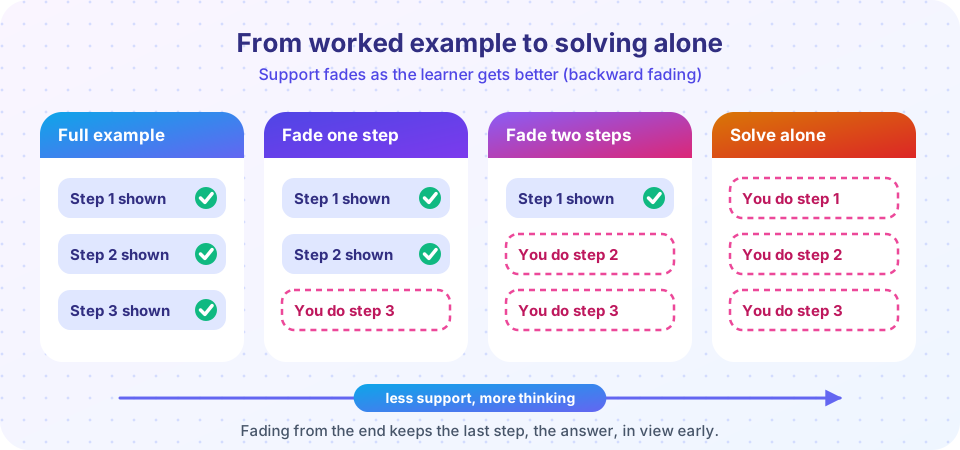
If worked examples were always best, nobody would ever learn to solve problems alone. The fix is fading. In a faded sequence the first example is complete. In the next, one step is left blank for the learner. Then two, then three, until the learner solves the whole problem alone. The study by Alexander Renkl, Robert Atkinson, Uwe Maier and Richard Staley (2002) compared different fading orders and found that backward fading (removing the last steps first) tended to work well, which fits the idea that the learner always sees the structure of the solution and the final answer early on.
The first TryIt below lets you experience this with a one-variable equation. Try the "Full example" level first, then move toward "Solve alone".
Studying examples actively
Reading a worked solution passively is easy to do and surprisingly ineffective. In 1989 Michelene Chi and colleagues asked students to think aloud while studying physics examples. The students who later did best were those who explained to themselves why each step was taken, relating it to principles they had read. Weaker students mainly paraphrased what was on the page. This self-explanation effect suggests two practical habits:
- After each step, ask "Why this step, and why now?" and answer in your own words.
- Cover the next step, predict it, then uncover it to check.
Teachers can build in the same prompts. A worked example with a question such as "Which rule allows this step?" outperforms one without.
The expertise reversal effect
Here is the twist. In 2003 Slava Kalyuga, Paul Ayres, Paul Chandler and John Sweller reviewed studies showing that instructional supports which help beginners can hurt people who already know the material. For an expert, a full explanation of something they can do automatically is redundant. Processing it takes working memory and may interfere with the schema they already hold. This is the expertise reversal effect.
The practical rule is to match support to prior knowledge. As a learner's schemas grow, move from worked examples to faded examples to full problems. The second TryIt below plots a schematic version of this idea. It is not measured data, only a drawing of the shape of the effect.
What the theory does not say
Cognitive load theory is influential and well supported for well-structured problems in mathematics, science and programming, where there is a clear sequence of correct steps. It is less clear how far it extends to open-ended tasks such as writing an essay or designing a building, where there are many acceptable solutions. Critics also note that the original distinction between "germane" and other kinds of load has been revised by Sweller and colleagues themselves in later papers, because it was hard to measure separately. Treat the theory as a well-tested set of design principles for teaching novices, not a complete theory of learning.
Common misconceptions
"Struggling is always how real learning happens." Struggle can help (you will see productive failure in the next lesson), but a beginner who has no relevant knowledge usually gains little from long unguided search.
"Worked examples make students lazy." Used with self-explanation prompts and fading, they push learners toward independence faster. Passive reading is the risk, not the examples.
"Once an example helps, it always helps." It stops helping, and can harm, as expertise grows.
Try it
The widget below is a demonstration, not an assessment. It shows a worked solution to 3x + 5 = 20 and hides steps according to the level you choose. Type your results into the dashed boxes.
The second demo draws a schematic of the expertise reversal effect. The numbers are invented to show the shape: the advantage of studying examples is large for beginners, shrinks, and turns negative as knowledge grows.
Press Run (or Ctrl + Enter) to see the result here.
Program input · what you'd type while the program runs
Type the answers before you press Run, one per line. Each time the program reads a line (with input()), it gets the next line from this box.
Check your understanding
Quick check · 5 questions
of 5 answered You scored / 5 · perfect!
-
1. According to cognitive load theory, why do beginners often learn little from solving problems by trial and error?
Means-ends search is demanding. The learner may find the answer without storing a reusable schema. -
2. What is the worked example effect?
It is a finding about learning outcomes for novices, not about preferences, and it is not universal. -
3. In backward fading, which steps are removed first?
The learner sees the early steps and the structure of the solution and completes the end first. -
4. What is the expertise reversal effect?
For experts, detailed guidance is redundant and can interfere with their existing schemas. -
5. Which habit makes studying a worked example more effective?
Chi and colleagues found that good learners generated explanations, not just paraphrases.
Summary
- Working memory is small, and beginners have no schemas to compress new material, so unguided search can use up the capacity needed for learning.
- Worked examples reduce that load, and the worked example effect has been found in mathematics, science and programming.
- Faded examples (especially backward fading) move the learner gradually to solving alone.
- Self-explanation makes examples far more effective than passive reading.
- The expertise reversal effect means support should shrink as knowledge grows.
- The theory is strongest for well-structured problems and its details are still being refined.
Track your progress
Create a free account to tick off lessons and pick up where you left off on any device.
of The Psychology of Learning lessons completed