


















Lesson 31 of 46 · Spaced Practice and Study Strategies
Study strategies and metacognition
Which of ten popular study techniques the evidence supports, why students misjudge their own learning, and how to monitor and control your learning with better calibration.
Between lectures, textbooks and exams, students use a surprisingly small set of techniques: rereading, highlighting, summarizing, making flash cards, doing practice questions. Psychologists have tested these methods one by one. The verdicts are not what most people expect. Some of the most popular methods turn out to give little benefit, while less popular ones give a lot.
This lesson covers the most cited review of study techniques, then moves to a deeper question: why do students keep using weak methods? The answer is metacognition, the way we monitor and judge our own learning, and the ways in which it systematically misleads us.
What you will learn
- The ten techniques reviewed by Dunlosky and colleagues, and how they were rated
- What students actually do when they study, and why
- How illusions of knowing arise, and how to reduce them
- The monitoring and control model of metacognition
- A simple routine for self-assessment that you can use at once
Key terms
Practice testing: trying to recall or answer questions from memory, without the materials.
Metacognition: knowledge about, and monitoring and control of, your own thinking and learning.
Judgment of learning (JOL): your prediction of how well you will remember something later.
Calibration: how closely your confidence matches your actual performance.
Illusion of knowing: feeling that you know something when you could not retrieve or use it.
Ten techniques under review
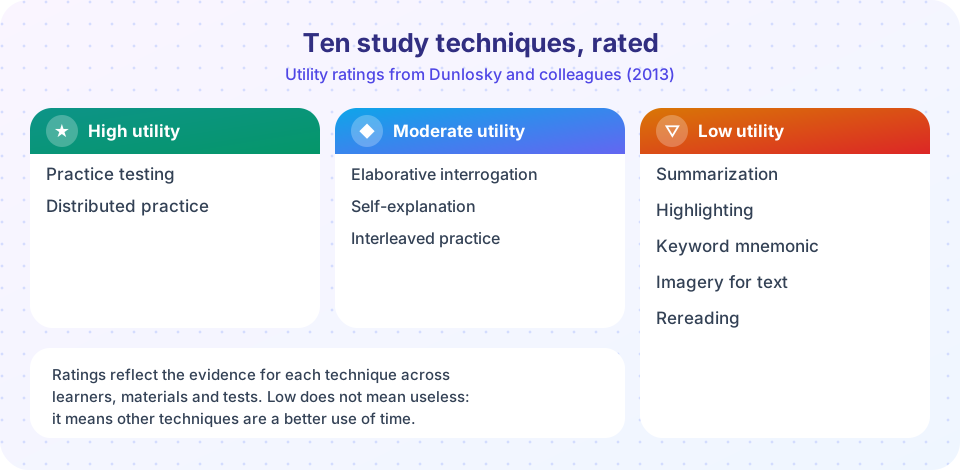
In 2013 John Dunlosky, Katherine Rawson, Elizabeth Marsh, Mitchell Nathan and Daniel Willingham published a long review in Psychological Science in the Public Interest. They examined ten techniques that students commonly use or that are widely recommended, and for each they asked: how well does it work across different kinds of learners, materials, and tests, and how easy is it to use? They rated each one as high, moderate or low in utility.
High utility
- Practice testing: quizzing yourself, with flash cards or practice questions. It improved performance across many ages, materials and delays. The key is that you try to retrieve before looking.
- Distributed practice: spreading study over time, as you saw in the spacing lesson.
Moderate utility
- Elaborative interrogation: asking and answering "why is this true?" about facts.
- Self-explanation: explaining how new information relates to what you know, or the steps you took in solving a problem.
- Interleaved practice: mixing problem types, as in the last lesson.
Low utility
- Summarization: writing summaries. Benefits depended heavily on how well students were trained to do it.
- Highlighting and underlining: in many studies it did not help, and could even distract from making connections.
- Keyword mnemonic: linking a foreign word to a similar-sounding English word through an image. It can help for vocabulary but is limited in scope and tends not to last.
- Imagery for text: forming mental pictures while reading. It helped only in limited conditions.
- Rereading: reading material again. It gave small benefits, especially if spaced, but was usually outperformed by testing.
A "low" rating does not mean "never useful". It means that, given limited study time, other techniques offered more for the same effort. The reviewers noted that for several techniques the evidence was thin in realistic classroom settings, so the ratings are evidence-based judgments, not final truths.
What do students actually do?
Jeffrey Karpicke, Andrew Butler and Henry Roediger (2009) surveyed university students about their study habits. A large majority said they reread notes or textbooks. Self-testing was much less common, and where students did use it, they mostly said they used it to find out what they knew, not to strengthen memory. Few knew that retrieval itself strengthens memory.
That is the testing effect (Henry Roediger and Karpicke, 2006). In their experiment students studied prose passages. Some read a passage four times, while others read it once and recalled it three times without the text. Five minutes later, the rereading group did better. But a week later the pattern flipped: the group who had practiced retrieval remembered far more. When asked beforehand, the rereaders were more confident that they knew the material. Students had the wrong idea about which method served them better.
Why we misjudge our own learning
We cannot observe memory directly, so we judge it by cues. A common cue is fluency: how easily the material comes to mind or reads. Fluency is useful, but it can mislead, because things can feel easy for reasons that have nothing to do with later recall.
- Rereading breeds familiarity. After a second reading the page looks familiar, and familiar feels like known. Recognizing a page is not the same as recalling its contents in an exam.
- The answer is in front of you. When you check a flash card by looking at both sides, you may think "I knew that" when in fact you only recognized it. Asher Koriat and Robert Bjork (2005) called this a foresight bias: judging learning while the answer is visible makes us overconfident about what we will recall without it.
- Immediate judgments are poor. Thomas Nelson and Dunlosky (1991) discovered the delayed-JOL effect. If people predicted their later recall right after studying, their predictions were weak. If they made the prediction after a delay, and tried to retrieve the answer from the cue alone, the predictions became remarkably accurate. The delay and the retrieval attempt supply honest evidence.
- We prefer the smooth route. As the earlier lessons showed, massed and blocked practice feel better and mislead students into abandoning more effective practice.
A related and widely quoted claim, the Dunning-Kruger effect, says the least skilled people overestimate their skill the most (Justin Kruger and David Dunning, 1999). It is plausible that people who lack knowledge also lack the knowledge to judge their own. But statisticians have argued that much of the pattern can arise from regression to the mean and from the general tendency for everyone to rate themselves above average, so it should be treated as a debated finding and not as a law.
Monitoring and control
Thomas Nelson and Louis Narens (1990) described metacognition with a simple model. There is the object level, where you actually study, and a meta level, which holds a model of your own learning. Two flows connect them.
- Monitoring carries information up: "Do I know this?" "Is this chapter hard for me?"
- Control carries decisions down: "Study this section again." "Stop and move on." "Switch to practice problems."
Good learners monitor accurately and control wisely. The trouble is that poor monitoring, which comes from the illusions above, produces poor control. If you wrongly feel you know a chapter, you stop studying it. Barry Zimmerman's model of self-regulated learning wraps this into a cycle: forethought (set goals and plan), performance (use strategies, monitor), and self-reflection (judge results, adjust).
The plot below is a simulation of calibration. Students' predictions of how well they will do are drawn from invented rules: a general overconfidence and a fluency boost for easy-looking items. A perfectly calibrated learner would lie on the dashed line.
Press Run (or Ctrl + Enter) to see the result here.
Program input · what you'd type while the program runs
Type the answers before you press Run, one per line. Each time the program reads a line (with input()), it gets the next line from this box.
A routine that fixes monitoring
- Predict first. Before a self-test, write what score you expect.
- Test with the answer hidden. Use cues only, closed book.
- Delay your judgment. Check what you know a little after studying, not right away.
- Compare predictions and results. If you were too confident, treat that as information about yourself.
- Re-plan. Spend the next session on what you could not retrieve.
The demonstration below lets you try a miniature version with word pairs. It is a demonstration of calibration, not a test of any ability.
Common misconceptions
"If I can recognize it, I know it." Recognition is much easier than recall or application.
"Highlighting and rereading are bad, so never do them." They are weak as main strategies. They can still help with a first pass or with planning what to quiz yourself on.
"Confidence means competence." Confidence is a feeling that can be inflated by fluency.
Check your understanding
Quick check · 5 questions
of 5 answered You scored / 5 · perfect!
-
1. Which two techniques did Dunlosky and colleagues (2013) rate as high utility?
They worked across many learners, materials and tests, and they are easy to apply. -
2. In the Roediger and Karpicke (2006) experiment, what happened on the test one week later?
Rereaders did better after five minutes, but retrieval practice won after a week. -
3. What is the delayed-JOL effect?
Nelson and Dunlosky found that delayed judgments with cue-only retrieval predicted later recall far better. -
4. In the monitoring and control model, what is monitoring?
Monitoring is your assessment of your own learning. Control is the decision made from it. -
5. Why is rereading a risky strategy?
Familiarity raises confidence without providing the retrieval practice that strengthens memory.
Summary
- Practice testing and distributed practice earned the top ratings in a major review. Highlighting, rereading and summarizing did poorly.
- Many students reread because it feels productive, and they do not realize that self-testing helps learning.
- Fluency and familiarity create illusions of knowing. Judgments made with the answer in view or immediately after study are overconfident.
- Delayed, cue-only self-testing gives honest feedback on what you know.
- Learn the monitoring and control cycle, and predict before you test.
Next: Chapter 6 review
Track your progress
Create a free account to tick off lessons and pick up where you left off on any device.
of The Psychology of Learning lessons completed