


















Lesson 28 of 46 · Spaced Practice and Study Strategies
Chapter 6 overview: spaced practice and study strategies
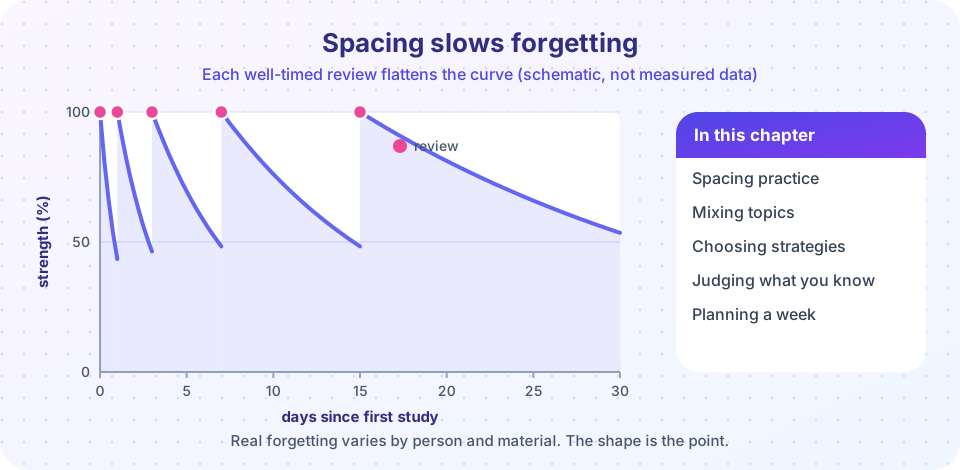
Why when and how you study matters as much as how long: a map of spacing, interleaving, retrieval and metacognition, with a schematic forgetting curve.
Ask a hundred students how they study and most will describe the same routine: read the chapter, highlight the important parts, read it again before the exam and, if there is time, copy out the notes. Ask psychologists who study memory, and they will tell you that this routine is close to the opposite of what the research supports. The strategies that feel most natural are often the least effective, while the ones that work best feel awkward, slow and uncertain.
This chapter is the practical heart of the course. Having seen how learning and memory work, you now turn them into choices: when to study, in which order, by which method, and how to tell whether it is working.
What you will learn
- Why the timing and the form of study can matter more than the amount
- The four big ideas of the chapter: spacing, interleaving, strategy choice and metacognition
- How "desirable difficulties" explain why good study can feel bad
- What the chapter's lessons cover
Key terms
Spaced (distributed) practice: spreading study over several sessions with gaps between them.
Massed practice: cramming study into one block.
Interleaving: mixing different topics or problem types within a session.
Desirable difficulty: a learning condition that slows apparent progress but improves long-term retention and transfer (Robert Bjork, 1994).
Metacognition: knowing and monitoring what you know and how you learn.
The forgetting curve
In 1885 the German psychologist Hermann Ebbinghaus published the first scientific study of memory. Using himself as the only participant, and lists of meaningless syllables such as "DAX" and "BOK" so that prior knowledge could not help, he measured how much he retained after different delays. His results showed a pattern that has been seen in many later studies: forgetting is fast at first and then slows down. A large share of newly learned material is lost within hours to days, and the remainder fades gradually.
This is the forgetting curve. The curve in the picture above is a schematic, not Ebbinghaus's data, but it shows the key idea behind this chapter. If you review material just before you would have forgotten it, strength returns, and the next forgetting is slower. Review again later and the curve flattens further. Repeated retrieval at widening gaps is how people hold information for years instead of days.
Desirable difficulties
Robert Bjork and Elizabeth Bjork at UCLA noticed that many of the best study conditions share an odd property. They make learning feel harder and produce worse performance during practice, yet they give better performance on later tests. Bjork called these desirable difficulties. Spacing, interleaving, testing yourself and varying the conditions of practice are all examples.
The reverse is also true. Conditions that make practice feel fluent, such as rereading a page you have just read or doing ten identical problems in a row, can produce a confident feeling of knowing without durable learning. We are bad at judging our own learning from how easy it feels in the moment. Later in this chapter you will see experiments in which students preferred the strategies that worked worse.
Not every difficulty is desirable. Trying to learn from a badly written text, or from a task far beyond your current knowledge, is just hard. A difficulty is desirable when you have the background to succeed with effort and when the effort involves retrieving and organizing knowledge.
Four big ideas
Why spacing works
Why feelings mislead
Bjork: desirable difficulties
Your plan
What each lesson covers
- The spacing effect: the oldest robust finding in memory research, how far apart sessions should be, and why spacing feels worse than it is.
- Interleaving and mixed practice: why alternating problem types beats doing them in blocks.
- Study strategies and metacognition: the ratings of ten popular techniques, and why students misjudge their own learning.
- Chapter 6 review: a recap, a one-page picture and a longer quiz.
A word on evidence and your own situation
Most of the research summarized here comes from experiments with a clear design: random groups, a controlled amount of study time, and a later test. That design makes it possible to say which method caused better results. But the typical participant is a university student studying word pairs, texts or short lectures, and tests typically take place minutes to weeks later. How well the findings carry over to a year-long course, to a different age group or to a practical skill is an open question for each case. Where classroom studies exist, such as those with school students and university courses, they mostly support the lab findings, though effects tend to be smaller and messier.
So treat the chapter's advice as strong default hypotheses. Then test them on yourself: Chapter 9 shows how to run a small experiment on your own study habits.
Check your understanding
Quick check · 4 questions
of 4 answered You scored / 4 · perfect!
-
1. What did Ebbinghaus's forgetting curve show?
A large share is lost soon after learning, and the remainder fades more slowly. -
2. What is a desirable difficulty?
Bjork's term covers spacing, interleaving, testing and similar conditions that feel harder than they are harmful. -
3. Massed practice means:
It is the opposite of spaced or distributed practice. -
4. Why should you be cautious about judging your learning by how fluent practice feels?
Rereading and blocked practice feel smooth but often give weaker long-term results.
Summary
- Ebbinghaus showed that forgetting is steep at first and then slows, and reviews flatten it.
- The chapter's four big ideas are spacing, interleaving, retrieval and honest self-assessment.
- Desirable difficulties make learning feel harder but pay off later, and the easy-feeling methods are often weak.
- The evidence is mostly from experiments with students, so use it as a strong starting hypothesis and test it on yourself.
Next: The spacing effect
Track your progress
Create a free account to tick off lessons and pick up where you left off on any device.
of The Psychology of Learning lessons completed