


















Lesson 36 of 46 · Skills, Expertise and Transfer
Chapter 7 review: skills, expertise and transfer
Review chunks and schemas, deliberate practice, the 10,000-hour myth and transfer with a recap table, a one-picture summary and a ten-question quiz.
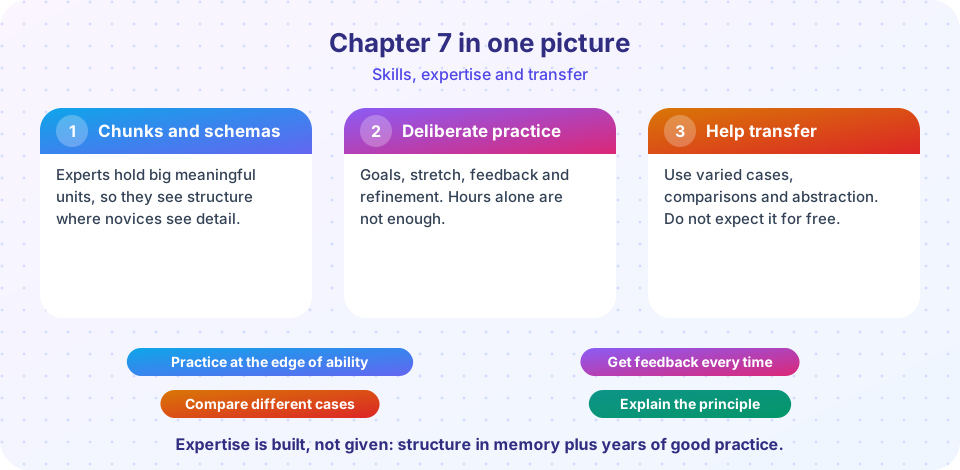
This chapter asked what skill is made of, how it is built and whether it travels. The answers: experts hold large meaningful chunks and organize knowledge by principle; good practice is targeted, stretching and fed back; and transfer, the hope of every educator, must be designed for because it will not happen by default.
What you will learn
- The chapter's findings in one table
- How the ideas relate to one another and to earlier chapters
- A short plan for building a skill you care about
Recap table
| Idea | Who and when | Key finding | Caveat |
|---|---|---|---|
| Five stages of skill | Dreyfus and Dreyfus, 1980 | From rule-following novice to intuitive expert | Descriptive. Not derived from controlled experiments |
| Chunking | Chase and Simon, 1973 | Chess masters' recall advantage is for meaningful positions and nearly vanishes for random ones | Masters keep a small edge on random positions. Gobet and Simon proposed templates |
| Narrow chunk training | Ericsson, Chase and Faloon, 1980 | S.F. extended digit span to nearly 80, but not his letter span | One participant. Shows domain specificity |
| Deep schemas | Chi, Feltovich and Glaser, 1981 | Experts sort problems by principle and novices by surface | Small samples in physics |
| Deliberate practice | Ericsson, Krampe and Tesch-Romer, 1993 | Top violinists had more solitary, goal-directed practice | Retrospective estimates of hours |
| Variance explained | Macnamara, Hambrick and Oswald, 2014 | About 26% in games, 21% in music, 18% in sports, 4% in education, under 1% in professions | Debated. Ericsson and Harwell (2019) disputed the coding of practice |
| Identical elements | Thorndike and Woodworth, 1901 | Transfer is greater when tasks share components | Too narrow. Principles also transfer (Judd, 1908) |
| Analogical transfer | Gick and Holyoak, 1980 and 1983 | Many people do not notice a relevant analogy unless told | Comparison of two cases helps |
| Brain training | Owen and colleagues, 2010. Simons and colleagues, 2016 | Gains on trained tasks, little far transfer | Some evidence of near transfer |
How the ideas fit together
Think of skill as three layers.
- Structure in memory. Chunks and schemas let experts see a situation as a few meaningful units and recognize its deep type. This structure is domain-specific, which is why it does not carry over to random material or to other fields.
- Effortful building. The structure is created by practice that stretches you, with feedback. The quantity of practice matters, but its quality matters at least as much. When practice becomes automatic, improvement stops.
- Bridges. To use the structure in new places, you need to see how the new place resembles the old. This needs varied examples, comparison and explicit teaching of application.
Connections to earlier chapters help here. Worked examples (Chapter 5) are a way to build schemas efficiently, and experts need them less. Feedback (Chapter 5) is a defining part of deliberate practice. Spacing and interleaving (Chapter 6) are how deliberate practice should be scheduled, and interleaving trains the discrimination that transfer needs. Metacognition (Chapter 6) is how you tell whether a practice session is stretching you or whether you are coasting.
A plan for building a skill
Choose a skill, such as a language, an instrument, a sport or a programming technique, and work through these steps.
- Map the skill. List its components. Which can you do, which not yet?
- Pick one component and set a session goal that is specific and slightly beyond your current level.
- Find a model. Watch or study an expert's performance and worked examples.
- Practice with feedback. Use a coach, recordings, a checker or a test. Track errors.
- Mix and space. Return to the component on later days and mix it with other components.
- Apply it somewhere new. Deliberately use it in a different context, and note what carried over and what did not.
- Check for plateau. If you are no longer making mistakes, raise the difficulty.
Common misconceptions
"An expert is a person with a lot of experience." Performance, not years, is the criterion.
"Chunking is a memory trick." It is knowledge. Chunks are made from what you know, so they cannot be borrowed from another domain.
"If I can do it in class, I can do it anywhere." Transfer needs support and practice in varied settings.
Check your understanding
Quick check · 10 questions
of 10 answered You scored / 10 · perfect!
-
1. Which finding best shows that chess masters' advantage is not a general memory ability?
The advantage depends on meaningful chunks, which random positions do not contain. -
2. S.F. extended his digit span to nearly 80, but his span for letters fell back to about normal. What does this show?
His chunks were built from running times, which did not apply to letters. -
3. In Chi and colleagues' (1981) study, experts sorted physics problems by:
Experts' knowledge is organized by deep structure. -
4. Which is NOT a feature of deliberate practice?
Comfort-zone repetition leads to the autonomous stage and a plateau. -
5. What is the best description of the 10,000-hour rule?
There is no fixed threshold, and the hours required vary by domain and by person. -
6. The Macnamara and colleagues (2014) meta-analysis suggests that deliberate practice:
The share was highest in games, music and sports and low in education and professions. -
7. Which finding from Gick and Holyoak's studies is most important for teaching?
Teachers need to make the structural match visible. -
8. What is the best summary of the evidence on brain training?
Large reviews found gains that stayed close to the practiced tasks. -
9. Why do experienced people sometimes plateau?
In Fitts and Posner's autonomous stage, performance is automatic and improvement needs new challenge. -
10. Which step most directly promotes transfer?
Variation plus comparison builds abstract schemas that can be recognized in new settings.
Summary
- Expertise is domain-specific structure: chunks and schemas built by years of effortful practice.
- Deliberate practice, with goals, stretch, feedback and refinement, matters a great deal but does not explain everything.
- Transfer is not automatic. It improves with varied examples, comparison and explicit teaching of application.
- Brain-training programs have not shown broad far transfer.
- The next chapter looks at technology: what software, video and AI can and cannot do for learning.
Track your progress
Create a free account to tick off lessons and pick up where you left off on any device.
of The Psychology of Learning lessons completed