


















Lesson 29 of 46 · Spaced Practice and Study Strategies
The spacing effect
Learn why spreading study over time beats cramming, how long the gaps should be according to Cepeda and Bahrick, why spacing feels worse than it is, and how to plan it.
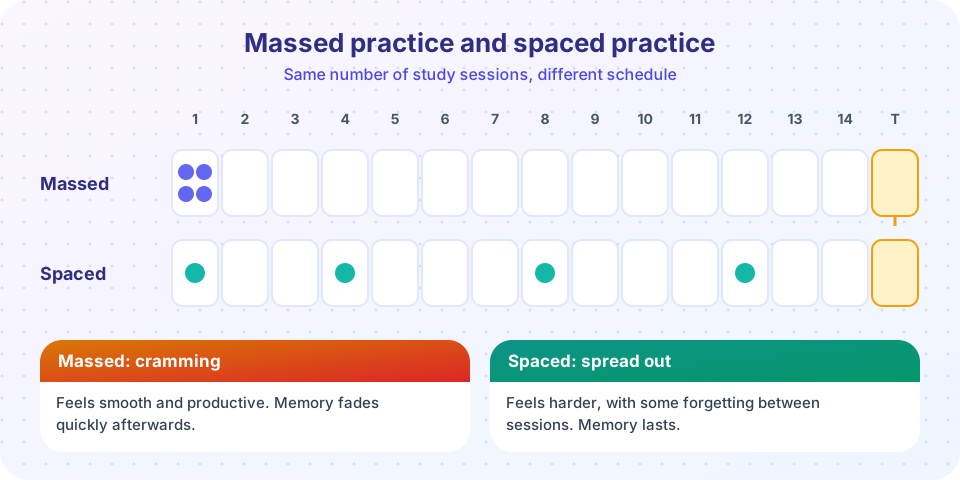
If you want to remember something for a week, cramming works well enough. If you want to remember it for a year, it works poorly. The most reliable way to turn short-term knowledge into long-term knowledge is not more hours but different timing: the same amount of study spread over several sessions with gaps between them. This is the spacing effect, and psychologists have known about it for well over a century.
This lesson looks at the evidence, at how large the gaps should be, at why students so often resist spacing, and at how to build a schedule you can actually follow.
What you will learn
- What the spacing effect is and where it was discovered
- What large studies say about the best gap between sessions
- Why spacing works, and why it feels like it does not
- How to plan a spaced schedule for a real exam or skill
Key terms
Spacing effect: better long-term memory when study is spread over time than when the same study is massed.
Gap (inter-study interval): time between two study sessions.
Retention interval: time between the last study session and the final test.
Expanding schedule: gaps that grow longer after each review.
Savings: Ebbinghaus's measure of memory, the reduction in effort needed to relearn something.
From Ebbinghaus to today
Ebbinghaus, whose forgetting curve you met in the overview, also reported that material studied in spread-out sessions needed less total effort than the same material crammed. Later work in the twentieth century found the effect in words, pictures, facts, skills and animals. In 2006 Nicholas Cepeda, Harold Pashler, Edward Vul, John Wixted and Doug Rohrer published a quantitative review in Psychological Bulletin of more than 300 experiments on spacing in verbal recall. Spaced practice was better in the large majority of them.
Several features of the evidence are worth noticing.
- The same total time. The spacing effect is not about studying more. In most experiments both groups study for equal total time.
- Wide range. It has been found in children and older adults, in vocabulary, mathematics, science concepts, medical skills and motor tasks.
- It lasts. The advantage is bigger when the final test is far away. A test five minutes later may favor cramming. A test five weeks later nearly always favors spacing.
The graph below plots the often-quoted values from Ebbinghaus's own forgetting experiments. They come from one participant (himself) and nonsense syllables, so they show the shape of forgetting and not a rule for everyday learning.
Press Run (or Ctrl + Enter) to see the result here.
Program input · what you'd type while the program runs
Type the answers before you press Run, one per line. Each time the program reads a line (with input()), it gets the next line from this box.
How big should the gap be?
Everyone who hears about spacing asks the same question. The best answer comes from a large web-based experiment by Cepeda and colleagues (2008), with more than 1,300 participants. They taught people obscure facts, then gave a second study session after a gap that ranged from minutes to months, and finally tested after a retention interval that also varied from about a week to nearly a year.
Two results stand out.
- There is an optimal gap, and it depends on the retention interval. Gaps that were too short or too long were both worse than a middle gap. The pattern looked like a ridge.
- The optimal gap grows with the retention interval but as a shrinking fraction of it. For a test a week away, the best gap was about a day. For tests a month or two away, gaps of one to three weeks did best. For tests nearly a year away, the best gap was a few weeks, a small percentage of the whole interval. As a rough rule: about 10 to 30 percent of the time until the test for tests days to a few months away, and less than that for tests a year or more ahead.
The loss from a gap that is slightly too long is small compared with the loss from one that is too short. That is good news: when in doubt, space a bit wider.
A second classic study, by Harry Bahrick and his family (Bahrick, Bahrick, Bahrick and Bahrick, 1993), tracked the memory of foreign-language vocabulary among four people for up to five years. Study sessions were spaced at 14, 28 or 56 days apart. Learning in the sessions looked similar across conditions, but long-term retention was best for the longest gap. Bahrick also reported that vocabulary studied in school was still partly available fifty years later for people who had reviewed it over time, a state he called "permastore".
Why does spacing work?
No single explanation has won, and several probably contribute.
- Retrieval effort. After a gap, you have partly forgotten, so you must work to retrieve. That effortful retrieval strengthens the memory more than easy re-reading would, a key idea in Bjork's account of desirable difficulties.
- Encoding variability. Each session happens in a slightly different mental context, so the memory gets more retrieval cues.
- Study-phase retrieval and attention. Right after you studied something, you may only half-attend to it a second time, since it feels familiar ("deficient processing").
- Consolidation. Memories strengthen over time, and sleep between sessions appears to help.
Why spacing feels bad
In a 2009 study, Nate Kornell asked students to learn vocabulary flash cards, either massed or spaced. Nine out of ten students did better when the cards were spaced, yet most of them believed that massing worked as well or better. Kornell and Bjork (2008) found a similar mismatch when students learned painters' styles. Massed practice feels smoother and gives better scores during practice, which is the evidence students use to judge. The benefit of spacing only appears on a later test.
Remember this when you plan: during spaced study you will forget things between sessions and feel clumsy at the start of each one. That is not a sign the method fails. It is the effort doing its work.
Planning a spaced schedule
- Find the test date, or decide how long you want to remember the material.
- List the topics and give each a first session.
- Add reviews with gaps that grow: for instance, a review after a day or two, then after about a week, then about two or three weeks.
- End with a review a few days before the test, not on the night before.
- Use retrieval, not rereading, in each review: close the book and recall what you can first.
The planner below applies a simple rule of thumb for expanding gaps. It is a convenience tool, not an optimum, because the real best schedule depends on the material and on you.
Limits and open questions
- The best gap depends on what you want to retain and for how long. The 10 to 30 percent rule is a summary of laboratory results.
- Very complex skills may not show the same pattern. Some studies with intricate materials or very young children have found weaker spacing effects.
- Spacing needs enough initial learning. If the first session leaves you with nothing, there is nothing to retrieve after the gap.
- Practical limits matter. A perfect schedule you do not follow loses to a decent one you do. If your life allows only three sessions, space them.
Common misconceptions
"Spacing means studying more." In most experiments total time is equal. Only the timing differs.
"If it feels harder, I must be learning less." For spacing the feeling points the wrong way.
"A single long review the night before is spacing." It is massed practice, and its benefits fade fast.
Check your understanding
Quick check · 5 questions
of 5 answered You scored / 5 · perfect!
-
1. In most spacing experiments, how does the total study time of the spaced and massed groups compare?
The effect comes from timing, not from extra time. -
2. What did Cepeda and colleagues (2008) find about the best gap?
The optimal gap grew with the time until the test, but as a smaller and smaller percentage. -
3. Why do students often prefer massed practice, according to Kornell's studies?
They judged by performance during practice, not by what a later test shows. -
4. Which of these is a plausible reason spacing works?
Retrieval effort is one of the leading explanations, along with encoding variability and consolidation. -
5. You have a test in 6 weeks and four sessions available. Which plan fits the research best?
Spread, expanding gaps and a final review before the test is the pattern the evidence favors.
Summary
- The spacing effect is the better long-term memory that follows spreading the same study over several sessions.
- Cepeda's large study found an optimal gap that grows with the time until the test, roughly 10 to 30 percent for tests days to a few months away and less for a year.
- Bahrick found that longer gaps gave better retention over years.
- Spacing works by effortful retrieval and probably by other mechanisms. It feels worse than massing while being better.
- Plan sessions with growing gaps, and use retrieval in each review.
Track your progress
Create a free account to tick off lessons and pick up where you left off on any device.
of The Psychology of Learning lessons completed