


















Lesson 27 of 46 · Instruction and Feedback
Chapter 5 review: instruction and feedback
Review the research on worked examples, guidance, productive failure and feedback with a recap table, a one-picture summary and a ten-question quiz.
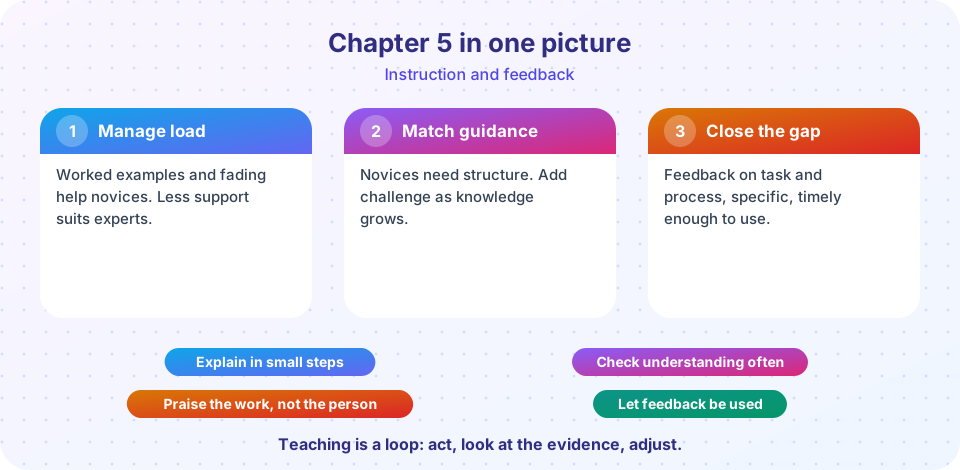
You have now seen how the same learner can be helped or hindered by the way material is presented. This review gathers the main findings of the chapter into one picture, one table and one quiz. Use the quiz without looking back at first. Wrong answers are useful: they show you exactly which parts to revisit.
What you will learn
- A compact recap of the chapter's main ideas, people and studies
- Which claims are well supported and which come with caveats
- How to apply the chapter's ideas to a study session or a lesson plan
Recap table
| Idea | Who and when | Key finding | Caveat |
|---|---|---|---|
| Cognitive load | Sweller, 1988 | Working memory is small. Unguided search uses capacity that schema building needs | Strongest for well-structured tasks. Load types were revised |
| Worked example effect | Sweller and Cooper, 1985 | Novices learn more from studying solutions alternated with problems | Needs active processing, such as self-explanation |
| Fading | Renkl and colleagues, 2002 | Backward fading moves learners smoothly to solving alone | Best order may vary with the task |
| Expertise reversal | Kalyuga and colleagues, 2003 | Support that helps novices can hurt experts | Needs a way to judge prior knowledge |
| Discovery vs guidance | Kirschner, Sweller and Clark, 2006. Alfieri and colleagues, 2011 | Unassisted discovery is weaker on average. Guided discovery does well | Labels hide large differences in how methods are run |
| Direct vs discovered strategy | Klahr and Nigam, 2004 | Taught children mastered the control-of-variables strategy far more often, and discoverers did not transfer better | One strategy, one age group |
| Productive failure | Kapur, 2008 onward | Attempting problems first, then consolidation, can improve conceptual understanding | Needs doable problems and teacher consolidation |
| Feedback overall | Kluger and DeNisi, 1996 | Average effect positive, over a third of effects negative | Wide variation. Depends on what attention is directed to |
| Four levels | Hattie and Timperley, 2007 | Task, process and self-regulation feedback tend to help. Self-level praise rarely does | A framework, not a measurement of each level |
| Grades and comments | Butler, 1988 | Comments only beat grades in one set of classrooms | Single study design |
| Timing | Butler and Roediger, 2008 | Delayed feedback helped retention a week later | Immediate feedback suits beginners and procedural skills |
Connecting the pieces
The studies fit together into one story about the learner's working memory and attention.
- Novices have few schemas, so they need structure: worked examples, scaffolds, small steps.
- As schemas form, support should fade, or the learner is slowed by unneeded help (expertise reversal).
- Exploration is valuable when it is guided, when learners have some relevant knowledge and when a consolidation phase makes the result explicit.
- Feedback is a form of guidance. It works when it tells the learner where they are going, how they are doing and what to do next, and when attention stays on the task and the method.
Notice the common thread: matching what you give a learner to what the learner already knows. This is why good teachers continually check understanding. A question to the class, a quick quiz, or a look at the work in progress is how the loop of instruction gets its information.
How to use these ideas
If you are studying alone
- When learning a new procedure, first study two or three worked solutions and explain each step to yourself.
- Then attempt a problem with a partial solution, and then one alone.
- When you get feedback, find the level it is on. If it only says "wrong", ask yourself what the process-level reason is.
- Write down your answer and your confidence before checking. Pay most attention to confident errors.
If you are teaching
- Plan the loop: explain in small steps, guided practice, feedback, review.
- Choose the amount of guidance from your learners' prior knowledge, and fade it.
- Give comments in a form students can act on, with time to act.
- Praise what was done and how, not who the learner is.
Common misconceptions
"The research proves one method is best." The studies show tendencies under specific conditions: the learner, the task and the form of guidance all matter.
"Cognitive load theory says never let students struggle." It says to avoid unproductive load. Challenge that builds understanding, such as properly consolidated productive failure, is fine.
"A big average effect size means every case works." Averages hide variation, as the feedback meta-analysis shows.
Check your understanding
Quick check · 10 questions
of 10 answered You scored / 10 · perfect!
-
1. Which statement best summarizes cognitive load theory?
The theory is a set of design principles built on the limits of working memory. -
2. A student studies three worked solutions, then solves one problem with the last two steps blank, then one with all steps blank. This is an example of:
The last steps are removed first and then more of them, until the learner works alone. -
3. Why might a long, detailed worked example hurt an experienced programmer?
This is the expertise reversal effect. -
4. Which finding is best supported by the Alfieri and colleagues meta-analysis?
Guidance, not the label, explained most of the difference. -
5. In the Klahr and Nigam study, children who discovered the control of variables strategy themselves:
Direct instruction led far more children to master the strategy. -
6. Which two conditions help productive failure work?
Learners need some relevant knowledge to try, and afterwards the canonical method is explained and related to their attempts. -
7. Which feedback comment is at the self-regulation level?
It builds the habit of monitoring your own work. -
8. What did Butler (1988) report about comments and grades?
Grades drew attention to comparison and the self, so comments were less likely to be used. -
9. What is the hypercorrection effect, and what does it suggest in practice?
Surprise at a confident error draws attention, so noting confidence makes those moments count. -
10. Which is the best single description of good instruction in this chapter?
The adjustment from observed evidence is what closes the loop.
Summary
- Match support to the learner. Novices need structure, experts need challenge.
- Worked examples and fading reduce load. Self-explanation makes them active.
- Guidance is the key variable. Guided discovery and consolidated productive failure both include it.
- Feedback helps when it is specific, about the task or the method, and used. It can harm when it targets the person.
- The next chapter turns to when and how to study: spacing, mixing topics and picking strategies that work.
Next: Chapter 6 overview: spaced practice and study strategies
Track your progress
Create a free account to tick off lessons and pick up where you left off on any device.
of The Psychology of Learning lessons completed