


















Lesson 22 of 46 · Attention, Motivation and Mindset
Chapter 4 review: Attention, motivation and mindset
Review chapter four: attention and focus, cognitive load, motivation theories, mindset and self-efficacy, with a study-session planner and a ten-question quiz.
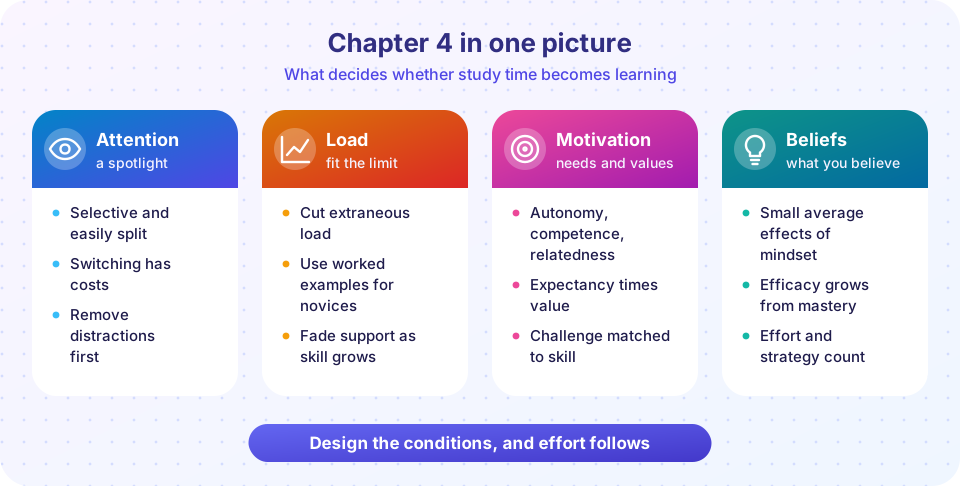
Chapter 4 moved from the memory system to the person doing the learning. You saw that attention is a limited spotlight, that working memory can be overloaded by poor design, that motivation depends on needs, expectations and values, and that beliefs about ability can matter, though less dramatically than headlines suggest. This review pulls those pieces together and turns them into a concrete plan.
What you will learn
- A recap of the four ideas in chapter four.
- How they combine in the design of a single study session.
- A ten-question review quiz.
Recap table
| Lesson | Big idea | Key names | Do this |
|---|---|---|---|
| Attention and focus | Attention is selective and limited; switching has costs | Cherry, Broadbent, Treisman, Simons and Chabris | Single-task; remove temptations; check in |
| Cognitive load | Match instruction to working memory | Sweller, Chandler, Kalyuga, Mayer | Use worked examples; integrate text and diagrams; fade support |
| Motivation theories | Needs, expectancy, value and flow drive effort | Deci and Ryan, Eccles and Wigfield, Csikszentmihalyi | Offer choice, build competence, show relevance |
| Mindset and self-efficacy | Beliefs shape effort, with modest average effects | Dweck, Bandura, Weiner | Praise process; engineer real successes |
Designing one study session
Suppose you must learn the main ideas of a chapter on cell division this evening.
- Protect attention. Put your phone in another room, close other tabs and set a time block.
- Fit the load. Study two stages at a time with a labeled diagram on one page, not text on one page and labels on another.
- Build motivation. Write one sentence on why you want to understand it, choose the order you tackle topics in, and start with a step you can finish.
- Support belief. Notice a past success with a similar topic, and treat early mistakes as information.
- Retrieve. Close the book and write what you remember, then check (chapter 3).
Notice how the plan uses ideas from several chapters together. That is the point of the loop at the start of the course.
Reading the chapter critically
A good habit from chapter 1 is to ask how strong each claim is. Here is a quick audit of this chapter's main claims.
- Strong and well replicated: attention is selective and limited; switching between demanding tasks has costs; the worked-example effect for novices; split-attention effects; self-determination theory's three needs as predictors of engagement; self-efficacy's link to effort and performance.
- Real but smaller or more conditional than popular accounts: the effects of growth-mindset interventions; the effect of rewards on intrinsic motivation; the benefits of particular multimedia principles in every setting.
- Contested or not reliably replicated: the idea that merely having a phone nearby drains capacity; some laptop note-taking results; the claim that "grit" is a distinct trait that adds much beyond conscientiousness; the exact shape of the Yerkes-Dodson curve.
- Myths: the eight-second attention span, and "multitaskers are better at multitasking".
When you meet a new claim about attention or motivation, place it on this ladder before you act on it. Most of the time, the best advice is the least exciting: protect your focus, reduce clutter, support your needs, and build real successes.
Try it
A session planner. Choose how long you have, how hard the topic feels, and how many distractions you expect. The tool suggests block lengths, a load strategy and a retrieval step. The suggestions are rules of thumb built from this chapter, not a validated prescription.
Check your understanding
Ten questions mix every lesson in this chapter.
Quick check · 10 questions
of 10 answered You scored / 10 · perfect!
-
1. In the cocktail party effect, why might you notice your own name in an ignored conversation?
Treisman's attenuation idea explains why highly relevant signals can pass through a weakened filter. -
2. About how many viewers counting passes in the gorilla video missed the gorilla?
Roughly half missed it, an example of inattentional blindness. -
3. What is the best-supported statement about multitasking?
Task switching has measurable costs, especially on complex tasks. -
4. A diagram's labels are listed on a separate page. This creates:
Learners must mentally combine separated sources, wasting working memory. -
5. The expertise reversal effect suggests that:
Detailed support duplicates what experts already know. -
6. Which is NOT a need in self-determination theory?
The three needs are autonomy, competence and relatedness. -
7. In expectancy-value theory, motivation is low if:
Both questions, 'Can I?' and 'Does it matter?', must receive a positive answer. -
8. Which is the strongest source of self-efficacy?
Bandura identified successful experience as the most powerful source. -
9. What do large studies suggest about growth-mindset interventions?
Sisk et al. (2018) and Yeager et al. (2019) found small average effects, larger for some groups. -
10. Overjustification refers to:
Lepper, Greene and Nisbett (1973) found less free-time drawing in children who had expected a reward.
Summary
- Attention is limited, selective and easily disrupted by switching; single-tasking and removing temptations help.
- Cognitive load must fit working memory: cut extraneous load, use worked examples, fade support.
- Motivation grows with autonomy, competence, relatedness, expectancy and value.
- Beliefs matter modestly: build self-efficacy through real successes and process feedback.
- The rest of the course turns these foundations into teaching methods, study strategies, expertise and projects.
Track your progress
Create a free account to tick off lessons and pick up where you left off on any device.
of The Psychology of Learning lessons completed