


















Lesson 2 of 46 · Getting Started
What is learning?
A clear, evidence-based definition of learning in psychology, the main kinds of learning, and why how well you do today is not the same as what you have learned.
Everyone uses the word "learning", yet it is surprisingly hard to pin down. A baby learns to recognize a face. A teenager learns to solve quadratic equations. A sea slug learns to ignore a harmless touch. A pianist learns a new piece and an adult learns to feel calm on a plane. These are very different achievements. Psychologists need one definition that covers all of them, and they need a way to tell real learning apart from things that only look like it.
In this lesson you will build that definition step by step, meet the main kinds of learning, and learn the single most important distinction in the whole field: learning versus performance.
What you will learn
- A working definition of learning and what it excludes.
- Why psychologists separate learning from performance, and how to measure each.
- The main kinds of learning, from habituation to insight.
- Why some conditions that slow you down during practice help you in the long run.
Key terms
Learning: a relatively lasting change in knowledge, behavior or capability that results from experience.
Performance: what you can do at a particular moment, such as during practice or on a test today.
Habituation: a simple form of learning in which a response to a repeated, harmless stimulus gets weaker.
Association: a link formed in memory between two events, or between an action and its result.
Transfer: using what you learned in a new situation that differs from the one in which you learned it.
A working definition
Most textbooks define learning in some version of this sentence: learning is a relatively lasting change in knowledge or behavior that results from experience. Each part of it is doing work.
- "Change in knowledge or behavior" covers both what you can say (facts, concepts) and what you can do (skills, habits, reactions). Sometimes the change is invisible at first. You may understand something without showing it until a question comes up.
- "Relatively lasting" excludes temporary states. If you are wide awake after a coffee and sharp for an hour, that is not learning. If you remember a fact for ten seconds because you just heard it, that is short-term memory. Learning has to survive at least some time.
- "Results from experience" excludes changes caused by growth (a child's arm gets longer), fatigue, injury, or drugs. Experience includes practicing, watching, being rewarded, being surprised, and thinking.
By this definition, learning is not a thing you can see directly. It is an inference. A teacher sees you answer a question correctly and infers that you have learned something. That inference can be wrong, which brings us to the key distinction.
Learning is not performance
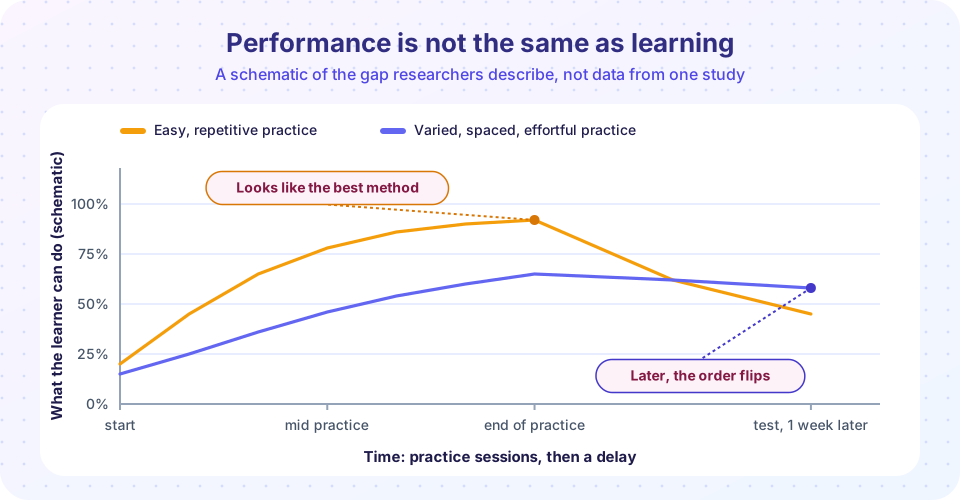
Imagine two students preparing for a vocabulary test. Student A reads a word list and the translations side by side, again and again. Student B covers the translations and tries to recall each one, getting many wrong at first. After one practice session, Student A is more accurate. Student A performs better. A week later, on the real test, Student B remembers more.
Robert Bjork and his colleagues have built a large research program on this pattern. In a widely cited 2015 review, Nicholas Soderstrom and Robert Bjork argued that performance during training is an unreliable guide to learning. Practice conditions that make performance look good can produce poor long-term retention, and conditions that make practice feel harder can produce better retention and better transfer.
The reasoning behind it is easier to grasp with a simple analogy. Think of memory as having two separate qualities:
- Storage strength: how deeply and richly a piece of knowledge is embedded in your memory. It builds slowly, and it does not fade much.
- Retrieval strength: how easily the knowledge comes to mind right now. It rises fast with recent exposure and falls fast when you stop.
Re-reading a list you have just seen gives high retrieval strength immediately, so you feel fluent. But it adds little storage strength. Trying to recall something that is a little hard to remember adds a lot of storage strength, even though it feels clumsy. Bjork and Bjork introduced this "new theory of disuse" in 1992, and Bjork later coined the phrase desirable difficulties for conditions that slow learning in the moment yet strengthen it for the long term.
The storage and retrieval idea is a model, a simplification used to organize findings. It is not a measurement of two separate things in the brain. Treat it as a useful picture rather than literal anatomy.
How to measure learning, not just performance
Because performance can mislead, researchers use several kinds of tests.
- A delayed test. Wait hours or days before testing, so that short-lived fluency has faded.
- A transfer test. Ask a new question that needs the same idea in a different form.
- A relearning measure. Check how quickly someone relearns material they appear to have forgotten. Hermann Ebbinghaus used this "savings" idea in the 1880s.
When you evaluate any study method, including your own, ask: "Did it help on the test a week later, and on a new problem?" If the answer is only about the end of today's session, the evidence is weak.
The main kinds of learning
Psychologists group learning into families. You will explore them in depth in chapter 2; here is a first map.
Non-associative learning involves a single stimulus. In habituation, you stop responding to something harmless that keeps happening: the hum of a refrigerator, the feel of your clothes. In sensitization, a strong or threatening stimulus makes you react more strongly to everything for a while. Eric Kandel won a Nobel Prize (2000, shared) partly for showing how these simple forms of learning change synapses in the sea slug Aplysia.
Associative learning links events. In classical conditioning you learn that one signal predicts another, such as the sound of a kettle predicting a hot drink. In operant conditioning you learn that an action leads to a consequence, such as pressing a button and getting a snack.
Observational learning means learning by watching others, without trying yourself. Albert Bandura's research on children and models showed how powerful it is.
Cognitive learning includes insight, mental maps, concepts and schemas. You suddenly see how a problem fits together, or you build a framework for a topic and fit new facts into it.
Implicit and explicit learning cut across these families. Explicit learning is something you can state ("Paris is the capital of France"). Implicit learning shows up in behavior without conscious knowledge, such as an accent or the feel of a typing rhythm.
Real learning usually mixes these. Learning to drive involves watching an instructor, associating signs with actions, building mental maps and gradually shifting from effortful, explicit control to fluent, implicit control.
Common misconceptions
"Learning is just memorizing." Memory is one ingredient. Learning also involves understanding, organizing, applying and, often, changing how you act.
"If I got it right, I learned it." A right answer today can be a short-lived burst of fluency. Check after a delay.
"Struggling means I am bad at this." Some struggle is the signature of strong learning. Bjork's "desirable difficulties" are hard on purpose. The difficulty is only desirable if you can eventually succeed, so it must be at the right level.
"Fast learning is better learning." Fast gains in practice often fade fastest.
Try it
First, a toy model of the simplest learning of all, habituation. The model assumes that each repetition of the same harmless stimulus cuts the response by 15 percent, and that a new stimulus restores a full response.
Press Run (or Ctrl + Enter) to see the result here.
Program input · what you'd type while the program runs
Type the answers before you press Run, one per line. Each time the program reads a line (with input()), it gets the next line from this box.
Second, a toy model of the learning-versus-performance gap. Easy practice quickly raises how fluent you feel (retrieval strength) but builds little lasting memory (storage strength). Hard, spaced practice does the opposite. The numbers are invented to show the idea; they are not measurements.
Press Run (or Ctrl + Enter) to see the result here.
Program input · what you'd type while the program runs
Type the answers before you press Run, one per line. Each time the program reads a line (with input()), it gets the next line from this box.
Check your understanding
Quick check · 5 questions
of 5 answered You scored / 5 · perfect!
-
1. Which of these best fits the definition of learning?
Learning is a relatively lasting change caused by experience. The route is remembered over a long time and was learned from experience. -
2. Student A reads translations beside words and does well after one session. Student B tries to recall them and does worse at first. A week later, which result is typical?
Effortful retrieval tends to build more lasting memory, even though performance during practice is lower. -
3. What is habituation?
Habituation is the simplest form of learning: you stop responding to something repetitive and harmless. -
4. Which test gives the best information about learning rather than short-lived performance?
Delay removes short-term fluency, and a new question checks transfer. Confidence and hours are poor guides. -
5. What does the phrase "desirable difficulty" mean?
Desirable difficulties are challenges that slow performance in the moment but strengthen learning, as long as the learner can succeed with effort.
Summary
- Learning is a relatively lasting change in knowledge, behavior or capability caused by experience.
- Learning is inferred from performance, but performance during practice can mislead.
- Delayed and transfer tests are better measures of learning than end-of-practice results.
- The main families are non-associative, associative, observational and cognitive learning, mixed in real life.
- Desirable difficulties slow practice yet strengthen long-term learning.
Track your progress
Create a free account to tick off lessons and pick up where you left off on any device.
of The Psychology of Learning lessons completed