


















Lesson 30 of 46 · Spaced Practice and Study Strategies
Interleaving and mixed practice
Why alternating problem types usually beats doing one type at a time: the key experiments, the discrimination explanation, the limits, and how to mix your practice.
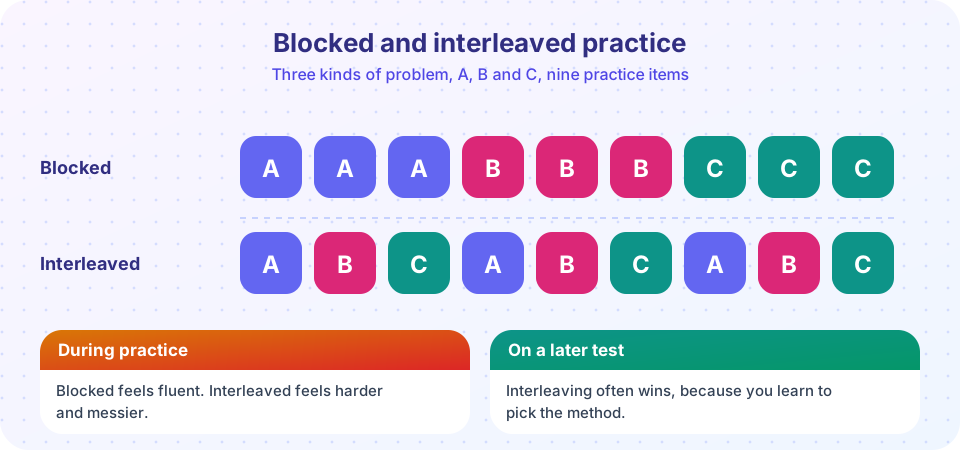
Open almost any mathematics textbook and you will see the same layout. A section explains one technique, and then come twenty exercises that use exactly that technique. A student who does them all is practicing blocked: one kind of problem at a time. It feels efficient. By the tenth exercise you are quick and confident.
Interleaved practice instead mixes kinds of problems: one on technique A, one on B, one on C, then A again. Practice feels harder and slower and you make more mistakes. Yet in many experiments, the interleaved learners perform far better when tested later. This lesson explains the evidence, why it happens and when it does not.
What you will learn
- What interleaving is and how it differs from spacing
- The main studies: mathematics, paintings and motor skills
- The discrimination explanation for why it works
- When interleaving helps less or not at all
- How to interleave your own practice
Key terms
Blocked practice: all items of one type are practiced before moving to the next type.
Interleaved practice: items of different types are mixed within a session.
Discrimination: learning to tell which category or method a problem calls for.
Contextual interference: the interference between tasks that arises in mixed practice, which in motor learning slows practice progress but aids retention.
The classic experiment
Doug Rohrer and Kelli Taylor (2007) taught university students to compute the volumes of four unusual solids, among them a wedge and a spherical cone. All students saw the same tutorial and did the same number of practice problems. One group did the problems blocked (all the wedge problems, then all the spheroid ones and so on). The other group did the same problems in a mixed order.
During practice, the blocked group did much better, getting around nine in ten correct against roughly six in ten for the mixed group. A week later all students took a test with a mix of problem types. The result reversed: the interleaved group scored around 63 percent and the blocked group only about 20 percent. These are approximate figures as reported in the paper. The pattern is what matters: the condition that looked best during practice was the worst on the test.
Press Run (or Ctrl + Enter) to see the result here.
Program input · what you'd type while the program runs
Type the answers before you press Run, one per line. Each time the program reads a line (with input()), it gets the next line from this box.
Beyond mathematics
Interleaving has been tested in many areas.
- Paintings. Nate Kornell and Robert Bjork (2008) had people study paintings by a dozen artists, with six pictures per artist, either grouped by artist or mixed. Later, participants classified new paintings by the same artists. Mixed study won clearly, yet most participants thought grouping had worked as well or better.
- Classrooms. Rohrer and colleagues have run studies in school mathematics classes. In a randomized trial with seventh-grade classes (2020), classes that did interleaved assignments scored higher on an unannounced test a month later than classes whose assignments were blocked.
- Motor skills. Earlier, John Shea and Robert Morgan (1979) found that people who practiced several movement patterns in random order did worse during practice but better in later retention tests than people who practiced one pattern at a time. The idea is called the contextual interference effect.
- Medicine and other professions. Studies of radiology images, dermatology and clinical reasoning also report advantages for mixed practice, though the evidence is less extensive.
A meta-analysis by Paulo Brunmair and Tobias Richter (2019), covering dozens of studies, found a moderate benefit overall. It was large for visual categories such as paintings and for mathematics, and weak or even negative for some word-learning tasks. So interleaving is not magic, but it is among the better-supported study techniques, and it earns a "moderate utility" rating in the review of study techniques you will meet in the next lesson.
Why does interleaving work?
The leading explanation is discrimination. In blocked practice, you know from the sequence which method to use on each problem (the same as last time). You rehearse how to apply a method but not when. In a mixed set, every problem makes you ask "What kind of problem is this?" before you solve it. That is exactly the skill you need in a test or in real life, where problems do not come labelled.
Interleaving also puts spacing into practice. Between two problems of the same type there are other problems, so you have partly forgotten the method and must retrieve it again. Researchers have tried to separate the two effects, and both seem to contribute, with discrimination more important when the categories are similar to each other.
That last point leads to an important qualification. Paulo Carvalho and Robert Goldstone (2014) found that the best order depends on how similar the categories are. When categories look alike and are easily confused, mixing helps because it highlights the differences. When categories are very different, blocking can help because it highlights what members of a category have in common.
Limits and cautions
- Start with a little blocking. A brand new idea needs some blocked practice so that you understand each method before you mix. Many experts suggest learning each type in a small block and then moving to mixed sets.
- It feels bad. You will make more errors during practice. A learner who judges progress by practice scores may drop the method.
- Not every material benefits. The evidence for verbal and some abstract materials is weaker than for categories and problem solving.
- Quality of the mix. Randomly throwing in unrelated items is not the point. The best mixes include items that could be confused.
- Lab and classroom differences. Most studies are short. Whether the benefit of interleaving a whole curriculum is as large over a year is not well established.
How to interleave your own practice
- Mix problem types in homework. If your textbook is blocked, build a mixed set by picking a few problems from several sections.
- Revisit older topics within each new session, in line with spacing.
- Mix categories in language learning: do not drill all past tenses, then all future tenses. Alternate.
- In sports and music, rotate between skills within a session, for example different shots or different passages of a piece.
- Always ask first, for each item: "Which method does this need, and why?"
The demonstration below turns a list of topics into a blocked plan and an interleaved plan, to help you build mixed sets.
Common misconceptions
"Interleaving is just spacing." They overlap, but interleaving also trains discrimination between problem types.
"If the mixed set is harder, I should go back to blocks." The extra difficulty is the point, as long as you can succeed with effort.
"Interleave from day one." Learn the basics of each type first, then mix.
Check your understanding
Quick check · 5 questions
of 5 answered You scored / 5 · perfect!
-
1. In Rohrer and Taylor's (2007) study, how did the blocked group perform on the later test compared with the interleaved group?
Blocked practice looked better during practice but gave far lower scores a week later. -
2. What is the leading explanation for the benefits of interleaving?
In blocked practice the method is given by the sequence, so you do not rehearse the choice. -
3. According to Carvalho and Goldstone (2014), when might blocking be preferable?
Blocking emphasizes what category members share and helps when differences are already obvious. -
4. Which is a fair summary of the meta-analysis by Brunmair and Richter (2019)?
The effect varies with the type of material. -
5. A student finds interleaved practice harder and makes more errors. What should she conclude?
Performance during practice is a poor guide to long-term learning.
Summary
- Interleaving mixes problem types within practice, while blocking does one type at a time.
- Blocked practice looks better during practice but interleaved practice often wins on later tests.
- The main explanation is discrimination, helped by built-in spacing.
- The advantage depends on the material, and some initial blocking helps with brand-new ideas.
- Build mixed sets, ask which method each item needs, and do not trust how smooth practice feels.
Track your progress
Create a free account to tick off lessons and pick up where you left off on any device.
of The Psychology of Learning lessons completed