


















Lesson 42 of 46 · Projects and Practice
Project: build and test your personal study plan
A hands-on project: turn the course into a weekly study plan, schedule it with a planner, and run a small self-experiment that compares two methods, with its statistical limits.
You now know a lot about how learning works, but knowing is not doing. The aim of this project is to turn the research into a plan that you will follow, and then to test one part of it on yourself, since the averages in a meta-analysis cannot tell you what works best for you. The project has two parts. Part one builds a spaced, retrieval-based study plan for a real goal. Part two designs a small experiment that compares two study methods on your own material.
What you will learn
- How to set a goal and break it into units
- How to choose methods for each unit, using the research from Chapters 5 to 8
- How to schedule a plan with growing gaps, using the planner below
- How to design and analyse a fair self-experiment, and why small samples are noisy
Key terms
N-of-1 trial: an experiment in which one person compares conditions on themselves.
Counterbalancing: balancing the order or assignment of conditions so that effects of order or difficulty do not look like effects of the method.
Confidence interval (CI): a range of values that is compatible with the data, given the noise.
Confound: a difference between conditions other than the one you meant to test.
Part one: the plan
Step 1: Define the goal and the deadline
Write one sentence with a skill or a body of knowledge, a measure and a date. Examples: "Pass the biology exam on 12 June" or "Hold a ten-minute conversation in Spanish by the end of August". Vague goals ("get better at math") cannot be scheduled or checked.
Step 2: Break it into units
List the topics or skills, in a sensible order. Ten to thirty units are typical for a course. Give each an estimated difficulty (easy, medium, hard). If you are not sure what is in the exam, use the syllabus, the past papers or the textbook's chapters.
Step 3: Choose methods for each unit
For each unit, pick methods from the course, using this checklist.
- Learn. Start with a clear explanation and a worked example or two (Chapter 5). For a new procedure, study examples and then try faded ones.
- Recall. After the first session, close the book and write down what you remember (Chapter 3 and Chapter 6). Check and mark gaps.
- Mix. Later sessions combine problems from several units (interleaving).
- Test. End each week with a closed-book self-test, preceded by a score prediction (calibration).
- Feedback. Decide how you will know whether you were right: an answer key, a teacher, a tutor, a checker program.
- Tools. If you use flash cards, keep each card to one idea and use a scheduler (Leitner or SM-2). If you use AI, use it for hints and quizzes, not for answers.
Step 4: Schedule it
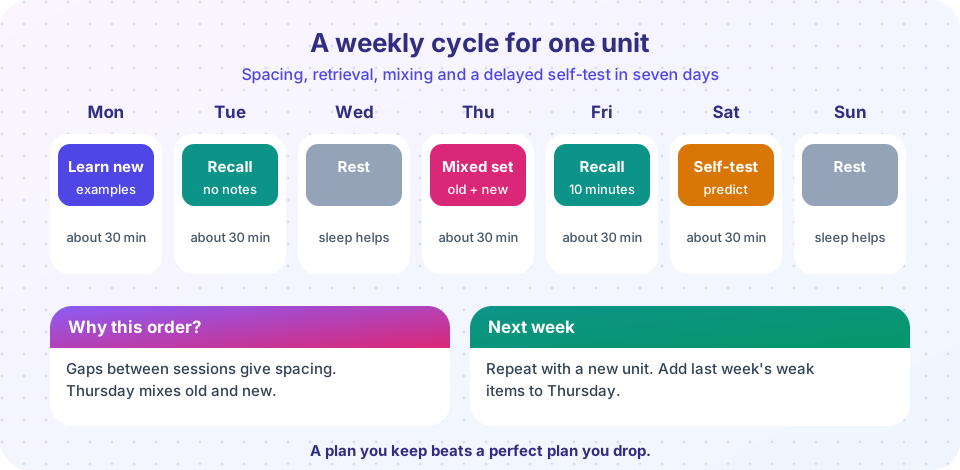
Use the weekly cycle in the picture as a starting point. The important features are that each unit appears on several different days, that recall comes before rereading, and that gaps grow, for example next day, then four days later, then in the next weekly self-test, then in a monthly review. Block time on your calendar. Aim for sessions of 25 to 45 minutes, because concentration drops with length, and put the hardest unit at the time of day when you are most alert.
The planner below turns your start date, the exam date and the number of units into a dated list. It is a template generator: it implements the weekly cycle above, then finishes with two full mixed self-tests before the exam. Adjust the output by hand.
Part two: a self-experiment
Suppose you wonder: "Does self-testing really beat rereading for me, on my material?" You can find out cheaply, if the design is fair.
Design
- Pick material you can split evenly, such as 40 vocabulary items or 40 short facts.
- Split it at random into two sets of 20, A and B. Randomizing prevents you from putting the easy items into the method you favor.
- Study set A by rereading and set B by self-testing, for the same total time, in the same kind of sessions. To cancel any effect of the day or of fatigue, swap which set gets which method halfway through a repeat of the experiment, or alternate the order of sessions.
- Test everything together after a delay (a week is good), with no notes, in a random order.
- Score each set, then compare.
Analysis, and its limits
The simplest analysis is the difference between the percentages correct. But with only 20 items per condition, the result is noisy: even if self-testing really is better, a lucky run for rereading can hide it. The analyzer below gives a rough 95 percent confidence interval. The interval is a normal approximation and is rough for small counts, so use it as a guide. If the interval includes zero, your data are consistent with no difference.
The simulation below shows why you should not be disappointed by a noisy result. It assumes self-testing really gives a 60 percent chance of a correct answer against 45 percent for rereading, both numbers invented, and repeats the experiment thousands of times with 20 and with 60 items per method.
Press Run (or Ctrl + Enter) to see the result here.
Program input · what you'd type while the program runs
Type the answers before you press Run, one per line. Each time the program reads a line (with input()), it gets the next line from this box.
Threats to a fair self-experiment
- Unequal material. If one set is simply harder, you will mistake difficulty for method. Random assignment helps.
- Unequal time or effort. Keep total study time the same, and note it.
- Expectation. You may try harder in the method you believe in. Using a partner to hand you the sets blindly helps.
- Testing differences. Test everything the same way and at the same delay.
- Small samples. One run is weak evidence. Repeat with new material.
Deliverables
At the end of the project you should have: (1) a one-page plan with goal, units, methods and calendar; (2) the planner output pasted into your calendar; (3) a short log of what you did each day; and (4) the results of at least one self-experiment, with a sentence about what you would change.
Common misconceptions
"A study that works on average works for me." Averages are a good start, but your material and habits matter. Check.
"One experiment settles it." With small samples, a single run can mislead in either direction.
"A perfect plan guarantees results." Plans work only when carried out. Make the plan easy to keep.
Check your understanding
Quick check · 5 questions
of 5 answered You scored / 5 · perfect!
-
1. Why should you assign study items to methods at random in a self-experiment?
Random assignment prevents item difficulty from being mistaken for a method effect. -
2. A 95 percent interval for the difference between methods runs from -5 to +30 points. What is a fair reading?
An interval that includes zero means the run cannot rule out no difference. -
3. Which step of the plan builds in spacing?
Different days with growing gaps is the core of spaced practice. -
4. In the simulation, what happens to the chance of a misleading result as the number of items per method grows from 20 to 60?
More items reduce the noise in the observed difference. -
5. What is a confound in a self-experiment?
For example, different study time or harder items in one condition.
Summary
- Turn the course into a plan: goal, units, methods, a calendar with growing gaps, and feedback.
- Use the planner to date a weekly cycle, then adjust it to your life.
- A self-experiment needs random assignment, equal time, delayed testing and honest scoring.
- Small experiments are noisy. Report intervals, repeat and do not over-claim.
Track your progress
Create a free account to tick off lessons and pick up where you left off on any device.
of The Psychology of Learning lessons completed