


















Lesson 43 of 46 · Projects and Practice
Case studies: three learners
Apply the course to three realistic learners, a medical student, a language learner and a career-changer learning to code, with diagnoses, fixes, a workload simulation and limits.
Principles are easy to nod along to and hard to use. This lesson works through three fictional but realistic cases. Each learner has a habit that feels productive and is not. For each you will diagnose the problem using ideas from the course and propose a plan, then check how much you agree with the suggested plan. The learners are invented composites, not real people, and the plans are applications of general findings. Treat them as worked examples of reasoning, not as prescriptions.
What you will learn
- How to diagnose a study problem by naming the principle that is being missed
- How to turn a diagnosis into a small, realistic change
- How to estimate the workload of a spaced-repetition plan
- Why every plan is a hypothesis to be checked
Key terms
Diagnosis: identifying which learning principle is not being used, and why.
Transfer-appropriate processing: memory is best when the processing during study resembles the processing needed at test (Morris, Bransford and Franks, 1977).
Lapse: a failed review of a flash card, which resets its schedule.
Workload: the number of reviews due per day in a spaced-repetition plan.
Case 1: Maya, a first-year medical student
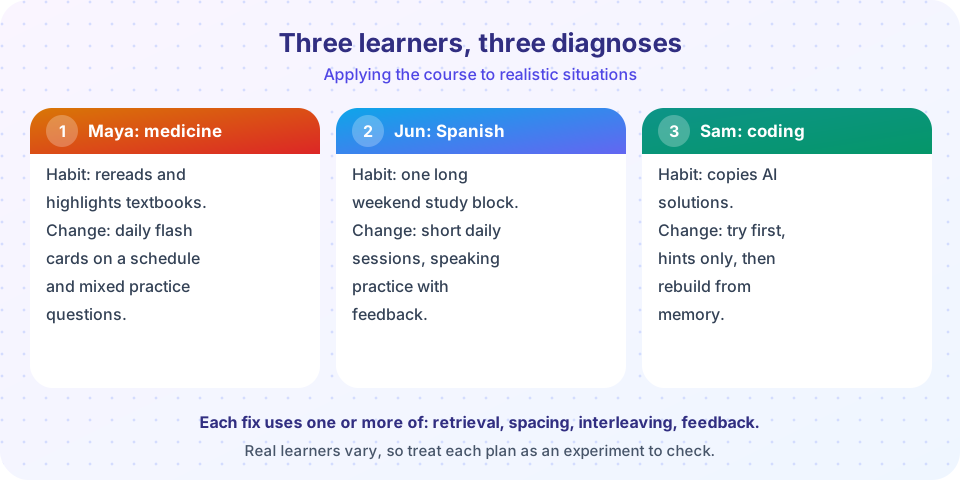
The situation. Maya studies about three hours every evening. She reads the lecture slides and textbook chapter, highlights key terms in two colors and rereads her highlights before bed. After the first anatomy test she is shocked: she scored well below her expectations on questions that mixed several body systems, although she "knew the material".
Diagnosis.
| What she does | Principle missed | Evidence from the course |
|---|---|---|
| Rereads and highlights | Retrieval practice | Rereading and highlighting were rated low utility (Dunlosky and colleagues, 2013). Retrieval beat rereading after a week |
| Feels confident | Calibration | Familiarity feels like knowing (Koriat and Bjork, 2005) |
| Studies one system at a time | Interleaving | Mixed practice improves discrimination |
| Everything on the evening before | Spacing | Massed study fades faster |
Changes. Keep the reading but cut it to one pass. Turn each lecture into 20 to 30 single-idea flash cards (a structure, its function, a clinical link) and review them with a spaced-repetition scheduler every day. Replace half the rereading time with practice questions, mixing systems, and write out answers before checking them. Once a week, take a closed-book test on the week's lectures after predicting the score.
Keep. The reading, the lectures and the group study sessions, which can be used for explaining to each other.
Limits. Studies linking flash-card scheduling to medical exam results are mostly observational, and students who use the tools are probably motivated to begin with. The reasoning rests on the laboratory evidence for retrieval and spacing, which is strong, but the size of the benefit in Maya's situation is uncertain.
The simulation below estimates Maya's daily review workload if she adds 20 new cards each day for 30 days. It assumes every review is answered correctly and uses fixed intervals (1, 6, 15, 38 and 95 days after learning, roughly what SM-2 gives for an ease factor of 2.5). Real learners forget some cards, so real workloads are higher.
Press Run (or Ctrl + Enter) to see the result here.
Program input · what you'd type while the program runs
Type the answers before you press Run, one per line. Each time the program reads a line (with input()), it gets the next line from this box.
Case 2: Jun, learning Spanish for an exchange year
The situation. Jun, sixteen, will spend a year in Mexico. He spends five hours every Saturday on a language app, mostly multiple-choice exercises. After three months he recognizes many words but freezes when speaking, and he forgets words by the following weekend.
Diagnosis.
- Massed practice: one long weekly session means long gaps and a lot of forgetting between them.
- Recognition instead of production: choosing the right option is far easier than producing a word. Transfer-appropriate processing predicts that practice should resemble the performance needed, which here is speaking.
- No feedback on speech: nobody tells him what is wrong with his pronunciation or grammar.
- Blocked topics: the app teaches one unit at a time.
Changes. Replace the weekend block with 20 to 30 minutes every day. Make flash cards that require production (English prompt, say the Spanish aloud, then check). Add a weekly conversation with a tutor or exchange partner, who gives specific feedback and who sets tasks just beyond his current level. Mix grammar topics in the same session. Record himself and compare with a native speaker's version.
Keep. The app for vocabulary exposure and listening practice, because it is enjoyable and gets him started.
Limits. Language learning has features beyond memory, such as listening skills and confidence, and motivation matters a great deal. The plan targets the memory and practice side only.
Case 3: Sam, learning to program for a career change
The situation. Sam is thirty and learning Python in the evenings. When an exercise is hard, Sam asks an AI assistant for the solution, reads it, nods and moves on. Homework is always correct. In a practice interview, Sam cannot write a simple function without help.
Diagnosis.
- Performance is not learning: correct homework reflects the assistant. Unaided skill has barely grown (the Bastani study pattern).
- No retrieval or generation: reading a solution is passive, so there is no effortful production.
- Illusion of knowing: the solutions seem obvious after reading.
- No transfer practice: Sam solves the problems the tutorial poses but never builds anything from scratch.
Changes. Try each exercise first for a fixed time, such as 15 minutes, before asking for help. Ask the assistant for the smallest hint and for questions that probe understanding, not for full solutions. The next day, rebuild yesterday's solutions from a blank file without looking (spacing and retrieval). Study short worked examples of good code first, then fade to writing alone (Chapter 5). Mix problem types. Build one small project a week from a blank page, which practices transfer. Take a weekly closed-book coding test, with a prediction first.
Keep. The AI assistant, in a tutor role: explaining error messages, quizzing and reviewing code after Sam has written it.
Limits. Sam's learning curve will feel slower at first. The plan trades faster early progress for durable skill. How much time to spend on each part depends on the job target.
A diagnosis game
Match each symptom to the main principle that is being missed. Because several principles can apply, the widget accepts the best fit and explains the others.
Turning cases into your own plan
Use the same four questions on yourself.
- What do I do when I study? Write it down for a week. Many people are surprised by how much is reading and highlighting.
- Which principle is it missing? Retrieval, spacing, interleaving, feedback or calibration.
- What is the smallest change? For example, replace the last 20 minutes of rereading with writing everything you remember.
- How will I know it worked? Choose a measure that does not depend on how it feels: a closed-book test, a timed task or a conversation.
Common misconceptions
"If the plan comes from research, it will certainly work for this person." Each plan is a hypothesis to be checked against results.
"A learner who struggles needs an easier method." Often the struggle is the right kind. The fix is to make it productive with feedback and structure.
"One principle is enough." The cases above need several working together.
Check your understanding
Quick check · 5 questions
of 5 answered You scored / 5 · perfect!
-
1. Why does Maya's confidence after rereading mislead her?
She never tested recall, so she had no evidence about what she could retrieve. -
2. What does transfer-appropriate processing predict for Jun?
Memory is best when study processing resembles test processing. -
3. What is the best next step for Sam when a coding exercise is hard?
Trying first and getting hints preserves retrieval and generation. -
4. In the workload simulation, why is real workload higher than the plotted one?
The simulation assumed every review was correct. -
5. Which question best checks whether a plan worked?
Performance on delayed unaided tests is the better indicator than feelings or hours.
Summary
- Diagnose by naming the principle that is missing: retrieval, spacing, interleaving, feedback, calibration or production practice.
- Make the smallest change that adds the missing principle, and keep what already works.
- Plans are hypotheses. Measure with delayed, closed-book checks.
- A spaced-repetition plan has a workload that peaks and then fades. Failed cards add to it.
Next: Glossary
Track your progress
Create a free account to tick off lessons and pick up where you left off on any device.
of The Psychology of Learning lessons completed