


















Lesson 18 of 46 · Attention, Motivation and Mindset
Attention and focus
How attention works and why it limits learning: the cocktail party effect, the invisible gorilla, the cost of task switching, mind wandering, and practical ways to protect focus.
"Pay attention!" is one of the most common instructions in any classroom, and one of the least useful, because it does not say how. What is attention? Why is it so easy to lose? And why do we so often fail to notice that we have failed? Psychologists have studied these questions since the 1950s, and their answers matter for every learner, because nothing can be learned from information that never gets attended to.
In this lesson you will meet the research on selective attention, the famous "invisible gorilla" experiment, the real cost of multitasking, and the evidence behind common advice about focus, including the parts that are less solid than they sound.
What you will learn
- The main kinds of attention and the classic experiments that revealed them.
- Why people miss obvious things (inattentional blindness) and why that matters for studying.
- What the research says about multitasking, task switching and phones.
- Practical, evidence-informed ways to protect focus, and which popular claims are weak.
Key terms
Selective attention: focusing on some information while filtering out the rest.
Divided attention: attempting to attend to more than one task or source at once.
Sustained attention (vigilance): keeping attention on a task over time.
Inattentional blindness: failing to notice an unexpected object in plain view while attending to something else.
Task switching cost: the slowing and extra errors that result from switching between tasks.
A limited spotlight
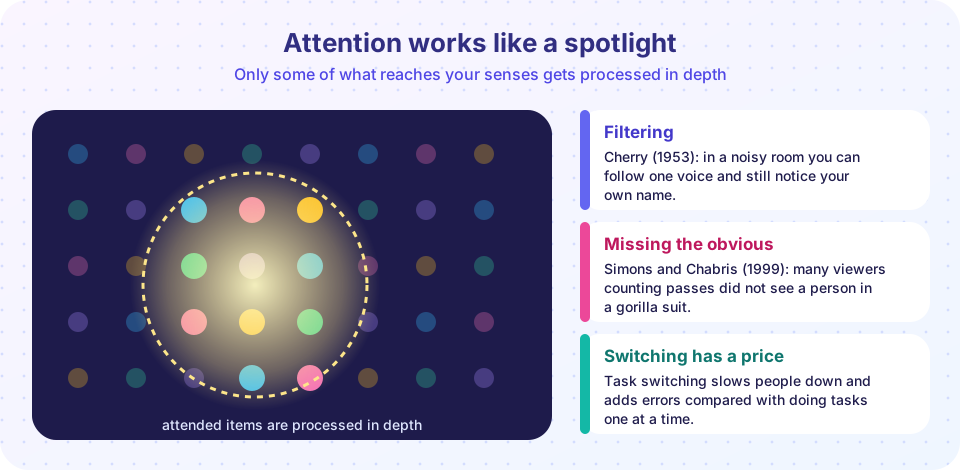
Your senses take in far more than you can process. Attention is the mechanism that selects. Three kinds appear again and again.
- Selective attention picks out one stream. In a noisy cafe you follow one conversation.
- Divided attention spreads effort across tasks. It works when one task is automatic (walking and talking) and fails when both need conscious control.
- Sustained attention holds focus over time. It fades faster than we expect.
The cocktail party and the filter
In 1953 Colin Cherry played a different message to each ear of listeners through headphones and asked them to repeat the message in one ear (a technique called shadowing). Afterward, they could say almost nothing about the other ear, except that it contained speech or a tone, not what the words were or even whether the language had changed. But the filter is leaky: Neville Moray (1959) found that about a third of people noticed their own name in the ignored ear. Donald Broadbent proposed that attention works like a filter that blocks unattended input early; Anne Treisman suggested that the unattended message is turned down rather than blocked, so that very important signals, such as your name, can still break through. Later theories treat attention as a limited resource that can be allocated (Daniel Kahneman, 1973).
The Stroop effect: automatic processing competes
In 1935 John Ridley Stroop showed that naming the ink color of a word is slowed when the word names a different color (the word RED printed in blue). Reading is so automatic that it interferes with the task. The Stroop effect is a standard demonstration that automatic processes cannot easily be switched off, and that attention has to work to resolve conflict. You can feel it in the demo below.
Missing the obvious: inattentional blindness
In 1999 Daniel Simons and Christopher Chabris asked viewers of a short video to count how many times players in white shirts passed a basketball, while players in black shirts also passed a ball. In the middle, a person in a gorilla suit walked through, stopped, thumped their chest and walked off. About half of the viewers did not notice the gorilla. The effect, now known as inattentional blindness, was larger when the counting task was harder.
Related is change blindness: people often fail to notice large changes in a scene when the change happens during an interruption, such as a cut or a blink. The lesson for learners is humbling: feeling that you noticed everything is not evidence that you did. When you read a textbook while your attention is on a message, the words may enter your eyes and never reach understanding. You can read an entire page and have nothing to show for it.
Mind wandering
Even without distractions, the mind drifts. In an experiment by Matthew Killingsworth and Daniel Gilbert (2010), thousands of people were pinged on their phones throughout the day and asked what they were doing and thinking. Around 47 percent of the time, people reported thinking about something other than what they were doing. Mind wandering during reading is linked to worse comprehension, partly because people often do not notice it (Jonathan Smallwood and Jonathan Schooler have studied this). The good news: noticing and gently returning your attention is a trainable skill, and "checking in" with questions about what you just read helps.
Multitasking and task switching
Most "multitasking" is really rapid switching. Each switch has a cost. Joshua Rubinstein, David Meyer and Jeffrey Evans (2001) found that switching between tasks takes extra time and that the cost increases with task complexity and unfamiliarity. Sophie Leroy (2009) proposed that after switching, part of your attention stays on the previous task ("attention residue"), which hurts performance on the new one.
Other findings are more mixed, so claims should be handled with care.
- Media multitasking. Eyal Ophir, Clifford Nass and Anthony Wagner (2009) reported that heavy media multitaskers did worse on some filtering and switching tasks. Later studies have found weaker or inconsistent differences, so the direction of cause is still debated.
- Laptops in class. Faria Sana and colleagues (2013) found that students who multitasked on a laptop during a lecture scored lower, and so did the students sitting behind them who could see their screens. A well-known study of laptop note-taking by Pam Mueller and Daniel Oppenheimer (2014), claiming that handwriting beats typing, has been hard to replicate in later work, so it should not be treated as settled.
- Phones in sight. Adrian Ward and colleagues (2017) reported that the mere presence of a phone reduced available cognitive capacity. Some replications did not find the effect, so the safe conclusion is that using a phone clearly harms focus while the effect of just having it nearby is less certain. Putting it in another room is still cheap and sensible.
- Attention span myths. The popular claim that people now have an eight-second attention span, shorter than a goldfish, has no sound scientific source.
What to do about it
- Single-task. Give one task your full attention for a defined block, and write down distracting thoughts instead of acting on them.
- Reduce temptations before you start. Silence notifications and put the phone out of reach. Willpower is a poor defence against a device that is designed to attract attention.
- Make the task engaging. Active strategies, like retrieval practice and problem solving, demand attention and keep it. Passive reading invites wandering.
- Take breaks. Breaks help sustained attention, but evidence for any specific schedule (such as 25 minutes on, 5 off) is thin. Pick a rhythm that works for you.
- Check in. Pause every few paragraphs and ask "what did I just read?" If you cannot say, reread with attention.
- Sleep and exercise. Both support attention.
Common misconceptions
"I am good at multitasking." Self-rated multitaskers are often not better at it. Switching costs affect almost everyone for demanding tasks.
"If it was in front of my eyes, I saw it." Inattentional blindness shows that attention, not just looking, determines what you perceive.
"Attention is just willpower." It is also shaped by the environment, the design of the task, sleep and interest.
"Background music always helps." Music without lyrics can be neutral or helpful for some, but music with lyrics tends to interfere with reading and writing.
Try it
First, a Stroop test. A word appears in colored ink. Press the button that matches the ink color, not the word. Trials are either congruent (the word names its own color) or incongruent (it names another). The demo records your reaction time on each type. It is a classroom demonstration; your times depend on your device and your reflexes.
Second, a toy model of switching costs. Ten tasks that each take 3 minutes are done either one after another, or switched every minute. Each switch costs a fixed number of seconds plus a small chance of an error that needs a minute to repair. The costs are assumed values to illustrate the idea, not measurements of real people.
Press Run (or Ctrl + Enter) to see the result here.
Program input · what you'd type while the program runs
Type the answers before you press Run, one per line. Each time the program reads a line (with input()), it gets the next line from this box.
Check your understanding
Quick check · 5 questions
of 5 answered You scored / 5 · perfect!
-
1. In the invisible gorilla experiment, about how many viewers who were counting passes missed the gorilla?
Roughly half of viewers did not notice it, an example of inattentional blindness. -
2. Why does the Stroop effect occur?
Automatic word reading competes with the task of naming ink color. -
3. Which statement about multitasking is best supported?
Task switching slows performance and adds errors, especially for complex tasks. -
4. What did Treisman add to Broadbent's filter idea?
Attenuation explains why your own name can capture attention in an ignored stream. -
5. Which popular claim has no sound scientific basis?
The goldfish claim has no credible scientific source.
Summary
- Attention is a limited, selective resource; important signals can break through filters.
- Inattentional blindness shows that looking is not the same as perceiving.
- Mind wandering is common, and task switching has real costs; some media and phone effects are less certain than headlines suggest.
- Single-tasking, removing temptations, active study and regular check-ins protect focus.
Next: Cognitive load
Track your progress
Create a free account to tick off lessons and pick up where you left off on any device.
of The Psychology of Learning lessons completed