


















Lesson 15 of 46 · Memory and Retrieval Practice
Retrieval practice: the testing effect
Why pulling information out of memory beats putting it in again: the testing effect, the key studies, why it works, how to use feedback, and where its limits lie.
Imagine two students preparing for the same exam. One rereads the textbook chapter four times. The other reads it once and then closes the book and writes down everything she can remember, checks her answers against the book, and repeats. After the first session, the rereader feels more confident, because the text looks familiar. A week later, the second student remembers much more. This pattern has been shown in laboratories and classrooms for over a century, and it is one of the most reliable findings in the science of learning.
The idea is called retrieval practice, and the benefit is called the testing effect. It is not about grades or high-stakes exams. It is about using memory to bring information out, because doing so changes the memory in a way that merely taking information in does not. In this lesson you will see the key experiments, the likely reasons it works, and how to make the most of it.
What you will learn
- What the testing effect is and the key experiments behind it.
- Why retrieval changes memory, and why students underuse it.
- How to design good retrieval practice, with the role of feedback.
- The limits of the method and common objections.
Key terms
Retrieval practice: deliberately recalling information from memory, for example by self-quizzing, rather than re-reading it.
Testing effect: better long-term retention of material that was tested than of material that was restudied for the same time.
Feedback: information about whether an answer was right and what the correct answer is.
Hypercorrection effect: the finding that errors made with high confidence are more likely to be corrected after feedback.
Successive relearning: practicing retrieval of an item repeatedly across sessions until it is recalled correctly several times.
The classic experiments
The idea is old. In 1917 Arthur Gates found that children who spent part of their study time reciting from memory remembered more than children who spent the whole time reading. In 1939 Herbert Spitzer tested more than 3,000 school pupils in Iowa and found that those who had taken a test soon after reading material kept more of it weeks later than those who had not.
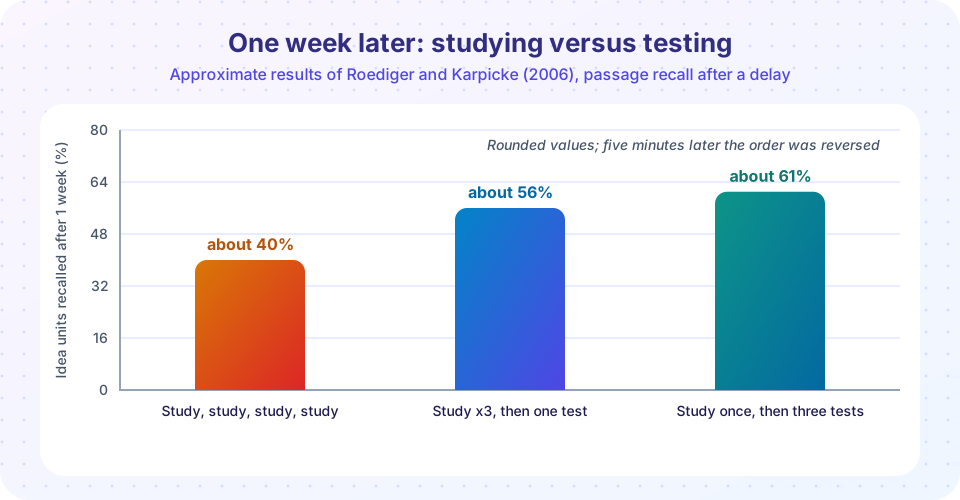
The study that brought the effect to wide attention was published by Henry Roediger and Jeffrey Karpicke in 2006. Students read short prose passages and then either studied them again or took free-recall tests, in which they wrote down everything they could remember without notes. Across the conditions, they spent the same total time. In one version, one group studied the passage four times (SSSS), another studied three times and took one test (SSST), and a third studied once and took three tests (STTT). Five minutes later, repeated study was best, which is the result that makes cramming feel good. But a week later, the order reversed: students who had tested themselves three times remembered about 61 percent, the one-test group about 56 percent, and repeated study about 40 percent of the ideas. Despite performing better a week later, the testing students had predicted the opposite. They thought repeated reading would serve them best.
In 2011 Karpicke and Janell Blunt compared retrieval practice with a technique many consider more sophisticated, creating concept maps while looking at the text. A week later, retrieval practice gave better scores, both on questions that asked for facts and on questions that needed inference. In real classrooms, Roediger and colleagues (2011) found that middle-school students did better on unit tests for material that had been covered in short, low-stakes quizzes than for equivalent material that had not.
Why does it work?
Researchers have several overlapping explanations.
- Effort strengthens memory. In Bjork's terms, trying to retrieve something that is somewhat hard to retrieve adds more storage strength than easy re-exposure. The harder (but successful) the retrieval, the bigger the benefit.
- Retrieval builds routes. Each time you retrieve an item, you practice the very pathway you will need later, and create new cues linking the information to the question. This matches the principle of transfer-appropriate processing.
- Elaboration happens during retrieval. Search involves related ideas, which become linked to the answer.
- Feedback exposes gaps. Testing reveals what you do not know, so you can direct study time where it is needed.
Notice that the testing effect does not depend on getting the answer right. Even unsuccessful attempts, followed by the correct answer, can improve learning compared with reading the answer first. This is sometimes called "pre-testing".
Feedback: closing the loop
Retrieval without feedback works if you recall correctly, but it can lock in mistakes. Corrective feedback matters most when you are not sure. Butterfield and Metcalfe (2001) found the hypercorrection effect: when people were highly confident in a wrong answer and then saw the right one, they were more likely to correct it later than when they were unsure. Surprise supports learning, in line with prediction-error ideas from chapter 2. In practice: check your answers right after you try, and give extra attention to ones you got wrong with confidence.
How to practice retrieval
- Close the book and write. After reading a section, write down everything you remember (a "brain dump"), then check against the source.
- Flashcards, used well. Cards that ask for recall of a specific answer work. Cards that you flip without trying to answer do not. Separate the cards you remember easily, and review the difficult ones more often.
- Practice problems and past questions. In maths and science, solving problems from memory (not following a worked example) is retrieval of procedures.
- Teach it. Explaining a topic to an imaginary student, without notes, tests your understanding.
- Quiz in layers. Return to earlier topics in later quizzes (this is interleaving with retrieval).
- Successive relearning. Rawson and Dunlosky have shown that retrieving each item until you get it right, then returning in later sessions, is a powerful combination of retrieval and spacing.
Question format matters less than effort. Short-answer and free-recall tests often give bigger benefits than multiple choice, but multiple choice still helps when the wrong options are plausible.
Limits and objections
- Anxiety. Quizzing can feel stressful, especially if graded harshly. Evidence favors low-stakes retrieval, such as ungraded quizzes, where feedback matters more than score.
- Complex materials. Some researchers, including Tamara van Gog and John Sweller (2015), noted that the testing effect may be smaller for very complex material with many interacting elements. In such cases, learners may need worked examples first and retrieval later. Evidence here is still developing.
- Understanding versus recall. Retrieval practice improves both fact and inference scores in several studies, but it works best when your practice questions ask for the kind of thinking you will need.
- Not a replacement for first learning. You need something to retrieve. Read, listen or practice first.
- Students avoid it. Karpicke, Butler and Roediger (2009) found that most college students did not use retrieval practice as a main strategy, partly because it feels harder. That feeling of difficulty is desirable.
Common misconceptions
"Testing is only for measuring learning." Tests are also learning events. The act of retrieving changes memory.
"If I get it wrong, the test was a waste." An unsuccessful attempt, followed by feedback, still helps.
"Retrieval practice means high-stakes exams." The research effects come mostly from low-stakes practice.
"Rereading is the same, just slower." Direct comparisons show a retention advantage for testing, which grows with delay.
Try it
First, a small retrieval-versus-restudy experiment on you. Eight facts from this course are split randomly: half are shown with their answers to restudy, half are quizzed (you type an answer, then see the correct one). After a pause, a final test covers all eight. A single run is far too small to prove anything, but it lets you feel the difference in effort. The effect is usually larger after a delay, so try the final test again later today.
Second, a toy model comparing restudy and retrieval. In this model a memory's stability grows by a small fixed amount when you restudy, but by an amount that grows with how hard the retrieval was (that is, how much had been forgotten) when you retrieve. The numbers are illustrative, not measurements.
Press Run (or Ctrl + Enter) to see the result here.
Program input · what you'd type while the program runs
Type the answers before you press Run, one per line. Each time the program reads a line (with input()), it gets the next line from this box.
Check your understanding
Quick check · 5 questions
of 5 answered You scored / 5 · perfect!
-
1. In Roediger and Karpicke (2006), what happened on the one-week test?
Studying once and testing three times produced the best recall after a week, even though repeated study had been best after five minutes. -
2. What is the hypercorrection effect?
Butterfield and Metcalfe (2001) found that high-confidence errors were more likely to be corrected after feedback. -
3. Which is the best example of retrieval practice?
Self-testing with feedback forces recall, which strengthens memory. -
4. Why do students often avoid retrieval practice?
The sense of difficulty is misread as a sign of poor learning, even though effortful retrieval helps. -
5. Which condition tends to favor retrieval practice most?
Low-stakes practice reduces anxiety, and feedback corrects errors.
Summary
- Retrieving information from memory strengthens it more than restudying, with the gap growing over time.
- Roediger and Karpicke (2006) and Karpicke and Blunt (2011) are landmark experiments; classroom studies show similar gains.
- It works partly because effortful retrieval strengthens memory and builds retrieval routes; feedback corrects errors.
- Use low-stakes quizzes, flashcards, brain dumps and problems, and return to items over days.
- It has limits: you must learn something first, anxiety should be low, and complex material may need worked examples.
Next: Chapter 3 review
Track your progress
Create a free account to tick off lessons and pick up where you left off on any device.
of The Psychology of Learning lessons completed