


















Lesson 8 of 46 · How Learning Works
Observational and cognitive learning
How people learn by watching others and by thinking: Bandura's Bobo doll studies, Tolman's cognitive maps, Köhler's insight, Piaget's schemas and Vygotsky's zone of proximal development.
Nobody learns to speak a language, drive a car or behave at a dinner table by trial and error alone. Most of what people know comes from watching, listening, imitating and thinking. A child who sees a parent open a door does not need to rattle the handle for ten minutes first. A student who finally "gets" how fractions work has done more than form a habit: they have rebuilt their understanding.
Conditioning could not explain these cases, which is why psychologists developed theories of observational and cognitive learning. In this lesson you will meet Albert Bandura, Edward Tolman, Wolfgang Köhler, Jean Piaget and Lev Vygotsky, and take away a set of ideas that teachers still use every day.
What you will learn
- How observational learning works and which four processes it needs.
- What latent learning and cognitive maps show about learning without visible behavior.
- How insight, schemas (assimilation and accommodation) and the zone of proximal development explain understanding.
- Why "learning styles" are not supported by the evidence.
Key terms
Model: a person (or character) whose behavior is observed and may be imitated.
Vicarious reinforcement: learning from seeing a model's actions be rewarded or punished.
Latent learning: learning that occurs without a visible change in behavior until a reason to show it appears.
Schema: an organized mental framework for a category of knowledge, such as "restaurant".
Zone of proximal development (ZPD): the range of tasks a learner cannot yet do alone but can do with help.
Learning by watching: Albert Bandura
In the early 1960s, Albert Bandura and his colleagues Dorothea and Sheila Ross ran a now-famous series of experiments. Children aged about three to six watched an adult in a room with toys, including a large inflatable "Bobo" doll. Some children saw the adult hit the doll with a mallet and shout phrases; others saw the adult play quietly. When the children were later left alone with the toys, those who had seen the aggressive model were more likely to hit the doll, and many reproduced the exact phrases and moves they had seen. No child had been rewarded for any of it.
The result was important because it showed that people can acquire a behavior simply by observing, without performing it or receiving a reward. Later work by the same team (1963) showed that children also respond to what happens to the model: seeing the model rewarded increased imitation and seeing the model punished reduced it. Bandura called this vicarious reinforcement.
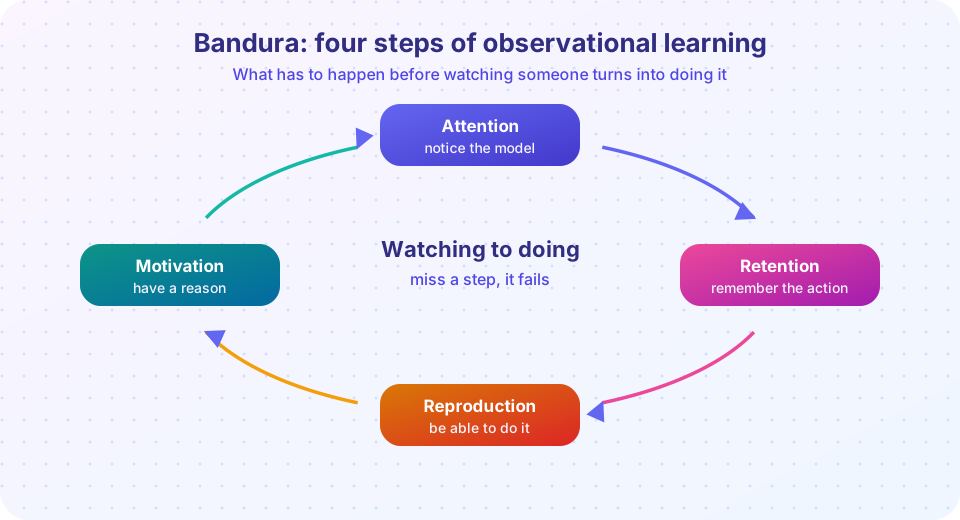
Bandura built a broader theory, now called social cognitive theory, around four processes that must all succeed for observation to turn into action.
- Attention. You must notice the model and the relevant details. Models who are similar, admired or skilled get more attention.
- Retention. You must store what you saw, usually as images or words, and rehearse it.
- Reproduction. You must be physically and mentally able to carry out the action. Watching a pianist does not make your fingers able to play the piece.
- Motivation. You must have a reason to do it, such as expected rewards, observed outcomes, or your own goals.
The Bobo studies have been debated: some critics argue that the doll is meant to be hit, so imitation may reflect a game rather than real aggression, and the long-term effect of media violence remains an area of disagreement. But the core claim, that people learn from models, is one of the most robust in psychology. It is why worked examples, demonstrations, apprenticeships and "think-aloud" teaching are so effective.
Learning without visible behavior: Edward Tolman
Behaviorists said that learning is a change in observable behavior caused by reinforcement. Edward Tolman, working with rats in mazes, disagreed. In a classic experiment (Tolman and Honzik, 1930), three groups of rats ran a maze once a day. One group always found food at the end. A second group never did. A third group found no food for ten days and then began to get food from day 11.
The first group steadily made fewer wrong turns. The second group improved little. But the third group, as soon as food appeared, dropped its errors within a day or two to match the first group. They had been learning the maze all along, without any reward, but did not show it until there was a reason to. Tolman called this latent learning, and argued that the rats had built a cognitive map, an internal representation of the layout. In later experiments, rats took new shortcuts when a familiar route was blocked, which fits the map idea better than a fixed chain of turns.
Cognitive maps have a modern echo in neuroscience. John O'Keefe discovered "place cells" in the rat hippocampus in 1971, and in 2014 he shared the Nobel Prize in Physiology or Medicine with May-Britt and Edvard Moser for discoveries of cells that form the brain's positioning system.
Insight: seeing how the pieces fit
Wolfgang Köhler, studying chimpanzees on Tenerife in the 1910s, described animals solving problems suddenly rather than by gradual trial and error. Faced with bananas out of reach, a chimpanzee named Sultan stacked boxes, or fitted two sticks together to make a longer tool. Köhler called it insight: a restructuring of the problem so that the solution becomes clear.
Insight in humans has been studied with puzzles such as the nine-dot problem and with word problems. People often report an "aha" moment, and the solution feels sudden even if unconscious work happened earlier. Researchers debate how different insight really is from ordinary problem solving, and earlier experience (such as playing with sticks) probably matters. The practical lesson is that understanding is not only built by repetition; stepping away, rephrasing a problem and looking for structure can help.
Schemas: how knowledge is organized
Frederic Bartlett (1932) asked British participants to read a Native American folk story, "The War of the Ghosts", and recall it repeatedly over time. Their recalls got shorter and shifted toward familiar Western story patterns. Bartlett concluded that memory is reconstructive and guided by schemas, organized frameworks built from experience.
Jean Piaget, who studied children's thinking from the 1920s onward, put schemas at the center of cognitive development. He described two complementary processes.
- Assimilation: fitting new information into an existing schema. A child who knows "dog" calls a cat "doggie".
- Accommodation: changing the schema when new information does not fit. The child learns that cats are a different category.
Piaget thought the balance between the two (equilibration) drives development, and he described four stages: sensorimotor, preoperational, concrete operational and formal operational. Later research has criticized the stages as too rigid and has shown that infants and young children understand more than Piaget believed, but his central ideas, that learners actively construct understanding and that surprising evidence forces changes in thinking, remain influential.
Learning is social: Lev Vygotsky
Lev Vygotsky, a Soviet psychologist who died in 1934 at the age of 37, argued that thinking develops through social interaction and cultural tools such as language. His most famous idea is the zone of proximal development (ZPD): the gap between what a learner can do alone and what they can do with help from a more skilled person. Teaching aimed too low is boring; teaching aimed too high is frustrating; the sweet spot is just beyond current ability, with support.
Later researchers (Wood, Bruner and Ross, 1976) used the word scaffolding for such support: hints, worked examples, questions and structure that are gradually removed as the learner improves. Good tutors, coaches and software all follow this pattern: model it, do it together, let the learner try with hints, then step back.
Common misconceptions
"I learn best in my own learning style (visual, auditory, kinesthetic)." In a major 2008 review, Harold Pashler and colleagues found no adequate evidence that matching instruction to a preferred style improves learning. People do have preferences, and good teaching uses images, sound and action as the content demands. But the best format depends on the material, not on the learner's label.
"Children are blank slates who just copy adults." Observation is selective. Children (and adults) imitate models they attend to, understand and value, and they filter by what they expect to happen.
"Insight means no work was done." Insight usually follows effortful preparation.
Try it
First, a schematic of the pattern in Tolman and Honzik's latent learning experiment. The numbers are made up to show the shape of the result; they are not the original data.
Press Run (or Ctrl + Enter) to see the result here.
Program input · what you'd type while the program runs
Type the answers before you press Run, one per line. Each time the program reads a line (with input()), it gets the next line from this box.
Second, a zone-of-proximal-development explorer. Set how hard the task is, how skilled the learner is, and how much support (scaffolding) they receive. The model is a simplification: it assumes support effectively adds to skill, and it is meant to illustrate the idea, not to measure real students.
Check your understanding
Quick check · 5 questions
of 5 answered You scored / 5 · perfect!
-
1. In Bandura's Bobo doll studies, what was the key finding?
Children reproduced specific actions after merely watching, which showed observational learning. -
2. Which is NOT one of Bandura's four processes?
The four are attention, retention, reproduction and motivation. Extinction is a conditioning term. -
3. Rats that were rewarded only from day 11 quickly caught up with always-rewarded rats. This suggests:
They had learned the maze without reward, and showed it once there was a reason to. -
4. A child calls a horse a "big dog", then learns it is a different animal. The second step is:
Accommodation means changing the schema (adding a new category) to fit information that does not fit. -
5. What does research say about matching teaching to a learner's preferred learning style?
Pashler and colleagues (2008) found no adequate evidence for the matching hypothesis.
Summary
- Observational learning needs attention, retention, reproduction and motivation; models and their consequences matter.
- Latent learning and cognitive maps show that learning can occur without visible behavior or reward.
- Insight is a restructuring of a problem; schemas organize knowledge, changed by assimilation and accommodation.
- Vygotsky's ZPD and scaffolding explain why tasks should be just beyond current ability, with support.
- Learning-style matching is not supported by the evidence.
Next: The brain and plasticity
Track your progress
Create a free account to tick off lessons and pick up where you left off on any device.
of The Psychology of Learning lessons completed