


















Lesson 23 of 46 · Instruction and Feedback
Chapter 5 overview: instruction and feedback
See how teaching works as a loop of explaining, guided practice, feedback and review, and preview the research on worked examples, guidance and feedback.
The first four chapters of this course looked at the learner: how memory works, how attention is spent, why motivation rises and falls. This chapter turns to the other half of the story, the instruction that surrounds a learner. Instruction means everything a teacher, a book, a video, a coach or a piece of software does on purpose to help someone learn. Some of it works much better than the rest, and psychologists have run thousands of experiments to find out which.
What you will learn
- Why instruction can be described as a loop and not a single act of telling
- The main questions this chapter answers: how to present new material, how much to guide, and how to give feedback
- How the lessons in this chapter fit together
- What kind of evidence the field relies on and where it is weaker
Key terms
Instruction: deliberate activity designed to help someone learn.
Scaffolding: temporary support that is removed as the learner becomes capable.
Formative assessment: checking understanding during learning in order to adjust teaching, not to give a final grade.
Feedback: information about the gap between current performance and a goal.
Cognitive load: the demand that a task places on working memory.
Instruction is a loop
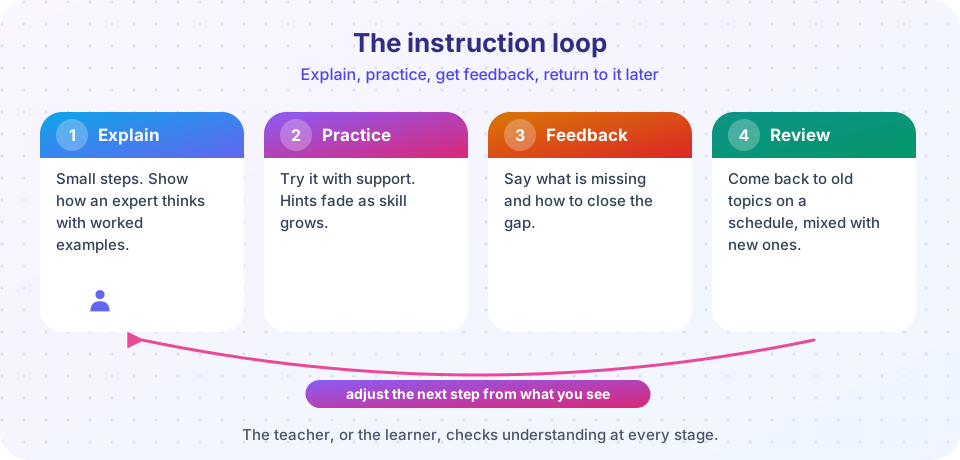
A common picture of teaching is a person at the front of a room who tells others things. Telling is part of it, but research on effective teaching, such as the classroom studies that Barak Rosenshine summarized in his widely read 2012 article "Principles of Instruction", describes something more like a loop with four parts.
- Explain and model. New material is presented in small steps, and the teacher shows how an expert thinks, often by working through an example aloud.
- Practice with support. Learners try the task while hints, partial solutions and prompts are still available. These supports are scaffolding.
- Feedback. Learners learn what was right, what was missing and how to improve.
- Review. Earlier material returns later, mixed with new material, so that it is not forgotten.
The loop closes because the teacher watches what happens in the practice and feedback steps and changes the next explanation. If half the class makes the same error, the next explanation addresses that error. A lecture without this loop is a broadcast. A lesson with it is a conversation, even when the "teacher" is a textbook with well-placed questions or a piece of software.
Three questions for this chapter
The lessons ahead answer three practical questions, each with a rich research literature.
How should new material be presented? A novice facing a hard problem has very little working memory to spare, because every element of the problem is new. In the next lesson you will meet cognitive load theory, developed by John Sweller and colleagues, and one of its best-known findings: studying worked examples is often better for beginners than solving the same problems unaided. You will also meet its twist, the expertise reversal effect, where the same help hurts people who already know the material.
How much guidance is right? For decades educators have argued about "discovery learning" against "direct instruction". The argument is often stated in black-and-white terms, but the research is more specific: what helps depends on what the learner already knows, how hard the task is and what exactly the guidance contains. You will read the main studies from both sides.
How should feedback be given? Feedback is among the most studied influences on learning, and its effects range from large and positive to clearly harmful. A famous meta-analysis found that more than one third of feedback interventions made performance worse. You will learn what separates useful feedback from the rest.
Chapter 5 at a glance
Three levers teachers can pull
Explain and model
Practice with support
Feedback
Review
Chapter 6 covers this in depth
What each lesson covers
- Worked examples and cognitive load explains why beginners benefit from seeing solutions and how to fade support as skill grows.
- Guided and discovery learning reviews the long argument about guidance, including productive failure.
- Feedback that works covers the four levels of feedback, timing and praise.
- Chapter 5 review pulls the chapter together with a recap table and a longer quiz.
How strong is the evidence?
Be a careful reader of this chapter. Education research is harder than much of laboratory psychology. Classrooms differ, studies run for weeks not years, and the best method for a ten-year-old learning fractions need not be best for an adult learning a programming language. Researchers use meta-analyses, which combine many studies into one estimate of an effect size, to see the broad pattern. You will see effect sizes quoted as d: roughly, the difference between two groups in standard deviations. Values near 0.2 are small, 0.5 medium and 0.8 large by convention, though context matters.
Two cautions run through the chapter. First, effect sizes from tightly controlled laboratory studies are usually larger than those from real classrooms. Second, many headline numbers come from a handful of influential reviews, and some have been challenged. Where that happens, the lessons tell you.
Check your understanding
Quick check · 4 questions
of 4 answered You scored / 4 · perfect!
-
1. Which description best fits good instruction according to this lesson?
The loop closes because the teacher uses what happens in practice and feedback to adjust the next explanation. -
2. What is scaffolding?
Scaffolds such as hints or partial solutions help at first and fade over time. -
3. What does formative assessment aim to do?
Formative assessment happens during learning and feeds back into what happens next. -
4. A meta-analysis reports an effect size of d = 0.5. What does this roughly mean?
d is a standardized difference between group means, in standard deviation units.
Summary
- Instruction is a loop of explaining, supported practice, feedback and review, adjusted by what the teacher sees.
- This chapter asks how to present material, how much to guide and how to give feedback.
- Effect sizes (d) allow comparison across studies, but classroom effects are usually smaller than laboratory ones.
- Treat any single study or review as one piece of evidence, not a final answer.
Track your progress
Create a free account to tick off lessons and pick up where you left off on any device.
of The Psychology of Learning lessons completed