


















Lesson 33 of 46 · Skills, Expertise and Transfer
Chapter 7 overview: skills, expertise and transfer
Preview how people become experts: the stages of skill, what chunks and schemas do, why practice must be deliberate, and why transfer to new problems is hard.
So far the course has mostly been about learning facts and ideas: how to hold them, when to review them and how to be taught them. But many people learn in order to do something: play the violin, diagnose a patient, write a program, referee a game, win at chess. Skill is more than a heap of facts. This chapter asks what experts have that novices lack, how they got it, and whether what they learned will carry over to anything outside their specialty.
What you will learn
- A map of the chapter: expertise, deliberate practice and transfer
- The Dreyfus five-stage model, and its limits
- What psychologists mean by expertise, and how it is measured
- Why the answer to "how long to get good?" is "it depends on how you practice"
Key terms
Expertise: consistently superior performance on representative tasks in a domain.
Skill acquisition: the process by which performance becomes faster, more accurate and less effortful with practice.
Automaticity: performing a component of a task with little conscious attention.
Deliberate practice: effortful, goal-directed practice designed to improve specific aspects of performance (Anders Ericsson).
Transfer: using what was learned in one situation to perform in another.
What is an expert?
It is tempting to say that an expert is someone with many years of experience. Psychologists avoid that definition, because experience and performance can come apart. Ericsson and colleagues proposed instead that expertise be defined by reproducibly superior performance on tasks that capture the essence of a field. A chess master can beat most amateurs again and again, and can find the best move in a position that is shown to them for the first time. By this standard, a physician with thirty years in practice is not automatically a better diagnostician than one with ten.
Two ideas recur throughout the chapter. First, expertise is specific. A grandmaster's memory for chess positions is spectacular, but the same person is ordinary at remembering random objects. Second, expertise is built and mostly by a particular kind of effort. The old view, still common in popular talk, treats talent as something you either have or lack. Research has made that view harder to defend, though it has not removed individual differences.
A staircase of skill
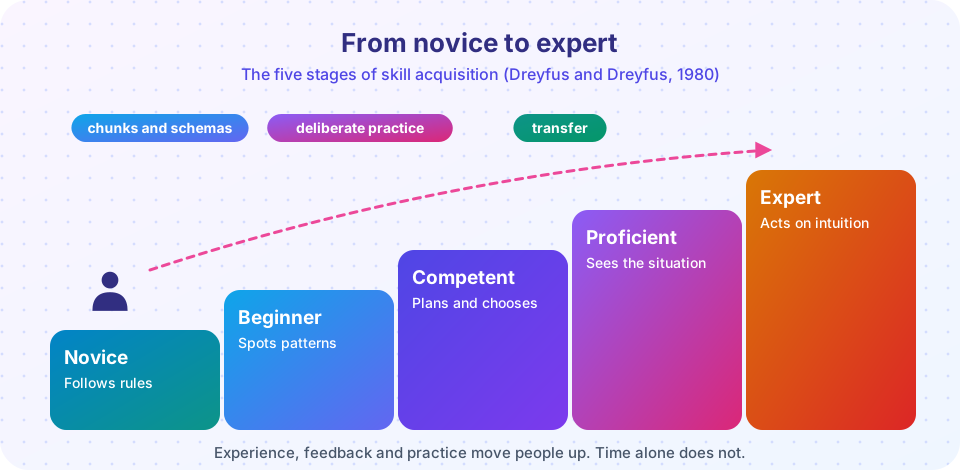
In 1980 the philosopher Hubert Dreyfus and his brother, the mathematician Stuart Dreyfus, described five stages of skill, based on observations of chess players and airline pilots.
- Novice. Follows context-free rules ("when the light turns red, stop").
- Advanced beginner. Starts to notice meaningful patterns from experience.
- Competent. Sets goals, plans and chooses what to attend to, and feels responsible for outcomes.
- Proficient. Sees situations as wholes and recognizes what matters, though still deliberates about what to do.
- Expert. Sees what to do immediately and acts fluently, using intuition built on huge experience.
Patricia Benner later adapted the model to nursing, and it is widely used in professional education. Treat it as a useful description, not an experimentally tested theory. The stages were not derived from controlled studies, the boundaries between them are blurry, and experts do still reason analytically when a situation is unusual.
Chapter 7 at a glance
What experts have
Not just a better memory
How they got there
The catch
The three questions of this chapter
What changes in the head of an expert? The next lesson starts with a famous finding: chess masters can reconstruct a board after a glance, not because they have photographic memories but because they see chunks, meaningful groups of pieces that they have met thousands of times. Experts also organize knowledge by deep principles, not surface features.
What kind of practice builds expertise? Ericsson's concept of deliberate practice says that improving performance needs goals, challenge, feedback and repetition. The idea has been hugely influential and has been criticized by researchers who found that practice explains only part of the differences in skill. Both sides are in the lesson.
Will it transfer? You might hope that learning chess builds general reasoning, or that learning Latin trains the mind. The history of research on transfer is a history of disappointment, with some bright spots. Lesson 3 explains why transfer is hard, what makes it more likely and what the evidence says about "brain training".
What you will not find here
This chapter does not promise a shortcut such as "become an expert in ten thousand hours". As you will see, that slogan oversimplifies the research it is based on. It also does not try to predict who will become a champion: many factors beyond practice, such as starting age, resources, coaching, health and chance, are involved and are not all well understood.
Check your understanding
Quick check · 4 questions
of 4 answered You scored / 4 · perfect!
-
1. How do researchers following Ericsson prefer to define expertise?
Experience and performance can come apart, so the definition focuses on performance. -
2. At which Dreyfus stage does a person follow context-free rules?
Novices rely on explicit rules that ignore the situation. -
3. What is a fair comment on the Dreyfus model?
It came from observation of chess players and pilots and has been applied widely, but it has limited experimental support. -
4. What does it mean to say expertise is specific?
A chess master remembers chess positions superbly but is ordinary at random objects.
Summary
- Expertise is best defined by reproducibly superior performance, not by years of experience.
- The Dreyfus model gives a useful five-stage description from novice to expert, though it is not experimentally tested.
- Expertise is specific to a domain and is built by a particular kind of effort.
- The chapter covers chunks and schemas, deliberate practice and the difficulty of transfer.
Track your progress
Create a free account to tick off lessons and pick up where you left off on any device.
of The Psychology of Learning lessons completed