


















Lesson 16 of 46 · Memory and Retrieval Practice
Chapter 3 review: Memory and retrieval practice
Review chapter three of the psychology of learning course: working memory, encoding, forgetting and retrieval practice, with a memory-problem diagnosis game and a ten-question quiz.
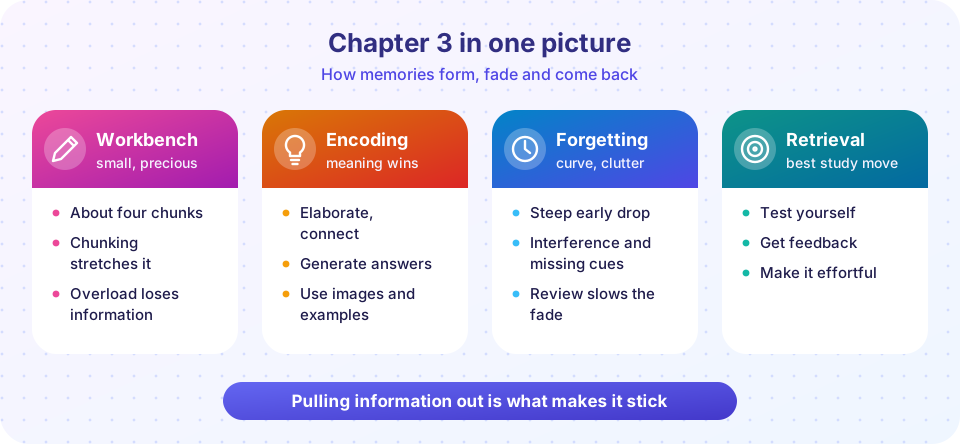
This chapter followed a memory from the moment it enters your head to the moment you try to get it back out. You saw that the workbench of working memory is small, that meaning-based encoding makes memories stronger, that forgetting is steep and cue-dependent, and that practicing retrieval is one of the best ways to make memories last. Now it is time to use that knowledge, and to do what the chapter recommends: retrieve it.
What you will learn
- A recap of the four ideas of the chapter and how they fit together.
- How to diagnose a memory problem as an encoding, storage, retrieval or interference problem.
- A review quiz that mixes all the lessons.
Recap table
| Lesson | Big idea | Key names | What to do |
|---|---|---|---|
| Memory overview | Three stores and three operations | Atkinson and Shiffrin, Sperling, Tulving | Think encoding, storage, retrieval |
| Working memory | A small workbench, about four chunks | Baddeley and Hitch, Miller, Cowan, Chase and Simon | Cut load, chunk, write things down |
| Encoding | Meaning-based processing gives stronger memory | Craik and Lockhart, Slamecka and Graf, Paivio, Bower | Elaborate, generate, organize, use images |
| Forgetting | Steep early drop; interference and missing cues | Ebbinghaus, Underwood, Tulving and Pearlstone, Godden and Baddeley | Review early, sleep, build many cues |
| Retrieval practice | Recall beats rereading, especially later | Roediger and Karpicke, Karpicke and Blunt | Self-test with feedback, low stakes |
One story that ties it together
Suppose you are learning the stages of the cell cycle. First you must attend and avoid overloading working memory, perhaps by learning two stages at a time (working memory). You encode them by explaining why each stage follows the previous one and drawing a diagram (encoding). That evening you sleep, and tomorrow some details have faded (forgetting). So you close the notes and write down all you remember, check, and mark what you missed (retrieval). Three days later, you do it again. Each part of the chapter has a job in that story.
Turning the chapter into a weekly routine
Knowing the research is not the same as acting on it. Here is a sample routine that applies every lesson of the chapter without adding much time.
- Monday, learn (30 minutes). Study one new topic in small steps so that working memory is not overloaded. Elaborate as you go: ask why, and connect each idea to something you know. Draw one diagram from memory at the end.
- Tuesday, retrieve (15 minutes). Without looking at your notes, write down everything you remember about Monday's topic. Check, and mark the gaps. This first review comes early, when the forgetting curve is steepest.
- Friday, retrieve again (15 minutes). Quiz yourself on both topics. Mix them so that you practice telling them apart, which reduces interference between similar ideas.
- Next week, relearn. Items you still miss go into a short pile for another round. Items you answer easily can wait longer.
Notice the pattern: first exposure with meaning, then repeated retrieval at widening gaps, with sleep between. Chapter 6 will explain the evidence for the spacing and mixing in detail. For now, remember that a little retrieval spread over days beats a lot of rereading on one.
Try it
A diagnosis game. For each situation, choose the most likely kind of memory problem: encoding (never stored well), interference (competing memories), retrieval (stored, but cue is missing) or overload (working memory exceeded). Several situations have more than one possible answer, so read the explanation.
Check your understanding
Ten questions mix every lesson in the chapter.
Quick check · 10 questions
of 10 answered You scored / 10 · perfect!
-
1. Which store holds a large, brief, detailed impression that fades within a second or two?
Sensory memory, such as Sperling's iconic memory, is brief and detailed. -
2. Cowan's estimate of working memory capacity is about:
With rehearsal and chunking controlled, capacity is about four chunks. -
3. Which part of the Baddeley model coordinates attention?
The central executive directs attention and coordinates the other components. -
4. Chess masters recall real game positions much better than beginners, but random positions only slightly better. This shows that expertise relies on:
Masters group pieces into meaningful patterns, which random boards do not offer. -
5. Which encoding task gives the best later memory?
Deep, meaning-based processing gives the strongest memory. -
6. Tulving and Pearlstone showed that forgotten words came back with category cues. This is evidence for:
Cues made stored items accessible. -
7. In the model R = e^(-t/S), each successful review does what to S?
Reviews raise stability, so forgetting is slower afterward. -
8. In Roediger and Karpicke (2006), which group did best one week later?
Repeated testing gave the best one-week retention, despite repeated study being best at five minutes. -
9. Why might a student prefer rereading although retrieval is better?
Familiarity feels like learning, even though it is a poor predictor of later recall. -
10. Which of these reduces interference?
Separating similar material and sleeping reduces competition between memories.
Summary
- Memory has stores (sensory, working, long-term) and operations (encode, store, retrieve).
- Working memory is small; chunking and reducing load make better use of it.
- Meaning-based encoding strengthens memory; forgetting is steep, cue-dependent and affected by interference.
- Retrieval practice with feedback is one of the strongest ways to build lasting memory.
Track your progress
Create a free account to tick off lessons and pick up where you left off on any device.
of The Psychology of Learning lessons completed