


















Lesson 46 of 46 · Projects and Practice
Further study: where to go next
Where to go after the course: related tracks on this site, books and papers worth reading, how to judge research claims, and ideas for turning what you learned into practice.
You have reached the end of the course, which is a good moment to ask what to do next. The psychology of learning is a young and active field, so there is plenty more to read and test. This lesson maps the paths out: related tracks on this site, books and key papers, a way of reading research critically, and a few ways to turn knowledge into habit.
What you will learn
- Which other tracks on this site extend what you learned
- A short, honest reading list of books and papers
- How to judge a claim about learning before you trust it
- How to keep practicing what you have learned
Key terms
Replication: repeating a study to see whether the result holds.
Preregistration: stating the hypothesis and analysis plan before collecting data, to limit after-the-fact choices.
Conflict of interest: a connection, such as a financial one, that may bias how a study is designed or reported.
Peer review: evaluation of a paper by independent experts before publication, an imperfect but useful filter.
Paths on this site
Depending on what drew you to this course, one of these may be the right next step.
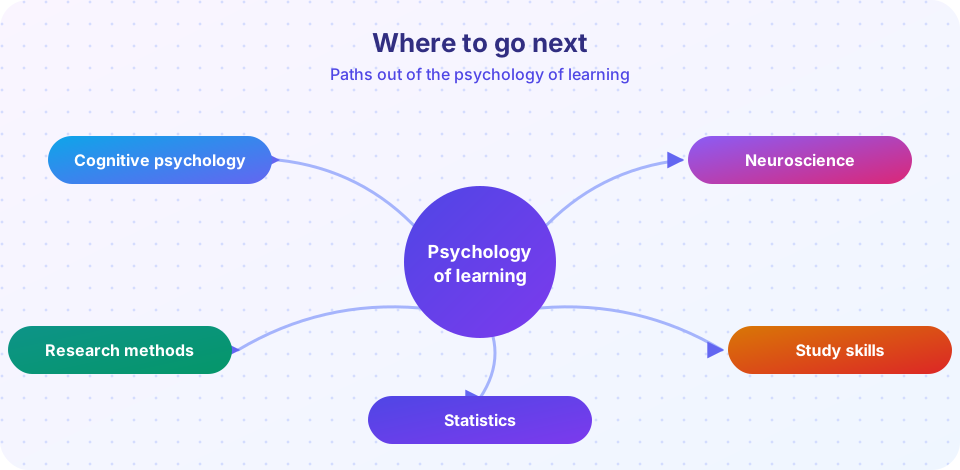
- How the mind works. Cognitive psychology goes deeper into memory, attention, perception, language and reasoning, the foundations of everything here. Cognitive science adds computational and philosophical views of the mind.
- The brain. Neuroscience explains neurons, circuits and the brain systems behind memory and learning. Beware of "neuromyths" along the way: many popular claims, such as "we use 10 percent of our brains", are false, and brain images rarely add practical advice for teaching beyond what behavioral studies show.
- How researchers know. Research methods in psychology teaches the design of experiments, measurement and the pitfalls (confounds, bias, replication) that came up in this course, such as in the self-experiment project.
- The numbers. Statistics and probability covers effect sizes, confidence intervals and tests, which you need to read learning research with confidence.
- Practical skills. Study skills and exam technique applies many of these ideas to the school and university routine. Language learning methods applies them to a skill where practice type and transfer matter a great deal.
- Across the lifespan. Developmental psychology looks at how learning changes from infancy to old age. Psychology: an introduction gives the broad map of the field, and behavioral economics shows how biases affect decisions, including decisions about how to study.
A short reading list
These are real works that are good next steps. They differ in difficulty.
Books for general readers
- Make It Stick: The Science of Successful Learning by Peter Brown, Henry Roediger and Mark McDaniel (2014). A readable account of retrieval, spacing and interleaving by researchers in the field.
- Why Don't Students Like School? by Daniel Willingham (2009). Nine principles of cognitive science for teachers, clearly written.
- Peak: Secrets from the New Science of Expertise by Anders Ericsson and Robert Pool (2016). The case for deliberate practice from its main proponent. Read it alongside the criticism in the expertise chapter.
- How Learning Works by Susan Ambrose and colleagues (2010). Seven research-based principles for university teaching.
Academic reviews you can read in full
- Dunlosky, Rawson, Marsh, Nathan and Willingham (2013), "Improving students' learning with effective learning techniques", Psychological Science in the Public Interest.
- Hattie and Timperley (2007), "The power of feedback", Review of Educational Research.
- Kirschner, Sweller and Clark (2006), "Why minimal guidance during instruction does not work", Educational Psychologist, together with the reply by Hmelo-Silver, Duncan and Chinn (2007).
- Pashler, McDaniel, Rohrer and Bjork (2008), "Learning styles: Concepts and evidence", Psychological Science in the Public Interest.
- Bjork and Bjork (2011), "Making things hard on yourself, but in a good way: Creating desirable difficulties to enhance learning".
- Mayer's Multimedia Learning (3rd edition, 2021) for the full account of the principles.
- Sweller, Ayres and Kalyuga's Cognitive Load Theory (2011).
Note that popular summaries, such as rankings of "influences on achievement" that list hundreds of factors by effect size, can mislead when they mix very different studies. Use them with care and go back to the original research.
How to judge a claim about learning
New claims appear every month: apps that double your memory, diets for the brain, "one weird trick" for studying. Before trusting one, ask the following questions.
- Who tested it, and how? Was there a comparison group, with random assignment?
- What was measured? A test of learning after a delay, without the tool, is much stronger than a satisfaction rating or the tool's own score.
- How big and how many? Tiny samples and tiny effects are fragile. Look for confidence intervals and effect sizes.
- Has it been replicated? Independent repeats matter. The history of psychology contains striking results that did not hold up.
- Is there a conflict of interest? Studies by sellers are not worthless, but they need a second look.
- Does it fit what else we know? A claim that contradicts well-established findings needs stronger evidence.
The checklist below turns these into a quick score. It is a thinking aid, and a high score does not prove a claim true.
Keep practicing
Knowledge about learning is only useful if it changes what you do. A few suggestions:
- Pick one habit from the cheat sheet and apply it for a month. Retrieval and spacing are the best starting points.
- Keep a learning log. Note what you did, what you predicted and what the delayed test showed. After a few weeks you will have your own evidence.
- Teach someone else. Explaining the course to a friend is retrieval, self-explanation and feedback in one.
- Revisit this course in a month and a half, without notes first. Trying to recall the main ideas is exactly the technique the course recommends.
- Stay skeptical and curious. The findings here will be refined. Newer studies on AI, on sleep and on motivation are coming.
A note on scope
This course gives educational information about how people learn. It is not a diagnosis tool and not medical, psychological or educational advice for a specific person. If you or someone you know has persistent difficulties with reading, attention, memory or mood, a teacher, school counselor or qualified health professional can help far better than any general course.
Common misconceptions
"Once I know the research, I know what works for everyone." Averages guide, but individuals vary. Test on yourself.
"A study in a famous journal must be right." Replication and consistency across studies matter more than the venue.
"Popular summaries are as good as the original." Summaries compress and sometimes distort. Read the source for claims that matter.
Check your understanding
Quick check · 4 questions
of 4 answered You scored / 4 · perfect!
-
1. Which evidence is strongest for a claim that a learning app works?
Random assignment, delayed unaided tests and independent replication all reduce the risk of being misled. -
2. What is preregistration?
It limits after-the-fact choices that can inflate results. -
3. Which track would help most with understanding confidence intervals and effect sizes?
Those concepts belong to statistics. -
4. What is a sensible way to keep using this course?
Practice and honest feedback on your own results turn knowledge into habit.
Summary
- Related tracks on this site extend the course: cognitive psychology, neuroscience, research methods, statistics, study skills and language learning.
- A handful of books and review papers give the best next reading. Prefer the originals to popular summaries.
- Judge claims by design, measures, size, replication, conflicts and fit with other evidence.
- Keep a learning log, pick one habit to practice and revisit the course with retrieval.
Back to the course overview.
Track your progress
Create a free account to tick off lessons and pick up where you left off on any device.
of The Psychology of Learning lessons completed