


















Lesson 26 of 46 · Instruction and Feedback
Feedback that works
What the research says about feedback: Kluger and DeNisi's warning, Hattie and Timperley's four levels, timing, grades versus comments, praise and how to make feedback usable.
Ask teachers what most helps their students and many will say "feedback". Ask students what they do with it and you get a different picture: some glance at the grade and put the paper away, some feel crushed by a red pen, some never read the comments at all. In research, feedback has one of the largest average effects on learning of any teaching practice, and yet it is also one of the most variable. Sometimes it is worse than no feedback.
This lesson explains why. It describes what feedback is, the model of four levels that helps separate useful feedback from the useless kind, the question of timing, and the debates about grades and praise.
What you will learn
- What counts as feedback, and the three questions good feedback answers
- Why a famous meta-analysis found that over a third of feedback effects were negative
- The four levels of feedback and which tend to work
- How timing, grades and praise change what learners do with feedback
- How to give and use feedback that actually closes a gap
Key terms
Feedback: information about the gap between current performance and a goal, given so the gap can be closed.
Feed up, feed back, feed forward: Hattie and Timperley's names for "Where am I going?", "How am I going?" and "Where to next?".
Hypercorrection effect: people correct confident errors more readily than low-confidence ones.
Effect size (d): the difference between groups in standard deviations.
Feedback is information, not judgment
The word comes from engineering. A thermostat compares the room temperature with a target and uses the difference to switch the heating on or off. Without a target there is no feedback, only a number. D. Royce Sadler, an Australian assessment researcher, argued in 1989 that feedback in education works only if three conditions hold: the learner knows the goal or standard, can compare their current work with it, and can take action to close the gap. Marks and praise often fail one of these, particularly the third. A "6/10" tells you where you stand, but not where to go.
John Hattie and Helen Timperley (2007), in an influential review in Review of Educational Research, framed good feedback as answering three questions: Where am I going? How am I going? Where to next? Feedback that answers the first two but not the third leaves the learner stuck.
The warning: feedback can backfire
In 1996 Avraham Kluger and Angelo DeNisi published a meta-analysis in Psychological Bulletin covering 607 effect sizes. The average effect of feedback was positive, about d = 0.4. But more than one third of the effects, around 38 percent, were negative: performance after feedback was lower than without it. The authors' feedback intervention theory explains why. Feedback works by redirecting attention. When it points attention at the task and how to do it better, performance tends to rise. When it points attention at the self (how clever or stupid am I?), performance tends to fall, because the learner's effort goes into protecting their self-image instead of fixing the work.
Later reviews have found a similarly positive average with a wide spread. A 2020 meta-analysis by Eva Wisniewski, Klaus Zierer and Hattie, covering several hundred studies, reported an average effect near d = 0.5, with substantial variation depending on the kind of feedback and the task. Like all large averages, this hides a lot. Use the number as a reminder that feedback is not automatically good, not as a promise.
Four levels of feedback
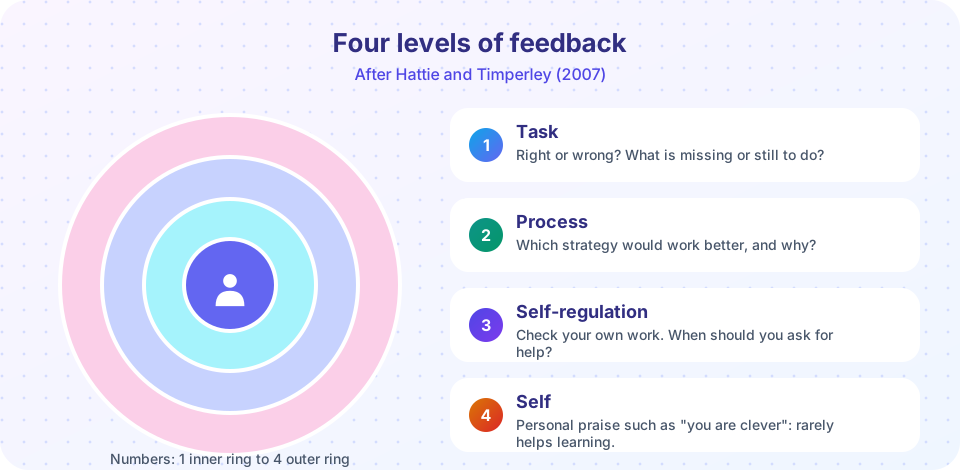
Hattie and Timperley sorted feedback by what it is about.
- Task level. Was the answer right or wrong? What is missing? "You left out the units in question 3." Useful, especially for correcting errors, but specific to this task.
- Process level. How was the task approached? "A diagram would show you which formula fits; try drawing the forces first." This transfers to later tasks because it is about method.
- Self-regulation level. Feedback that helps learners monitor and direct their own learning. "Before you hand it in, check each answer against the question. What do you notice?" It builds the habit of self-checking and seeking help.
- Self level. Personal remarks about the learner, such as "Well done, you are so clever." Praise feels nice but carries almost no information about how to improve. Hattie and Timperley judged it usually the least effective, and it can distract from the task.
A good rule is to aim for levels 1 to 3 and to say little at level 4. This links to the work on growth mindset you met earlier in the course: Claudia Mueller and Carol Dweck (1998) found that fifth graders praised for being intelligent did worse after a failure, in persistence and enjoyment, than those praised for effort. Later replication attempts have found weaker and less consistent results, so the safest reading is that process-focused comments are at least as good as ability praise and probably better.
Grades and comments
A neat classroom experiment comes from Ruth Butler (1988). Israeli students in the fifth and sixth grades received one of three kinds of feedback on a task: comments only, a grade only, or a grade with comments. Students who got comments only improved most on later tasks and showed more interest. The students who got grades, with or without comments, did not benefit as much. The usual explanation is that a grade invites comparison with others and draws attention to the self, so the comment never gets read properly. The finding has been echoed in other studies, though it is from one set of classrooms and should not be treated as an iron law. Many teachers now delay grades, or give them separately from comments.
Timing: immediately or later?
Should feedback come at once? The answer depends on the learning goal.
- For procedural skills and beginners (for example, learning a new algebra step), immediate feedback prevents the practice of errors and reduces frustration.
- For long-term retention, delayed feedback sometimes does better. Andrew Butler and Henry Roediger (2008) gave students multiple-choice tests on prose passages and then gave feedback immediately, after a delay, or not at all. On a final test one week later, those who got delayed feedback did better than those who got immediate feedback. One suggestion is that a delay is a kind of spacing, so processing the feedback becomes a second retrieval opportunity.
- Giving the answer too soon can also stop learners from thinking. Valerie Shute's 2008 review of formative feedback suggests letting the learner make an attempt first and offering hints before the full answer, particularly with difficult tasks.
There is no single best delay. The principle is that feedback must arrive while it can still be used, and that the learner must actually process it.
The hypercorrection effect
Janet Metcalfe and colleagues showed a surprising result. When people are confidently wrong, and are told the correct answer, they are more likely to correct the error later than when they were unsure. This hypercorrection effect (Butterfield and Metcalfe, 2001) may be because surprise draws attention. It is an argument for asking learners to commit to an answer, and rate their confidence, before they see feedback. Confident errors then become the most valuable moments in the lesson.
Making feedback usable
Here is a checklist pulled from the research above.
- Name the goal. Show the standard, for instance with an exemplar.
- Be specific. Refer to features of the work, not to general quality.
- Limit it. Two or three points that can be acted upon beat a page of corrections.
- Ask for a response. Give time in class to revise, or require an improved version, so that feedback is used and not filed.
- Separate comments and grades where possible.
- Teach students to seek and use it. Feedback is a conversation. Students who ask "what should I do next?" get more from it.
Common misconceptions
"More feedback is always better." Kluger and DeNisi found harmful effects in over a third of cases. Overload and personal criticism are common causes.
"Praise motivates, so give lots of it." Praise about the person carries little information. Praise that names what was done well and why is more useful.
"If I gave feedback, it was received." Feedback that is never read or acted upon has no effect.
Try it
The first demo is a sorting exercise. For each comment, decide which of Hattie and Timperley's levels it belongs to. It is a practice tool, and some comments could arguably fit more than one level.
The second demo is a simulation in the spirit of Kluger and DeNisi. It draws many invented effects of feedback with an average near 0.4 and a wide spread, so a sizeable share is negative. It is not their data, only an illustration of how an average can hide harm.
Press Run (or Ctrl + Enter) to see the result here.
Program input · what you'd type while the program runs
Type the answers before you press Run, one per line. Each time the program reads a line (with input()), it gets the next line from this box.
Check your understanding
Quick check · 6 questions
of 6 answered You scored / 6 · perfect!
-
1. What did Kluger and DeNisi (1996) find about the effects of feedback?
Feedback that directs attention to the self tends to lower performance, which explains much of the variation. -
2. Which comment is process-level feedback?
It is about the approach to the task, and a good approach carries over to new tasks. -
3. In Butler's (1988) study, which group improved most?
Grades pull attention toward comparison and the self, so comments tended to be ignored. -
4. What did Butler and Roediger (2008) report about timing?
A delay may act like spacing and give a second chance to process the material. -
5. The hypercorrection effect says that:
Surprise at being wrong while confident draws attention, so asking for confidence ratings before feedback is useful. -
6. According to Sadler, which condition must hold for feedback to work?
Knowing the goal, comparing and acting on the gap are the three conditions.
Summary
- Feedback is information about the gap between current performance and a goal. Without a goal or an action to take, it is only a score.
- Average effects are positive, but more than a third of effects in a major meta-analysis were negative, mostly when attention moved to the self.
- Aim for task, process and self-regulation feedback. Personal praise carries little information.
- Comments without grades did better than grades in a classic study, and delayed feedback sometimes helps retention.
- Ask for an answer and a confidence rating first. Give learners time to use the feedback.
Next: Chapter 5 review
Track your progress
Create a free account to tick off lessons and pick up where you left off on any device.
of The Psychology of Learning lessons completed