


















Lesson 5 of 46 · Getting Started
Chapter 1 review: Getting started
Review chapter one of the psychology of learning course: the definition of learning, key moments in its history, how to weigh evidence, with a ten-question quiz.
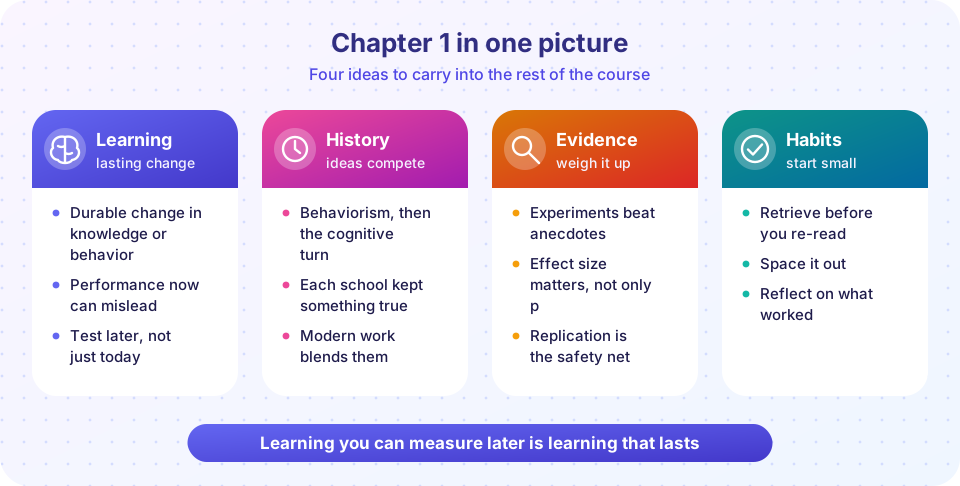
You have finished the foundations. In four short lessons you met a working definition of learning, a map of its main kinds, the story of how researchers came to study it, and a toolkit for judging evidence. This review pulls those threads together and asks you to do the most effective thing you can do with them: try to recall them.
What you will learn
- A consolidated recap of chapter one.
- A quick way to check which parts you remember and which need another look.
- How the ideas of chapter one point to chapter two.
The chapter in a table
| Lesson | Big idea | One thing to remember |
|---|---|---|
| What is learning? | Learning is a relatively lasting change from experience | Performance today is not the same as learning |
| History | Ideas moved from behaviorism to cognition to brain and classroom | Each school kept something true |
| Reading the evidence | Experiments, effect sizes and replication give strong evidence | One study is never enough |
Ideas that will keep coming back
- Delayed tests reveal learning. You will meet this again in the chapters on memory and spacing.
- Desirable difficulties. Effortful conditions often help long-term retention if the learner can succeed with effort.
- Mixed pictures. Real learning combines association, observation, insight and brain change. Chapter 2 takes them one at a time.
- Skeptical optimism. We take the research seriously and check how strong it is.
A worked example: judging a headline
Suppose you read: "Study finds that students who use a revision app score 20 percent higher." Before you believe it, run the checklist from lesson 4.
- What was measured, and when? If the score was taken right after using the app, it may reflect short-term fluency (lesson 2). Ask whether there was a delayed test or a transfer question.
- Who was compared? If the students chose the app themselves, motivated students may be the ones who chose it. If chance decided who got it, you have a randomized comparison.
- How big is it? "20 percent higher" on what scale? An effect size (Cohen's d) tells you how it compares with the natural spread between students, and a confidence interval tells you how certain the estimate is.
- How many students? A trial with 25 students is noisy (lesson 4's simulation). One with 2,500 is much steadier.
- Has it been repeated? A result that other teams reproduced in other schools is worth far more than a single press release.
- Who gains? If the claim comes from the company that sells the app, read it with extra care.
Notice that none of these questions needs advanced statistics. They need only the habit of asking.
Where this leads
Chapter 1 gave you the vocabulary and the skepticism. Chapter 2 now opens the box: what kinds of learning exist, and what happens in the brain? As you read it, keep two questions in mind. First, what would a delayed test or a transfer test look like for each kind of learning? Second, how strong is the evidence for each claim: a replicated experiment, a single study, or a plausible story? Asking both will make you a better learner and a better judge of advice about learning.
Try it
Use the flashcards below the way the chapter recommends. Read the prompt, say your answer aloud or in your head, then flip the card. Mark whether you got it right and the deck will repeat the missed ones more often.
Check your understanding
This is the review quiz, with more questions than a normal lesson. Answer each from memory before you read the options closely.
Quick check · 10 questions
of 10 answered You scored / 10 · perfect!
-
1. Which is NOT part of the definition of learning used in this course?
Changes due to maturation, fatigue, injury or drugs are excluded; learning results from experience. -
2. A student scores well right after studying but forgets by next week. This is best described as:
Performance during practice can be high even if the knowledge is not durable. -
3. Who studied forgetting using nonsense syllables?
Hermann Ebbinghaus published his forgetting studies in 1885. -
4. Rats that explored a maze without reward later ran it as well as rewarded rats once a reward appeared. This supports:
Tolman concluded that the rats had learned the layout without showing it until it was useful. -
5. Which finding is most associated with Bandura?
Bandura, Ross and Ross (1961) showed observational learning in children. -
6. A difference of 5 points between groups with a standard deviation of 20 gives d equal to:
d = 5 / 20 = 0.25, a small-to-moderate effect by Cohen's rough labels. -
7. Which design best supports a claim that a method causes better learning?
Random assignment with a fair comparison and a delayed test gives the strongest basis for a causal claim. -
8. Why do small studies often give misleading results?
Noise plus publication bias can make effects look larger than they really are. -
9. Which pair did Dunlosky and colleagues (2013) rate as high utility?
Practice testing and distributed practice earned the top ratings. -
10. What did strict behaviorism struggle to explain?
Insight, observational learning and the creativity of language pushed psychologists toward cognitive explanations.
Summary
- Learning is a relatively lasting change from experience; performance is only a clue to it.
- The field moved from memory experiments and behaviorism to cognition, neuroscience and classroom research.
- Strong evidence comes from randomized comparisons, sizable samples, effect sizes and replication.
- Retrieval, spacing and desirable difficulties will return in later chapters.
Track your progress
Create a free account to tick off lessons and pick up where you left off on any device.
of The Psychology of Learning lessons completed