


















Lesson 13 of 46 · Memory and Retrieval Practice
Encoding and elaboration: making memories that last
Why deeper, meaningful processing builds stronger memories: levels of processing, the generation and self-reference effects, dual coding, organization and mnemonic techniques.
You walk past the same coin every day, yet most people cannot say which way the head faces or where the date is printed. You hear a joke once and remember it for years. Both facts point to the same lesson: how well you remember something depends less on how often you see it than on what you do with it at the moment you take it in. That moment is called encoding, and it is the part of memory you control the most.
In this lesson you will meet the classic studies on depth of processing, the specific strategies that make encoding stronger, and the evidence behind memory techniques that have been used since ancient Greece.
What you will learn
- The levels-of-processing idea and its famous experiment.
- Five encoding strategies with good evidence: elaboration, generation, self-reference, imagery and organization.
- How mnemonics such as the method of loci work, and where they fall short.
- Why "feeling familiar" is a poor guide to what you know.
Key terms
Encoding: converting an experience into a form that can be stored in memory.
Levels of processing: the idea that deeper, more meaning-based processing produces stronger memories.
Elaboration: connecting new information to what you already know, with reasons, examples and links.
Generation effect: better memory for information you produce yourself than for information you only read.
Mnemonic: a technique that supports memory, such as an acronym or a mental journey.
Levels of processing
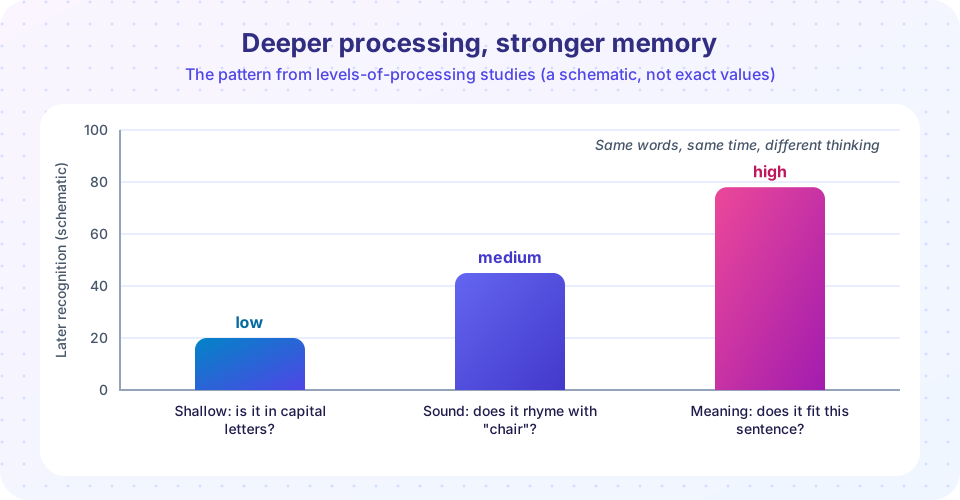
In 1972 Fergus Craik and Robert Lockhart proposed that memory strength depends on the depth at which information is processed. Shallow processing focuses on physical features (is the word in capital letters?). Intermediate processing looks at sound (does it rhyme with "train"?). Deep processing looks at meaning (does it fit in the sentence "He met a ___ in the street"?).
Craik and Tulving (1975) tested this idea in a series of experiments. Participants saw words one at a time, each preceded by one of those kinds of questions, and answered yes or no. They then got a surprise memory test. Words that had been processed for meaning were recognized far better than words processed for sound, which were in turn better than words processed for letter shape. Importantly, participants did not know they would be tested, so the difference came from the processing itself, not from effort to memorize.
The approach has its critics. "Depth" is hard to define independently of the result (it risks circularity), and later work showed that the type of test matters: if the test asks you to pick words that rhymed with a cue, people who processed sounds can do better than those who processed meaning (Morris, Bransford and Franks, 1977). The principle of transfer-appropriate processing says memory is best when the processing at study matches what the test demands. For most school learning, tests ask about meaning, so deep, meaning-based encoding is the right target.
Five strategies for stronger encoding
1. Elaboration
Ask "why?" and "how?", and link the idea to something you know. If you learn that the heart has four chambers, ask why a four-chamber design might be better than two, and compare it to a pump with a one-way valve. Elaborative interrogation (asking and answering why a fact is true) and self-explanation (explaining each step of a worked example in your own words) were rated as moderately useful in the Dunlosky review of study techniques, with the strongest benefits for people who already have some background knowledge.
2. Generation
In 1978 Norman Slamecka and Peter Graf had participants either read word pairs (such as "hot - cold") or generate the second word from a rule (such as "hot - c___", an opposite). Memory was better for the words people generated. The generation effect shows up in many settings: attempting an answer before seeing the solution, filling in blanks, or predicting what happens next is better than passively reading. Even failed attempts help when followed by feedback.
3. Self-reference
Rogers, Kuiper and Kirker (1977) asked people to judge words in different ways, including "does this word describe you?". Words encoded in relation to the self were recalled better than words judged for meaning alone. Relating material to your own life or goals is a form of elaboration with a personal anchor.
4. Imagery and dual coding
Allan Paivio (1971, 1986) proposed dual coding: information stored as both words and images has two routes to retrieval. Concrete words ("elephant") are recalled better than abstract ones ("justice"), and pictures are often remembered better than words, the picture superiority effect. Drawing a diagram, imagining a scene, or pairing text with a clear visual can strengthen encoding. The effect depends on the image being meaningful and relevant, not decorative.
5. Organization
Gordon Bower and colleagues (1969) had people learn 112 words presented either in organized conceptual hierarchies (such as minerals, then metals and stones, then specific kinds) or in random arrangements. Recall of the organized lists was much higher. Structure gives each item a place and a retrieval path. Outlines, concept maps, tables and chunking all use this principle.
Mnemonics: techniques with a long history
- Method of loci (memory palace). Imagine walking through a familiar place, and "place" each item on a spot along the route. To recall, take the walk again. The Roman writer Cicero tells a story about the poet Simonides who used the positions of dinner guests to identify them after a roof collapse. Modern studies find that trained users remember lists in order very well, and memory champions use it extensively.
- Keyword method. To learn that the Spanish word pato means "duck", imagine a duck patting something. Atkinson and Raugh (1975) found sizable gains for vocabulary learning.
- Acronyms and acrostics. "Every Good Boy Does Fine" for the lines of the treble clef. Useful for fixed lists but they do not build understanding.
- Peg systems and rhymes. Associating items with numbers or rhymes.
Mnemonics work, but they also have limits. They shine for arbitrary facts and ordered lists, and they take time to build. They do little for understanding relationships and they can add to the load if the learner already struggles. Use them for facts that you need verbatim, and elaboration for ideas.
Why "it feels familiar" is not enough
Reading a page a second time feels easy, because the text now seems familiar. That feeling of fluency is often mistaken for knowing. Researchers including Asher Koriat and Robert Bjork call it an illusion of competence. Highlighting and rereading can raise familiarity without raising retrieval ability. The remedy is to test yourself, which is the next but one lesson, and to use encoding strategies that force active thinking.
Common misconceptions
"Repeating something more times always makes it stick." Repetition without meaning ("maintenance rehearsal") adds little to long-term memory. Elaborative rehearsal, which connects the new thing to knowledge, is much more effective.
"Mnemonics are cheating." They are legitimate tools with decent evidence, though best used for facts rather than concepts.
"Photographic notes mean I have it." Having the information in a notebook or phone does not mean it is in your memory. Copying notes passively is a weak encoding task.
Try it
First, a miniature levels-of-processing experiment you can run on yourself. Sixteen words appear one at a time, each with a question: half ask about the letters ("Does it contain the letter E?") and half about meaning ("Is it something you would find in a house?"). Answer yes or no. After a short pause, type every word you remember. The demo shows your recall for each kind of question. A single run is a small and noisy sample, so treat it as an illustration.
Second, a method-of-loci helper. Give it a list of items to remember and a list of places (loci) along a familiar route. It pairs them in order and writes a prompt for a vivid scene. Replace the lists with your own.
Press Run (or Ctrl + Enter) to see the console output here.
No output.
Check your understanding
Quick check · 5 questions
of 5 answered You scored / 5 · perfect!
-
1. In Craik and Tulving's 1975 experiments, which question led to the best later recognition of words?
Questions about meaning produce deeper processing and stronger memory for the words. -
2. What is the generation effect?
Slamecka and Graf (1978) found better memory for words generated from a rule than words simply read. -
3. Which mnemonic uses a familiar journey?
The method of loci places items along a mental route. -
4. Why can rereading create an illusion of competence?
Familiarity feels like knowing, but it can exist without the ability to recall. -
5. Transfer-appropriate processing says that memory is best when:
Morris, Bransford and Franks (1977) showed that the best encoding depends on what the test will ask.
Summary
- Deeper, meaning-based processing at encoding gives stronger memories than shallow processing.
- Elaboration, generation, self-reference, imagery and organization are evidence-based encoding strategies.
- Mnemonics such as the method of loci work well for lists and arbitrary facts.
- Familiarity from rereading is not the same as learning.
- Match your study processing to what you will need to do later.
Track your progress
Create a free account to tick off lessons and pick up where you left off on any device.
of The Psychology of Learning lessons completed