


















Lesson 1 of 46 · Getting Started
Course map: how this course works
Start here: who the psychology of learning course is for, what each of the nine chapters covers, and how to study it so that you actually remember it.
Why do some people learn a language in a year while others study for a decade and still freeze in conversation? Why can you reread a chapter three times and still fail the test? Why does a song you heard once stay in your head for weeks, while a phone number you were told five minutes ago is already gone? These are questions about learning, and psychologists have been studying them, with experiments, for well over a hundred years.
This course turns that research into a practical, evidence-based picture of how people learn and how you can learn better. It is written for students aged about 14 and up, for teachers and parents, for adults who want to learn new skills, and for anyone curious about the mind. You do not need any background in psychology, statistics or biology. Every term is defined the first time it appears.
Educational information only. This course describes research on learning in healthy people. It is not medical, psychological or educational diagnosis or treatment. If you or a child you care about has persistent difficulty with learning, attention or mood, talk to a qualified professional such as a teacher, school psychologist or doctor.
What you will learn
- What psychologists mean by learning, and why it is more than "getting good at something right now".
- The main ways learning happens: association, observation, insight and physical change in the brain.
- How memory encodes, stores, loses and retrieves information, and what that implies for studying.
- How attention, motivation and beliefs decide whether study time turns into learning.
- How to weigh evidence, so that you can tell a well-supported study method from a popular myth.
The nine chapters at a glance
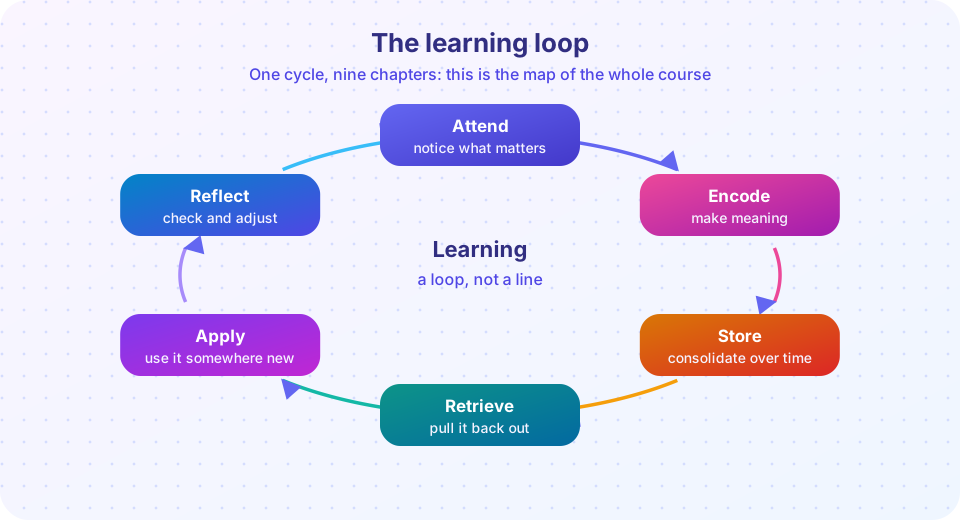
The course follows the loop in the picture above. Each chapter looks at one part of it. The first four chapters (this part of the course) build the foundations. Chapters 5 to 9 turn them into methods and projects.
Foundations
- Getting started
- How learning works
Memory
- Memory and retrieval
The learner
- Attention and motivation
Teaching and practice
- Instruction and feedback
- Spacing and strategies
- Skills and expertise
Technology and projects
- Learning technology
- Projects and practice
How the lessons are built
Every content lesson has the same shape so you always know where you are. You begin with a short list of outcomes ("What you will learn") and a box of key terms. Then come the explanations, worked examples and named studies. A "Common misconceptions" box corrects popular wrong beliefs. After that you meet small interactive demonstrations under "Try it". They let you run a model, see a curve change or take part in a mini-experiment. A short quiz and a summary close the lesson.
The interactive parts are demonstrations, not tests. A reaction-time game shows you what the effect feels like; it does not diagnose anything about you. When a demonstration is a simplified model rather than real data, the lesson says so.
How to study this course (using what it teaches)
The best advice in this course is also advice about this course. Here is a plan you can start today.
- Read actively. After each section, look away and try to say the main idea in your own words.
- Use the quizzes as practice, not as a score. Answer before you look at the options' explanations. Getting an answer wrong and then reading the explanation is a very effective way to learn.
- Space your sessions. Two 30-minute sessions on different days beat one 60-minute session.
- Come back later. At the start of each new lesson, try to recall three things from the last one.
- Connect to your life. For each idea, think of one place you could use it this week.
Do not worry if some of this feels slower than just rereading. That feeling of effort is a clue that the strategy is working. You will learn why in chapters 3 and 6.
Common misconceptions
"I am a visual (or auditory) learner." Many people believe that matching teaching to a preferred "learning style" improves results. Large reviews of the evidence have not found that it does. You will meet this myth again in chapter 2.
"Learning is all about talent." Talent matters, but the strategies you use and how you practice make a large difference. Chapters 4 and 7 show how.
Try it
First, a quick self-check of the habits you already use. It is only a reflection tool. Tick what you do, and see which of the habits the research favors.
Check your understanding
Quick check · 4 questions
of 4 answered You scored / 4 · perfect!
-
1. What is the main point of the learning loop in this course?
The loop shows that learning is a cycle: what you retrieve and apply shapes what you attend to and encode next. -
2. Which habit is better supported by research?
Self-testing (retrieval practice) is one of the best-supported study methods. You will see the evidence in chapter 3. -
3. How should you treat the interactive demonstrations in this course?
They are labeled demonstrations and models. They help you feel and see an effect; they never diagnose anything. -
4. Which of these is a sensible way to use this course?
Spacing and retrieving earlier material are two of the strategies the course itself recommends.
Summary
- Learning is a loop of attending, encoding, storing, retrieving, applying and reflecting.
- The course has nine chapters: foundations, memory, the learner, teaching and practice, technology and projects.
- Interactive parts are demonstrations and simplified models, never diagnostic tests.
- Study the course the way it recommends: retrieve, space, explain and connect.
- Common beliefs such as "learning styles" will be checked against evidence.
Next: What is learning?
Track your progress
Create a free account to tick off lessons and pick up where you left off on any device.
of The Psychology of Learning lessons completed