


















Lesson 11 of 46 · Memory and Retrieval Practice
Memory: the big picture
Chapter 3 overview: the three memory stores, how information is encoded, stored and retrieved, and try Sperling's famous brief-display experiment for yourself.
Memory is not one thing. When you remember a face, recite a poem, ride a bicycle after years away, or recall what you had for breakfast, you are using different systems that behave in different ways. A person with amnesia may fail to recall yesterday but still be able to learn a new motor skill. A student may hold a phone number for ten seconds and lose it a minute later. Understanding the parts of memory is the foundation for every practical strategy in the rest of this course.
What you will learn
- The three-store model of memory and what each store does.
- The three operations on memory: encoding, storage and retrieval.
- The main kinds of long-term memory.
- What each lesson in this chapter covers.
The three-store picture
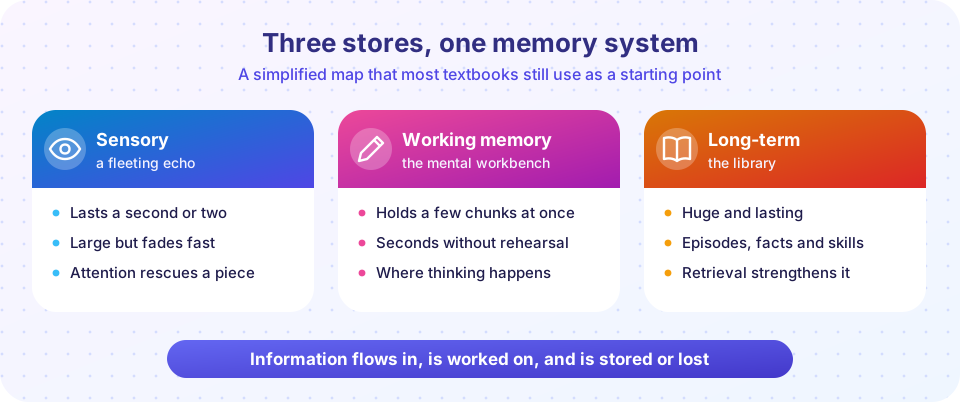
In 1968 Richard Atkinson and Richard Shiffrin proposed that information flows through three stores. The model is simplified, and modern researchers prefer more detailed ones, but it remains a good starting map.
Sensory memory
Working memory
Long-term memory
Sensory memory holds a brief, detailed impression of what your senses just took in. In 1960 George Sperling showed that people briefly shown a grid of twelve letters could report only about four or five, but when a tone right after the display cued them to report one row, they could report nearly the whole row, whichever row it was. That means the full image was available for a moment (iconic memory) and faded before it could all be read out. Its auditory counterpart, echoic memory, lasts a few seconds.
Working memory is where you hold and manipulate information right now: dialing a number, following a sentence, doing mental arithmetic. It is small, in the order of about four chunks of information, and information fades within seconds unless you refresh it. The next lesson looks at it closely.
Long-term memory is the vast, durable store of knowledge, experiences and skills. There is no known limit to its capacity, and memories can last a lifetime, although they are not always accessible.
Three operations
Every memory event involves three operations.
- Encoding: transforming experience into a form that can be stored. How you encode (by sound, by meaning, by image) strongly shapes how well you can remember it.
- Storage: maintaining the information over time, including consolidation.
- Retrieval: bringing it back when needed. Retrieval is not just reading out; it changes the memory, strengthening it and, sometimes, altering it.
Many "memory problems" are in fact encoding problems (you never paid attention) or retrieval problems (the information is in there, but you lack the right cue). Distinguishing them tells you how to fix them.
Kinds of long-term memory
Endel Tulving (1972) distinguished two kinds of explicit (conscious) memory. Episodic memory stores events from your own life: your first day at school, what you ate last night. Semantic memory stores general facts and concepts: that Paris is the capital of France, what a prime number is. Alongside explicit memory is implicit memory, which shows up in behavior without conscious recollection: procedural memory (riding a bike, typing), priming, and conditioned responses.
Tip for learners. Much of school learning starts as episodic ("I remember the teacher explaining this") and becomes semantic ("I know what a mitochondrion is") with repetition. Good study builds the semantic memory while keeping enough cues to retrieve it.
What each lesson covers
- Working memory: capacity, the Baddeley and Hitch model, chunking, and how to avoid overload.
- Encoding and elaboration: levels of processing, the generation effect, imagery and mnemonics.
- Forgetting and interference: the forgetting curve, interference, cue-dependent forgetting.
- Retrieval practice: the testing effect and how to use it.
- Chapter 3 review.
Common misconceptions
"Memory works like a video camera." Memory is reconstructive. Each recall rebuilds the memory from pieces and can be influenced by what you know and expect.
"Some people have photographic memories." Detailed visual recall is rare, mostly seen in children and not well documented as a reliable adult skill. Most "memory champions" use trained strategies.
Try it
A version of Sperling's experiment. Letters flash for a fraction of a second. In whole report mode, you try to type all nine from memory. In partial report mode, a row number appears after the letters vanish, and you report just that row. If the whole grid is briefly available in sensory memory, your accuracy for the cued row should be higher than your accuracy per letter on the whole report. This is a classroom demonstration, not a test of you. Results vary with screen, attention and practice.
Check your understanding
Quick check · 4 questions
of 4 answered You scored / 4 · perfect!
-
1. What did Sperling's partial report experiment show?
Participants could report almost any cued row, so the whole display was briefly available before fading. -
2. Which kind of memory stores events from your own life?
Tulving called memory for personal events episodic memory. -
3. Which is NOT one of the three operations on memory?
The three operations are encoding, storage and retrieval. -
4. Riding a bicycle after years away is an example of:
Skills that show up in performance without conscious recollection are procedural memory.
Summary
- Memory has three stores: sensory (brief), working (small and short) and long-term (large and lasting).
- Encoding, storage and retrieval are the operations; problems can arise at each.
- Long-term memory includes episodic, semantic and implicit memory.
- Retrieval is reconstructive, not like playing a video.
Next: Working memory
Track your progress
Create a free account to tick off lessons and pick up where you left off on any device.
of The Psychology of Learning lessons completed